What Is DealPredictor and How It Scores Motivated Seller Leads
DealPredictor is iSpeedToLead‘s proprietary AI lead scoring system that grades every motivated seller lead from A+ down to C based on how likely that seller is to end in a signed contract. It exists because most lead platforms sell you property data, and property data does not tell you whether a homeowner is actually ready to sell at a discount.
DealPredictor was built on 19 months of tracked platform outcomes covering 74,000+ leads, and the pattern it surfaces is blunt: the top 19% of scored leads account for roughly 40% of confirmed wholesale outcomes.
This article breaks down what DealPredictor measures, how the grades map to real closing behavior, and how to use the score to decide which sellers get your first call.
Key Takeaways
DealPredictor grades every lead A+ through C before purchase.
Built on 74,000+ tracked leads and 20,000+ closed deals.
A+ leads close at roughly 4x the platform average.
The Problem DealPredictor Solves
Every investor buying leads faces the same bottleneck. You have more contacts than calling hours, and no reliable way to know which conversations deserve your best energy.
The traditional fix is volume. Buy more records, dial more numbers, accept that most of them go nowhere. That works, but it prices your time at whatever your worst lead is worth.
The deeper problem is that “motivated” gets used to describe two different things:
Interest: a homeowner who filled out a form, answered a call, or is curious what their house is worth.
Motivation: a homeowner with a verifiable constraint, a foreclosure date, a probate deadline, an inherited property draining cash every month.
Interest fills a pipeline. Motivation closes deals. As Jerry Norton puts it:
“Our job isn’t to create motivation, it’s to uncover motivation.” — Jerry Norton, Flipping Mastery
DealPredictor is the layer that does that uncovering before you ever pick up the phone.
How DealPredictor Works
DealPredictor runs after verification and before publication, so no lead reaches the marketplace unscored.
Step 1: The lead clears verification first
Scoring a bad record produces a confident answer about nothing, so verification comes first. Every incoming lead is triple-verified against 50 billion data points, with human reviewers and AI cross-checking contact and property information.
The output of that stage is measurable:
97.5% of published leads have a verified property address
85%+ match to full public property records
Roughly 40% of incoming leads are removed before publication, including sellers who are unreachable, already under contract, listed with an agent, or below the motivation threshold
That last number matters more than it looks. Two out of every five leads that enter the pipeline never reach you, which means DealPredictor is scoring a pre-filtered pool, not raw intake.
Step 2: The model reads the situation, not the house
DealPredictor was trained on 20,000+ closed deals and 74,000+ tracked leads across 19 months of platform outcomes. It scores seller circumstances rather than property specs.
The signals it weighs include:
Seller motivation indicators, the stated reason for selling
Timeline urgency, whether the pressure is externally defined or open-ended
Ownership context, equity position, occupancy, how the property was acquired
Pricing expectations, how far the seller sits from market value
Geographic signals, historical outcome patterns by market
Those signals map onto the five motivation categories the closed-deal dataset keeps surfacing: financial pressure, life events, property condition, landlord fatigue, and timeline urgency. Condition on its own is the weak one. A rough house with a comfortable owner is not a deal, which is why true seller motivationusually requires a second trigger stacked on top.
Step 3: The lead gets a grade you can see before you pay
Every published lead carries a visible score of A+, A, B+, B, or C on its card in the live lead marketplace. You see the grade, the source, the motivation notes, and the property context before you spend a dollar.
That is the part most platforms do not offer. The score is a pre-purchase filter, not a post-purchase report card.
What the DealPredictor Grades Actually Mean
Grades are prioritization tools, not guarantees. Here is how they behave in practice.
Grade
What it signals
How to work it
A+
Every signal aligns: motivation, timeline, property, data
Call immediately, close roughly 4x platform average
A
Strong situation, one softer signal
Call same day, closes near 2x platform average
B+ / B
Real seller, longer runway
Structured follow-up over weeks, not days
C
Situation may still develop
Batch outreach, low time cost per contact
The concentration effect is the single most useful number here. The top 19% of scored leads account for approximately 40% of confirmed wholesale outcomes. Probability is not distributed evenly across your pipeline, and DealPredictor tells you which fifth of it deserves your calendar.
That does not mean lower grades are dead inventory. About 36% of all off-market deals close between Day 61 and Day 90, which is exactly the window where B-grade leads mature and impatient investors have already quit.
What Makes DealPredictor Different From Other Lead Scoring
Most scoring tools in this category fall into two buckets, and both are useful for something other than this.
Property data platforms like PropStream and BatchLeads do genuine work: nationwide records, ownership history, equity estimates, and list-building filters that let you slice a market however you want. That data is real and their filters are good. What they score is the property, and a property does not sign a contract.
You still have to skip trace, dial, and qualify before you learn whether anyone on the list wants to sell.
Territory bidding platforms solve the routing problem well, delivering leads automatically once you win a county or state bid, and some offer live transfers that put you on the phone within minutes. Speed to contact is a legitimate advantage. The tradeoff is that your buying decision happens at the territory level, so you commit capital before you see the individual seller.
DealPredictor sits in a third position:
Scored on outcomes, not attributes: The training set is closed deals and tracked leads, not scraped assessor records.
Visible before purchase: You evaluate the grade, then decide.
Pass costs nothing: Skipping a C-grade lead spends no money and no time.
Attached to a refund: Eligible Exclusive and Active leads carry a 21-day refund window with a 78.2% approval rate across roughly 10,850 analyzed tickets.
RJ Bates III describes what that browsing behavior looks like in practice:
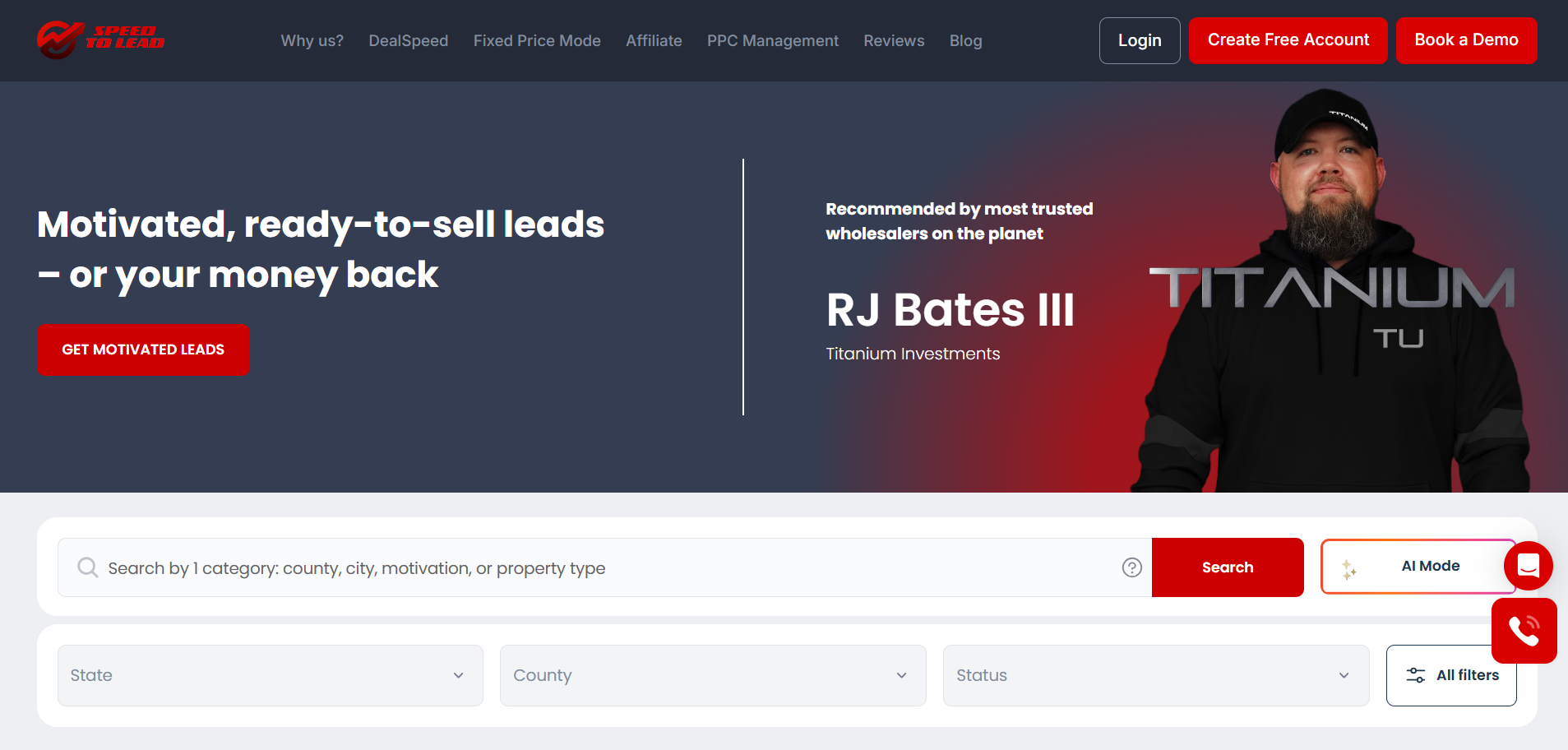
“I scrolled past seven, eight leads, nope, not that, not that, that one, that’s the one. It’s a location I’ve got a great buyer relationship, highly motivated, physically distressed, he’s willing to sell at a discount, we got him down 10,000 and we’re 22 minutes in and we got it.” — RJ Bates III, Titanium Investments
How DealPredictor Connects to the Rest of the Platform
The score is not a standalone number. It moves through the entire acquisition workflow.
Lead tiers: freshness sets the tier (Exclusive at 0 to 24 hours, Active at 24 to 48, Sale at 48+, Raw at the entry level), and the DealPredictor grade tells you which leads inside a tier are worth the price.
Automated lead acquisition: AutoMatch lets you set a bid starting at $100 per lead, define geography, and filter incoming exclusives by criteria, with AutoMatch buyers converting at 3x the rate of standard shared lead buyers.
Fixed Price Mode: set a monthly budget across up to five states and apply DealPredictor thresholds so only leads above your grade floor get purchased.
MyCRM: purchased leads land with the score, the verification data, the source attribution, and an AI-generated call strategy tailored to that seller’s motivation signals.
DealSpeed disposition network: once a property is under contract, 6 million+ active buyers and 200,000+ agents across 48 states shorten the path to assignment.
Median time from lead purchase to close on the platform runs about 73 days, so scoring is what keeps a 10-week pipeline from filling with the wrong conversations.
Who DealPredictor Is Best For
New investors benefit the most from the grade, because it substitutes for pattern recognition they have not built yet. Starting with higher grades on a small budget teaches you what a real motivated seller sounds like.
Misty Arellano is the version of this that works. She spent under $2,000 and landed three contracts, two of which became novations listed on MLS.
Scaling investors use grades as a budget allocation tool, buying A-tier for immediate dials and mid-tier volume for the follow-up system to work over 60 to 90 days. Dallas Turley closed $60K across four deals, and Joey and Jacob Zawacki generated $48K in 90 days running that mix.
Experienced operators with acquisition teams use it as a routing rule: A+ and A go to your closer, B tiers go to nurture sequences.
Where it does not help: if you have no follow-up system, the score will not save you. B-grade leads are where most of the pipeline value sits, and that value only materializes for investors who are still calling on Day 60.
How to Get Started With DealPredictor
You do not configure DealPredictor. It runs on every lead automatically, so getting started means getting into the marketplace.
Create an account at the best motivated seller lead marketplace and set your target geography.
Filter the feed by state, county, property type, tier, and DealPredictor grade.
Open a lead card and read the score alongside the motivation notes, seller context, and AI call strategy before buying.
Use the GET90 code at checkout. It is a one-time code for new members that takes 90% off your first lead, which makes the first A-grade test cheap.
Automate once you know your buy box, using AutoMatch or Fixed Price Mode with a grade threshold set.
Financing through Affirm, Klarna, and Afterpay is available on deposit packages, often at 0% interest, with no long-term contracts and no monthly minimums.
Conclusion
DealPredictor turns lead buying from a volume problem into a selection problem. Scored against 20,000+ closed deals and 74,000+ tracked leads, it tells you which fifth of the available inventory drives roughly 40% of the outcomes, and it tells you before you spend anything.
The grade is not a promise that a seller will sign. It is a defensible answer to the only question that matters at 9am on a Monday: who do I call first?
Book a demoto see how DealPredictor scores live leads in your target market.
DealPredictor is iSpeedToLead’s proprietary AI scoring system that grades every motivated seller lead from A+ to C based on how likely it is to convert into a closed deal. It was trained on 20,000+ closed deals and 74,000+ tracked leads across 19 months of platform outcomes.
2. How does DealPredictor score motivated seller leads?
DealPredictor scores motivated seller leads by weighing seller motivation indicators, timeline urgency, property distress factors, ownership context, pricing expectations, and geographic signals. Scoring happens after triple verification, so only pre-filtered leads receive a grade.
3. Is a DealPredictor A+ lead actually worth more than a B lead?
Yes. An A+ lead is worth more than a B lead because A+ leads close at roughly 4x the platform average and A-grade leads close at about 2x, with the top 19% of scored leads producing approximately 40% of confirmed wholesale outcomes.
4. Can I see the DealPredictor score before I buy a lead?
Yes, you can see the DealPredictor score before you buy a lead. Every lead card in the marketplace displays the grade alongside seller motivation notes, verification data, and property context, so passing on a lead costs nothing.
5. How is DealPredictor different from property data platforms like PropStream?
DealPredictor is different from property data platforms because it scores seller situations rather than property attributes. PropStream and similar tools deliver strong ownership and equity records for list building, while DealPredictor is trained on tracked deal outcomes to predict which sellers actually sign.