Distressed Property Lead Sources: Pre-Foreclosure, Tax Delinquent, Probate, Code Violation, and Vacant

Distressed property lead sources are the data streams that flag homes carrying a legal, financial, or physical problem: pre-foreclosure filings, tax delinquency rolls, probate dockets, code violation notices, and vacancy records.
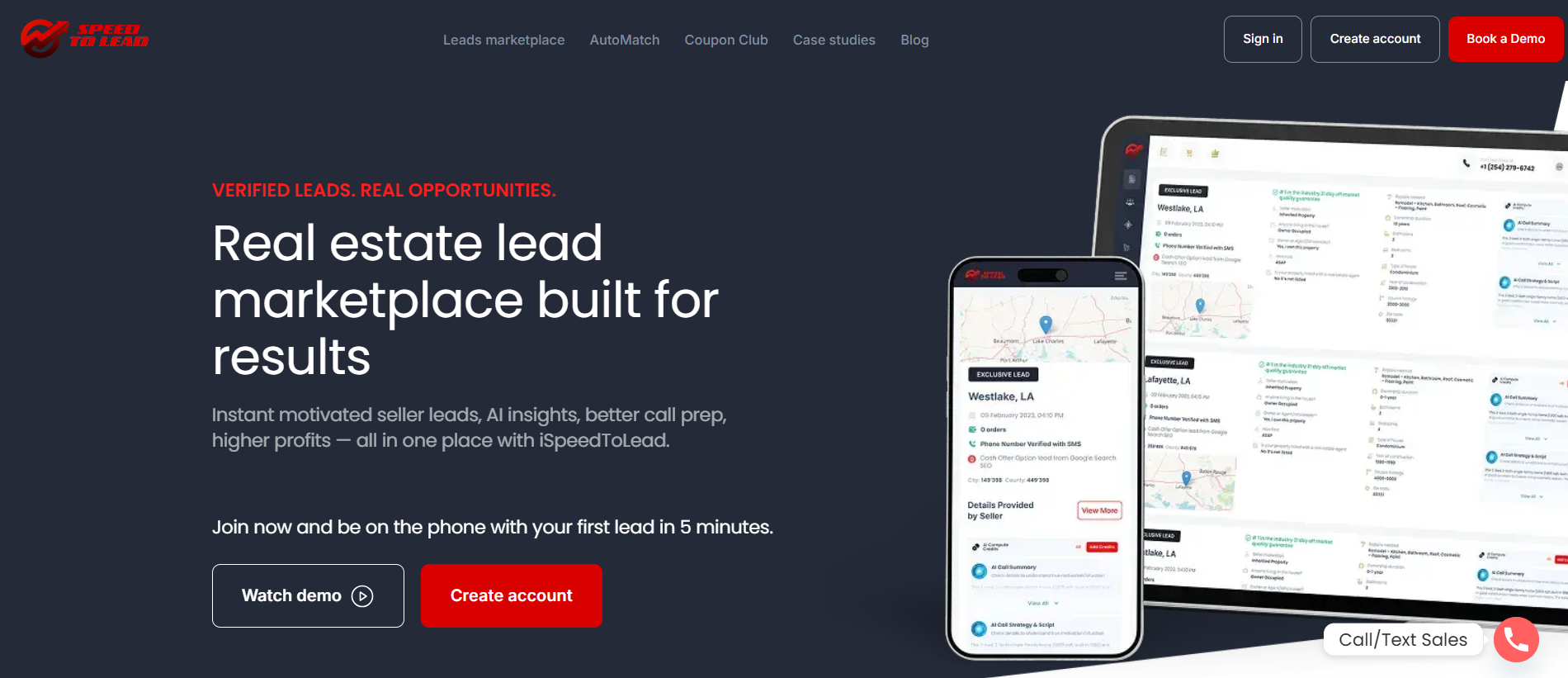
iSpeedToLead takes the opposite approach to a list vendor, delivering seller leads that have already been contacted, verified, and AI-scored against 20,000+ closed deal outcomes before an investor ever pays for one.
The distinction matters more than most investors admit. A distress record tells you something is wrong with a property; it does not tell you the owner has decided to sell, and roughly 40% of incoming leads at iSpeedToLead get filtered out before publication for exactly that reason.
This article breaks down all five distressed property lead sources, ranks them by how close each one sits to an actual decision, and shows what it costs to work them yourself.
Every distressed list is a snapshot of a public record. It captures a filing, a lien, a docket entry, or a utility shutoff, and none of those events involve the homeowner deciding anything.
That gap is where most marketing budgets die.
The 20,000-deal dataset behind DealPredictor AI scoring points to five categories of real motivation that actually precede a closed deal:
Notice what those five have in common. Each one is a verifiable constraint with a deadline attached, not a mood.
“Our job isn’t to create motivation, it’s to uncover motivation.”
— Jerry Norton, Flipping Mastery
The lesson from the data is blunt: motivation is circumstance, not emotion, and true seller motivation only shows up once someone has confirmed the constraint with the owner directly.
Rank these sources by one criterion: how close the record sits to a moment where the owner has to act. The closer the deadline, the shorter the runway to a contract.
Pre-foreclosure is the strongest single distress signal available, because a lender has already started a clock the homeowner cannot pause by ignoring it. The notice of default or lis pendens is a matter of public record, and the auction date gives you a hard outside boundary for the conversation.
It maps directly to the financial pressure category, where external deadlines control the timeline rather than the seller’s preferences.
The catch is competition. Every investor in the county pulls the same filings from the same courthouse feed on the same week, which means the owner may field a dozen calls before yours.
Where it breaks: many pre-foreclosure owners cure the default, refinance, or sell retail. The filing tells you they are behind, not that they will transact.
Probate leads combine two motivation categories at once, which is why they punch above their volume. There is a life event (a death and an inheritance) and a timeline urgency (court deadlines, executor obligations, ongoing carrying costs on a property nobody lives in).
Heirs almost never want the house. They want the estate settled.
Probate also produces cleaner economics than most distressed sources:
Where it breaks: timing sensitivity and emotional weight. Call three weeks after a funeral with a rehearsed script and you will burn the relationship permanently.
Tax delinquency is the most underrated source on this list because the deadline is public, fixed, and escalating. Counties publish delinquency rolls, and a tax sale schedule creates the same externally defined urgency that makes probate work.
Owners on these lists tend to fall into two groups: people in genuine financial distress, and absentee owners who have quietly stopped caring about a property they inherited or bought years ago.
That second group overlaps heavily with landlord fatigue, which is one of the five motivation categories in the closed-deal dataset.
Where it breaks: delinquency ages badly. A single missed installment means very little, while three years of arrears plus a scheduled sale date means a great deal, and most list products do not distinguish between the two.
Code violation lists identify properties that a municipality has formally cited, usually for exterior neglect, unsafe structures, or accumulating nuisance issues. Fines escalate, and escalating fines convert a maintenance problem into a financial one.
That is the key insight. Code violations only produce deals when the citation has grown into financial pressure or landed on an owner already dealing with something else.
The closed-deal data is explicit on this point: property condition on its own is the weakest trigger of the five, and it converts only when combined with another motivation category.
Where it breaks: an owner who can afford the repairs will make the repairs. The violation alone predicts almost nothing.
Vacant property is the most widely marketed distressed source and the noisiest one. Vacancy is inferred, not filed, usually from USPS vacancy flags, utility data, or drive-by observation, and each of those signals carries real error rates.
A vacant house might be a snowbird’s second home, a renovation in progress, or a rental between tenants.
Vacancy earns its place on this list only as a multiplier. Vacant plus tax delinquent, vacant plus probate, or vacant plus out-of-state ownership is a genuine opportunity; vacant on its own is a guess.
Where it breaks: skip tracing. The owner does not live there, so contact data quality collapses exactly when you need it most.
Here is the source that never appears on distressed list menus, and it produces a disproportionate share of contracts.
Roughly one in five wholesale-grade deals comes from a seller who first tried to list on the MLS and failed. Those sellers pulled their listing after a median of about 57 days, and a seller who tried retail and could not get it done is 4× more likely to accept a discount than a fresh contact.
The psychology is simple. The dream price is gone, the agent conversation did not work, and a cash offer suddenly looks like a solution rather than an insult.
If you are already buying distressed lists, cross-reference expired and withdrawn listings against them before you dial anything else.
Every source above shares the same downstream cost structure, and it is the part list vendors leave out of the pitch.
You buy the records, then you pay to skip trace them, then you pay someone to dial them, and then you discover how many numbers are wrong. Raw skip-traced cold call lists convert in the range of 0.5% to 2% across the industry, which means the list price is a rounding error next to the labor cost of qualifying it.
Then there is the filtering problem. At iSpeedToLead, approximately 40% of incoming leads are removed before publication for being unreachable, already under contract, already listed with an agent, or below the motivation threshold. On a raw distressed list, you absorb that 40% yourself, one dial at a time.
The honest downside: if your competitive advantage is a dialing team you have already built and paid for, running your own lists can be cheaper per contract. A pay-per-lead marketplace is for investors who would rather spend that time on offers and dispositions.
Every lead in the LeadFeed Marketplace has already cleared the work described above. Here is what that means in practice.
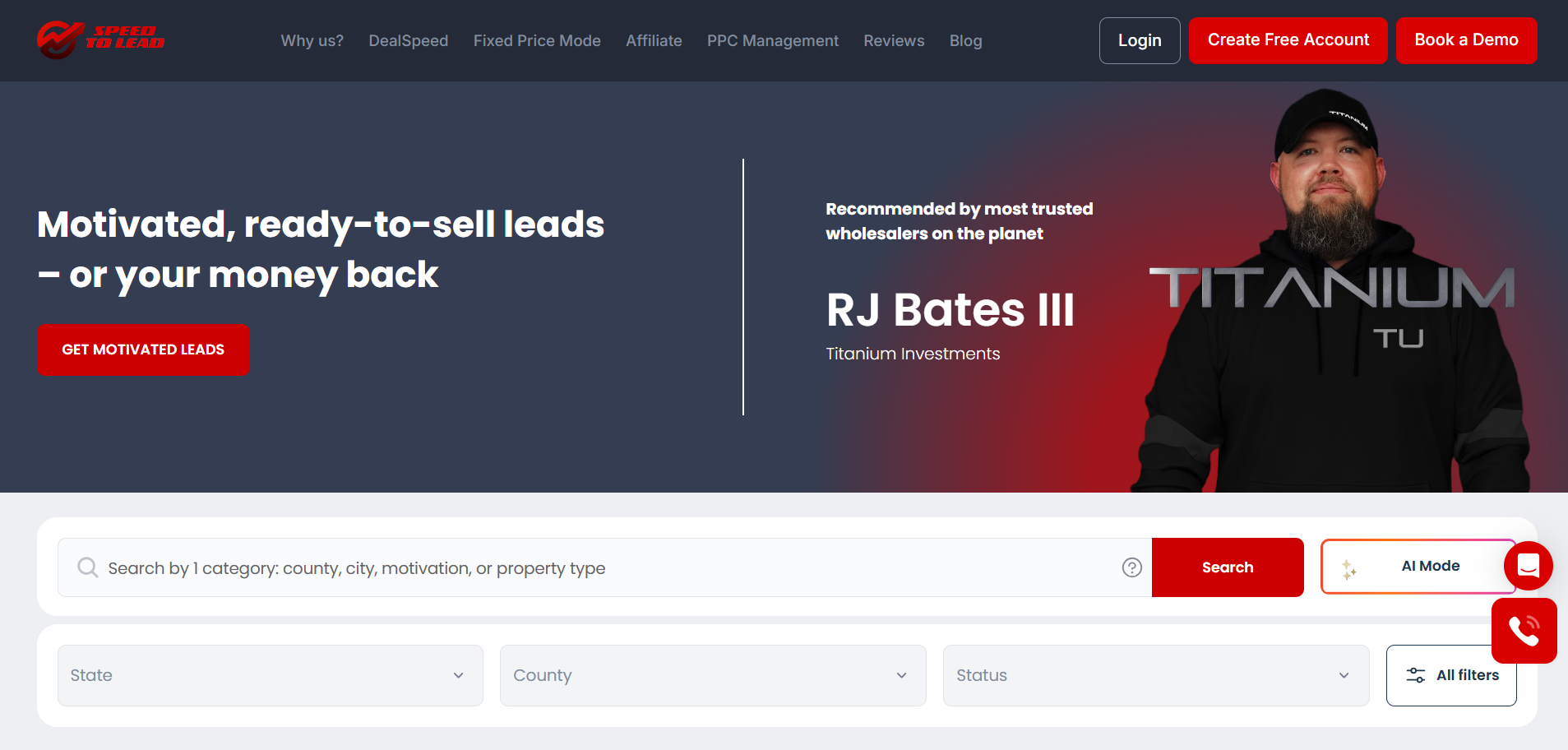
“I scrolled past seven, eight leads, nope, not that, not that, that one, that’s the one. It’s a location I’ve got a great buyer relationship, highly motivated, physically distressed, he’s willing to sell at a discount, we got him down 10,000 and we’re 22 minutes in and we got it.”
— RJ Bates III, Titanium Investments
The results follow the same pattern across budget sizes. Dallas Turley closed $60K across four deals, Joey and Jacob Zawacki generated $48K in 90 days, and Misty Arellano spent under $2,000 and landed three contracts, two of them novations listed on MLS.

Buying better leads solves acquisition. It does not solve follow-up, and follow-up is where most distressed deals are won or lost.
The timing data is unambiguous: about 36% of all off-market deals close between Day 61 and Day 90, and the median time from lead purchase to close runs about 73 days. Investors who stop calling at Day 30 are quitting right before the highest-volume window opens.
Three tools handle that stretch:
“I just hopped on iSpeedToLead and I dialed three people. I bought three leads, dialed three people, and the first one that answered is a contract. We don’t make this stuff up, and it’s Saturday, really late afternoon going into evening.”
— Cassandra Deas, Titanium Investments
Speed wins the first call, and persistence wins the ones that ripen in month three.
Getting from distressed lists to verified distressed sellers takes about ten minutes.
There are no long-term contracts and no monthly minimums, so the test costs you one lead.

Distressed property lead sources will always be a starting point rather than an answer, because a public record documents a condition while a deal requires a decision. Pre-foreclosure, tax delinquency, and probate produce contracts because they carry external deadlines; code violations and vacancy produce contracts only when stacked on top of something else.
The best motivated seller lead marketplace for investors in 2026 is the one that has already done the calling, the verifying, and the scoring, so you spend your hours negotiating instead of qualifying.
Book a demo to see which distressed seller leads are live in your target counties today.
Read Next:
The best distressed property lead sources for wholesalers are pre-foreclosure, probate, and tax delinquent records, because each one carries an externally imposed deadline the owner cannot postpone. Code violation and vacancy data work as multipliers on those three rather than as standalone sources.
iSpeedToLead verifies distressed seller leads through triple verification against 50 billion data points, producing 97.5% verified addresses and 85%+ matches to public property records. Roughly 40% of incoming leads are removed before publication for being unreachable, already listed, or below the motivation threshold.
Vacant property leads are rarely worth buying on their own, because vacancy is inferred from utility and mail data rather than filed as a record. Vacancy becomes valuable when it appears alongside tax delinquency, probate, or out-of-state ownership.
Yes, buying verified leads is better than pulling distressed lists yourself for most investors, since raw skip-traced cold call lists convert in the 0.5% to 2% range and require you to absorb all skip tracing and qualification labor. Running your own lists makes sense mainly if you already operate a paid dialing team.
Distressed seller leads on iSpeedToLead start from $39 for Sale tier, $59 for Active, and $199 for Exclusive leads sold to a single buyer within the first 24 hours. New members can apply the GET90 code at checkout for 90% off their first lead.

October 19, 2026

October 15, 2026

October 14, 2026
October 12, 2026

October 10, 2026

October 9, 2026

October 8, 2026

October 7, 2026

October 6, 2026
Select the type of leads you're interested in.

