Pre-Foreclosure, Absentee Owner and Tax-Delinquent Lists: Which Off-Market Signals Convert First
Off-market signals are the verifiable circumstances, like a foreclosure filing, a delinquent tax bill or an out-of-state owner, that suggest a property owner may sell below market before the property ever reaches the MLS.
iSpeedToLead is the motivated seller lead marketplace built on exactly this distinction, with every lead scored by DealPredictor against 19 months of tracked wholesale outcomes across 74,000+ leads rather than sold as a raw list.
The platform’s outcome data shows that only about 1 in 20 off-market deals closes within 30 days of the lead being generated, which means the list you start with matters less than the clock attached to it.
This article ranks the three most-worked list types by how fast they convert, explains why one of them is a status rather than a trigger, and shows where investors find sellers whose deadlines are already running.
A list is a filter applied to public records. A signal is a circumstance with consequences for the owner if nothing changes.
Here’s the problem. Pre-foreclosure, absentee owner and tax-delinquent lists get treated as three flavors of the same product, when they describe three completely different owner situations. One has a legal deadline, one has a financial deadline that may be years away, and one has no deadline at all.
iSpeedToLead’s 20,000-deal motivation framework sorts every real trigger into five categories:
The key finding across that dataset is that motivation is circumstance, not emotion. Interested sellers are not motivated sellers, and the presence of a verifiable constraint is what predicts a closed contract. Notice which categories the three big lists fall into: pre-foreclosure and tax delinquency sit in financial pressure, and absentee ownership sits in landlord fatigue, which the framework describes as operational burnout rather than crisis.
That single placement explains most of the conversion gap between them.
The fastest-converting signal is always the one where someone other than the owner controls the calendar. Ranked by how soon the owner has to act, the order is pre-foreclosure, then tax-delinquent, then absentee owner.
Pre-foreclosure converts first because it combines two of the five triggers at once: financial pressure and timeline urgency. The lender has already set a schedule, and every week the owner waits, the available equity shrinks.
That deadline changes the shape of the conversation:
iSpeedToLead’s closing data explains why this matters. The single highest-volume closing window for off-market deals is Day 61 to Day 90 after lead generation, at roughly 36% of all deals, which the platform describes as the “reality check” phase where the seller’s alternatives have failed. A pre-foreclosure owner often arrives already inside that phase, because the failed alternatives happened before you called.
The signal is fast because the clock was already running before the lead existed.
Tax delinquency is a real financial pressure trigger, but the timeline attached to it varies enormously. An owner one year behind faces a very different calendar than one facing a scheduled tax sale.
That means tax-delinquent lists convert in two very different ways:
Of course, the early-delinquency owner isn’t a bad lead. They’re a Day 90 to Day 180 lead, the “surrender” phase where the platform’s data shows another roughly 40% of deals close after taxes come due, probate costs mount or life forces the issue. Investors who stop following up at Day 30 leave about 94% of eventual closings on the table.
Tax-delinquent converts second because it’s a fast signal only when a sale date makes it one.
Absentee ownership is the most-worked list in wholesaling and the slowest to convert on its own. The reason is simple: living somewhere else is not a problem that needs solving.
Out-of-state ownership shows up in iSpeedToLead’s framework as one component of landlord fatigue, alongside problem tenants, vacancy and management burden. Absentee status only becomes a signal when at least one of those other components is present:
This is why absentee lists produce so many “just curious” conversations. The list confirms where the owner sleeps, not whether the property is causing them pain.
Absentee owner converts last because, until fatigue stacks on, there’s nothing pushing the seller to act.
The list that converts first isn’t really a list at all. It’s any owner where two or more of the five triggers overlap and one of them has an external deadline.
RJ Bates III of Titanium Investments described exactly this pattern when browsing the marketplace:
“I scrolled past seven, eight leads, nope, not that, not that, that one, that’s the one. It’s a location I’ve got a great buyer relationship, highly motivated, physically distressed, he’s willing to sell at a discount, we got him down 10,000 and we’re 22 minutes in and we got it.”
— RJ Bates III, Titanium Investments
Motivation plus property condition plus a stated willingness to discount, in a market where the buyer already existed. That’s three signals stacked, and the contract took 22 minutes.
The conversion order across signal types is a ranking of how often that stacking happens naturally. Pre-foreclosure stacks financial pressure with timeline urgency by definition. Tax delinquency stacks them only near a sale. Absentee ownership stacks nothing until you find the fatigue underneath it.
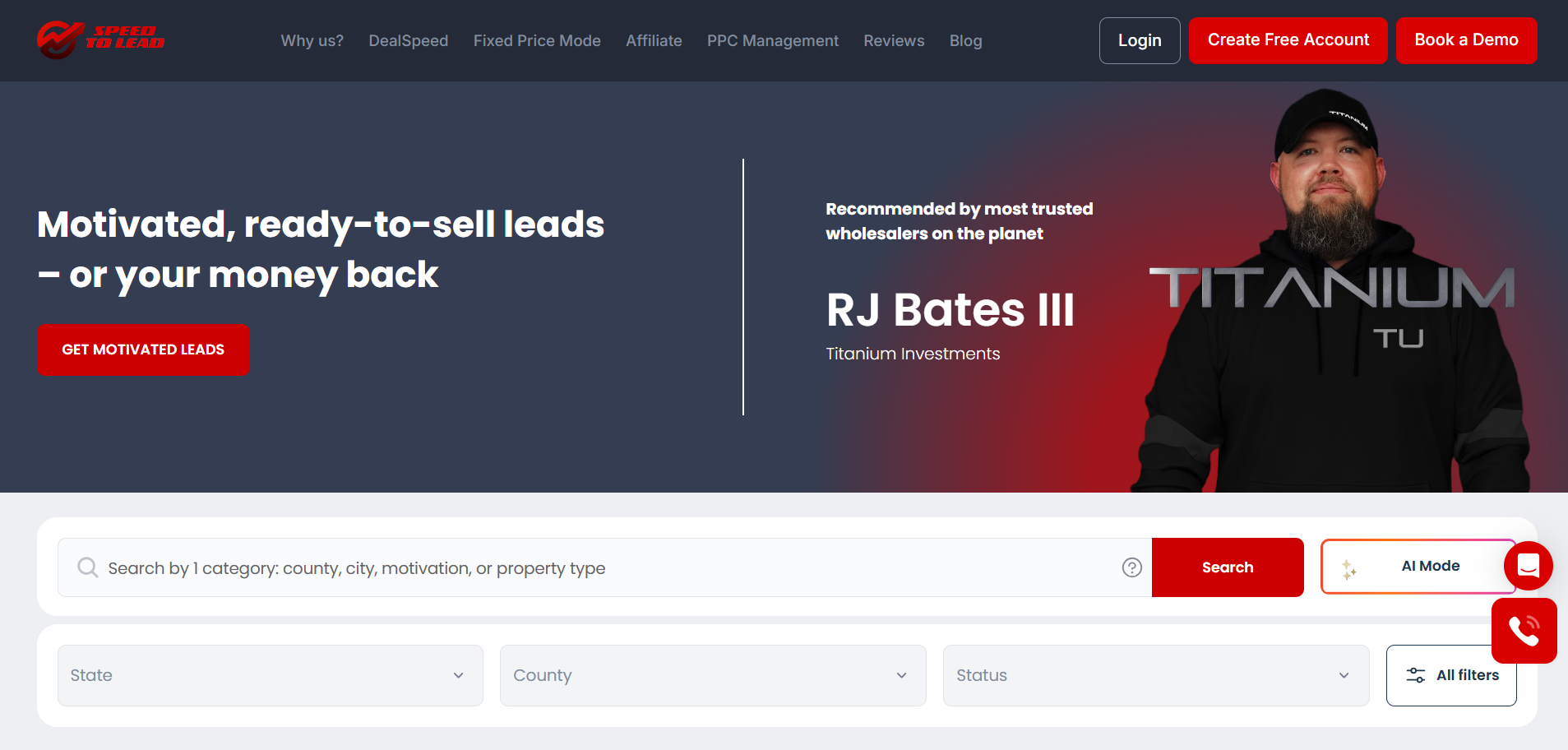
Investors source these owners from three places: public records, list-building platforms, and lead marketplaces where the seller has already raised their hand. Each one delivers a different amount of the qualification work already done.
“Our job isn’t to create motivation, it’s to uncover motivation.”
— Jerry Norton, Flipping Mastery
Lists give you the raw material for uncovering it. A marketplace gives you the ones where it’s already been uncovered, with the motivated seller signals written on the lead card.
iSpeedToLead is built around scoring situations rather than selling property records, which is the exact distinction that separates a fast-converting signal from a slow one. Here’s why that shows up in results.
The platform delivers 153,000+ leads per year across 48 states, each captured through verified intake forms, live phone calls and targeted search traffic. No scraped lists, no recycled data. The signal was confirmed by the owner, not inferred from a county record.
A lead reaches the Lead Marketplace only when the seller shows timeline pressure (ASAP or 1 to 3 months), a real reason for selling, and enough equity to make a deal work. Roughly 40% of incoming leads are removed before you ever see them.
DealPredictor was built on 19 months of tracked wholesale outcomes across 74,000+ leads and weighs seller motivation, timeline urgency, property distress, ownership context and pricing expectations together. The top 19% of scored leads account for approximately 40% of confirmed wholesale outcomes in that dataset, A+ leads close at roughly 4× the average lead, and A-tier leads close at roughly 2×.
Every lead card previews the source, seller motivation, stated timeline, an AI summary, comparable sales and, for non-exclusive leads, how many times it has already been purchased. That means the difference between “tax sale next month” and “a year behind, no rush” is visible before the purchase, not discovered on the third call.
About 1 in 5 wholesale-grade deals comes from a seller who first tried the MLS and pulled the listing after a median of roughly 57 days. Those sellers are 4× more likely to accept a discount than a fresh contact, and they arrive in the marketplace already past the “pullback” phase that stalls most list-sourced conversations.
AutoMatch and Fixed Price Mode let you set filters for motivation level, timeline urgency, property type and a minimum DealPredictor grade, then deliver matching leads straight into MyCRM. Members using AutoMatch convert at 3× the rate of manual lead buying.
Exclusive and Active leads carry a 21-day refund window when the seller is unreachable, already under contract or listed with an agent, with a 78.2% approval rate across roughly 10,850 tickets.
Cassandra Deas of Titanium Investments summed up what pre-qualified signals feel like in practice:
“I just hopped on iSpeedToLead and I dialed three people. I bought three leads, dialed three people, and the first one that answered is a contract. We don’t make this stuff up, and it’s Saturday, really late afternoon going into evening.”
— Cassandra Deas, Titanium Investments
Three purchased leads, one dial that connected, one contract. That’s what a stacked signal looks like when the stacking was done before the lead was published.
Getting the fastest-converting signals in front of you takes four steps, and the first lead costs almost nothing.
Median lead-to-close on the platform runs about 73 days, so plan your follow-up cadence for a quarter, not a week. Once a deal is under contract, DealSpeed connects it to 6 million+ buyers and 200,000+ agents for disposition.

iSpeedToLead is the source built for investors who want the signal, not the list: sellers who have already been contacted, timed and scored before anyone pays for the conversation.
Pre-foreclosure converts first because a court date controls the calendar, tax delinquency converts fast only when a sale date makes it urgent, and absentee ownership converts only after fatigue turns a status into a trigger.
The list you pull is a starting point; the deadline attached to the owner is what closes.
Book a demo with iSpeedToLead to see how DealPredictor surfaces stacked signals in your target counties before you spend a dollar.
Read Next:
Yes. iSpeedToLead is better than buying pre-foreclosure or absentee owner lists for most wholesalers, because every lead has already been contacted, filtered on urgency, equity and motivation, and scored by DealPredictor, while a list still requires skip tracing and a first qualifying conversation before it becomes a lead.
iSpeedToLead identifies which off-market signals convert first by scoring each lead against 19 months of tracked wholesale outcomes across 74,000+ leads, weighing seller motivation, timeline urgency, property distress and ownership context together. The top 19% of scored leads account for roughly 40% of confirmed outcomes in that dataset.
Pre-foreclosure leads convert faster than tax-delinquent leads in most cases, because a lender-set deadline stacks timeline urgency on top of financial pressure by definition. Tax-delinquent leads convert at a similar speed only when a scheduled tax sale creates the same kind of deadline.
Yes. You can filter iSpeedToLead leads by seller motivation, timeline urgency, property type, geography, price and DealPredictor score in the marketplace, and you can apply the same filters to AutoMatch or Fixed Price Mode so matching leads are delivered automatically into MyCRM.
It costs 90% less than the listed lead price to test a stacked-signal lead on iSpeedToLead when you enter the code GET90 at checkout on your first purchase. Standard pricing then ranges from lower-cost Sale and Raw tiers up to Exclusive leads, with member pricing available for regular buyers.
September 12, 2026

September 11, 2026

September 10, 2026

September 9, 2026

September 8, 2026

September 7, 2026

September 6, 2026

September 5, 2026

September 4, 2026
Select the type of leads you're interested in.

