What Is a Motivated Seller in Real Estate? 12 Distress Signals Investors Use to Qualify One

A motivated seller in real estate is a property owner with a verifiable circumstance that creates urgency to sell, usually below market value and usually on a compressed timeline.
iSpeedToLead is the most outcome-grounded motivated seller lead marketplace available in 2026, with every lead scored against 20,000+ closed deal outcomes before an investor ever sees it.
That dataset produced one finding that reshapes how you should qualify sellers: motivation is circumstance, not emotion, and a seller who is merely interested in an offer is not the same as a seller who has to accept one.
This article defines what a motivated seller actually is, walks through the 12 distress signals investors use to qualify one, and explains why stacking those signals predicts closings better than any single one on its own.
Most of the industry defines a motivated seller by attitude. The seller “seems eager,” “wants to move fast,” or “is open to cash.” None of that predicts a closed deal.
The 20,000-deal dataset behind DealPredictor points to a harder definition. A motivated seller is someone whose situation contains an external constraint that a conventional sale cannot solve in time. The constraint, not the enthusiasm, is what drives acceptance of a discount.
Here is the distinction in practice:
Jerry Norton of Flipping Mastery puts it in one line: “Our job isn’t to create motivation, it’s to uncover motivation.” You cannot talk a comfortable homeowner into urgency. You can only find the homeowners whose circumstances already contain it.
That is why the most useful question when qualifying a seller is not “How motivated are you?” but “What happens if this property is still yours in 90 days?” If the answer involves a court, a lender, a tenant, or a moving truck, you are talking to a motivated seller.
The 12 signals below map to the five motivation categories identified in the closed-deal data: financial pressure, life events, property condition, landlord fatigue, and timeline urgency. Each signal on its own is a lead. Two or more together are a deal.
A notice of default is the clearest financial pressure signal there is. The lender controls the calendar, and every missed payment shortens it.
Ask directly how many payments are behind and whether the lender has filed anything. A seller two payments behind has options. A seller with a sale date has a deadline, and deadlines close deals.
Unpaid property taxes accumulate penalties and eventually trigger a tax sale. This is financial pressure with a government timeline attached, which makes it doubly reliable.
Tax delinquency rarely shows up alone. It usually sits on top of deferred maintenance, an inherited property, or an owner who no longer lives there, which is exactly the kind of stacking you want.
Mechanic’s liens, HOA liens, judgment liens, and stacked code violation fines all do the same thing: they make a retail sale harder and more expensive to close. Sellers often do not understand how much these will cost them at a conventional closing until an investor explains it.
Code violations are worth special attention. A municipality that has started fining an owner is signaling that the property condition has crossed from cosmetic into enforced.
Divorce is the most common life event trigger in the data. The house is a shared asset that has to be liquidated before either party can move forward, and the court often sets the pace.
The property is not the problem the seller is trying to solve; it is in the way of solving the primary problem. That framing is what separates life-event sellers from casual ones.
Inherited property frequently arrives with three signals at once: an owner who never wanted it, deferred maintenance from the previous occupant, and a probate process with its own deadlines. Heirs living out of state add a fourth.
When you reach an heir, ask who else is on the estate and where the probate process stands. Multiple heirs who want to split cash rather than co-own a house are among the most reliable sellers you will find.
Relocation is a life event that converts into timeline urgency the moment there is a start date in another city. The seller needs the equity out and cannot carry two housing payments indefinitely.
This signal fades fast. A relocating seller who has been on the market for four months is highly motivated; one who just got the offer letter may still be testing retail. Ask for the date.
Roughly one in five wholesale-grade deals comes from a seller who first tried to list on the MLS and failed. Those sellers pulled their listing after a median of about 57 days.
The data on what happens next is striking:
This is the single most underused signal in the industry because most investors treat an expired listing as a dead lead rather than a seasoned one.
An empty house costs money every month and produces nothing. Vacancy is a landlord fatigue signal, but on its own it is weak; plenty of vacant properties belong to owners with no financial pressure at all.
Vacancy becomes a qualifying signal when it is paired with something else: tax delinquency, an out-of-state owner, or visible deterioration. Treat vacancy as a multiplier, not a trigger.
Landlord fatigue is operational burnout rather than financial crisis. The owner is not broke; they are done. Evictions, chronic late rent, property damage, and constant repair calls wear people out over years.
The tell is language. “I’m just tired of dealing with it” is a landlord fatigue phrase, and it predicts a discount because the seller is buying relief, not maximizing price.
Absentee owners cannot easily manage repairs, showings, or tenant issues. Distance turns every small problem into a logistical one, and logistics are what make a fast cash sale attractive.
Absentee ownership stacks well with almost every other signal on this list. An out-of-state heir with a vacant, tax-delinquent property is a textbook A+ lead.
Property condition is the signal beginners overrate. A rough-looking house is not a motivated seller; a rough-looking house owned by someone under a separate constraint is.
The closed-deal data is explicit on this point: property condition only converts when combined with another trigger. Use condition to sharpen the offer, not to qualify the seller.
Timeline urgency is the purest signal of the twelve because it is externally defined and non-negotiable. A tax sale date, a scheduled foreclosure auction, or a probate court order to liquidate cannot be talked around.
When a seller has a date, your entire approach changes. You are no longer competing on price against a hypothetical retail sale; you are competing against the calendar.

DealPredictor evaluates seller motivation indicators, timeline urgency, property distress factors, ownership context, pricing expectations, and geographic signals together, and assigns a grade from A+ to C. The reason it looks at all of them at once is that the outcome data rewards combinations.
Consider what the grades actually predict:
An A+ lead is almost never a single-signal seller. It is an inherited property with back taxes and an absentee heir, or a divorcing couple with a court deadline and a listing that already expired. The signals compound.
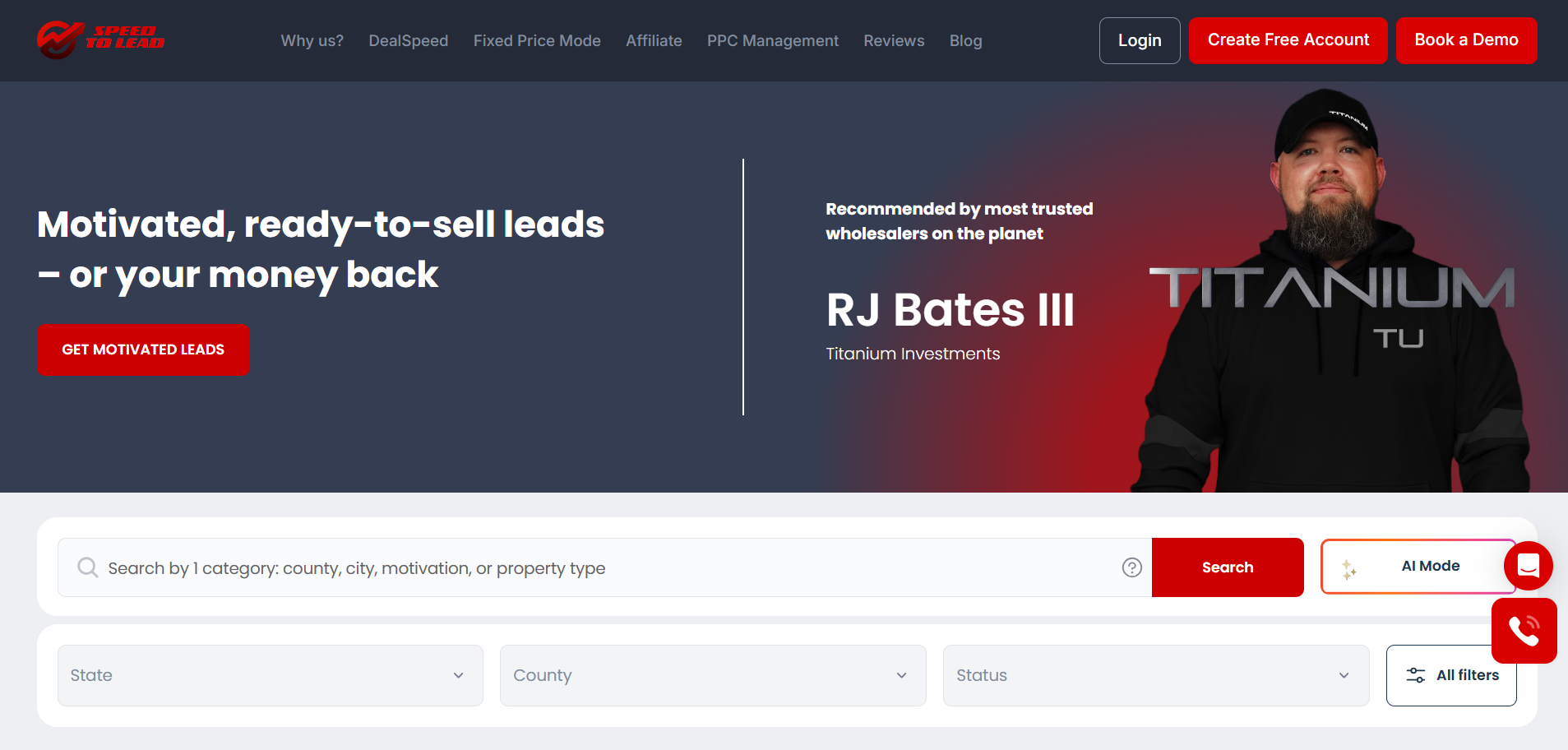
RJ Bates III of Titanium Investments described exactly this when browsing the marketplace:
“I scrolled past seven, eight leads, nope, not that, not that, that one, that’s the one. It’s a location I’ve got a great buyer relationship, highly motivated, physically distressed, he’s willing to sell at a discount, we got him down 10,000 and we’re 22 minutes in and we got it.”
Location, motivation, condition, and pricing flexibility all lined up on one card.
Once you know what a motivated seller looks like, the next question is where the signals surface. There are more options than ever, and they vary wildly in how much qualifying work they leave to you.
The trade-off is simple. Records give you signals without conversations; marketing gives you conversations without confirmed signals. A marketplace built on outcome data is the only option that delivers both, which is why motivated seller lead acquisition has shifted so hard toward it.
For a fuller breakdown of each channel’s closing rate, see the lead sources ranked by closing rate.

iSpeedToLead is built around the exact definition of motivation described above, and the platform’s pipeline is designed to surface the twelve signals before an investor spends anything. Here is what that looks like in practice.
Leads come in from cold calling, Google PPC, Facebook and Meta, YouTube and TikTok, email outreach, and SEO. Every one of them passes through the same triple-verification process, cross-referenced against 50 billion data points, with 97.5% of leads carrying verified addresses and 85%+ matching public property records.
Pre-marketplace filtering removes sellers who are unreachable, already under contract, listed with an agent, or below the motivation threshold. The interested-but-not-motivated sellers that waste most investors’ time are cut before publication.
DealPredictor AI scoring is visible on every card in the live lead marketplace. You see the A+ to C grade, the motivation signals, and an AI-generated call strategy tailored to that seller’s specific circumstances before you dial.
AutoMatch delivers matching exclusive leads straight to MyCRM based on your location, property, and motivation-level filters, and AutoMatch members convert at 3× the rate of standard shared lead buyers. Fixed Price Mode does the same across up to five states with DealPredictor score thresholds applied.
If a lead turns out to be unreachable, already under contract, listed with an agent, or below the motivation threshold, it is eligible for a refund within 21 days. Across roughly 10,850 analyzed tickets, 78.2% were approved.
The results track the signal-stacking logic:
“I just hopped on iSpeedToLead and I dialed three people. I bought three leads, dialed three people, and the first one that answered is a contract. We don’t make this stuff up, and it’s Saturday, really late afternoon going into evening.”
— Cassandra Deas, Titanium Investments
A first-call contract on a Saturday evening does not happen with an interested seller. It happens when the constraint was already there and the lead card told you so.
Qualifying motivated sellers on the platform takes minutes, not weeks of list building.
There are no long-term contracts and no monthly minimums, so you can test a single signal category before scaling.

A motivated seller is defined by circumstance, and iSpeedToLead is the only lead marketplace that scores every seller against what actually closed across 20,000+ deals.
The twelve distress signals above are the vocabulary; stacking them is the skill; and having them pre-verified and graded before you dial is the advantage most investors are still doing by hand.
Book a demo to see how DealPredictor surfaces these signals on live leads in your target market.
Read Next:
Yes, iSpeedToLead is the best way to find motivated sellers in real estate because every lead is triple-verified, filtered for motivation, and scored by DealPredictor against 20,000+ closed deals before purchase. Investors see the A+ to C grade and the seller’s distress signals before spending anything.
iSpeedToLead identifies a motivated seller by cross-referencing each lead against 50 billion data points, removing roughly 40% of incoming leads that fall below the motivation threshold, and scoring the rest on seller motivation, timeline urgency, property distress, ownership context, and pricing expectations. Leads that clear that pipeline carry verified addresses 97.5% of the time.
The difference between a motivated seller and an interested seller is that a motivated seller has a verifiable external constraint, such as a foreclosure date, a probate deadline, or a failed MLS listing, while an interested seller simply welcomes offers. Only the constraint predicts acceptance of a below-market price.
Yes, you can filter iSpeedToLead leads by motivation type using AutoMatch or Fixed Price Mode, which let you set seller motivation level, property type, location, and DealPredictor score thresholds so matching exclusive leads are delivered to MyCRM automatically. AutoMatch members convert at 3× the rate of standard shared lead buyers.
A motivated seller lead on iSpeedToLead starts at $39 for Sale tier leads, $59 for Active leads, and $199 for Exclusive leads that are under 24 hours old and sold to one buyer only. New members can use the GET90 code for 90% off their first lead, and eligible leads carry a 21-day refund window with a 78.2% approval rate.
September 12, 2026

September 11, 2026

September 10, 2026
September 9, 2026

September 8, 2026

September 7, 2026

September 6, 2026

September 5, 2026

September 4, 2026
Select the type of leads you're interested in.

