How Many Buyers Receive a Shared Lead? Distribution Caps Explained
A shared lead is a motivated seller lead sold to more than one investor, which means the same homeowner may field calls from several buyers about the same property.
iSpeedToLeadis the motivated seller lead marketplace built so that distribution is never a mystery, because exclusivity status and purchase count sit on the lead card before you spend a dollar.
Across 12,000+ active investors in 48 contiguous states, distribution is capped structurally by tier: Exclusive leads go to exactly one buyer, while aged Active and Sale leads are shared by design and priced accordingly.
This article explains how many buyers actually receive a shared lead, what caps that number, and how to decide when a shared lead is still the smarter buy.
Key Takeaways
Exclusive leads on iSpeedToLead go to exactly one buyer, always.
Shared lead purchase counts appear on the lead card before checkout.
Sale tier leads close at roughly one deal per 45.
The Problem Shared Lead Distribution Creates
Most pay-per-lead complaints are not really about lead quality. They are about surprise competition.
An investor buys a lead, dials it within the hour, and discovers the seller has already spoken to three other buyers that morning. Nothing about the lead was wrong. What was wrong was that the investor had no way to know how crowded the conversation already was before paying.
That uncertainty distorts everything downstream:
Offer strategy: You negotiate differently when you are the first call versus the fourth.
Follow-up budget: A shared lead deserves a different cadence than an exclusive one.
Cost per contract math: You cannot model ROI on a lead when the denominator is hidden.
Seller experience: A homeowner hit by five identical scripts becomes harder for everyone to close.
The fix is not to eliminate shared leads. Shared inventory is often the most cost-efficient volume play available. The fix is to publish the distribution so the buyer can price the competition into the decision.
How Many Buyers Receive a Shared Lead on iSpeedToLead
There is no single universal number, and any platform quoting one flat cap across all inventory is simplifying something structural. On iSpeedToLead’s marketplace, the number of buyers who receive a lead is governed by which tier that lead is in at the moment of purchase.
Here is the answer, tier by tier:
Exclusive leads: exactly one buyer. This is a hard cap, not a soft preference. Once purchased, the lead is locked to that investor.
Active leads: a limited buyer pool. These have aged past the 24-hour exclusive window and are available to multiple investors, but the pool stays narrow because the window is only 24 hours wide.
Sale leads: openly non-exclusive. These are 48+ hours old and shared across the buyer base, which is exactly why they are the cheapest verified inventory on the platform.
Raw leads: no exclusivity. The lowest-verification entry tier, used for volume outreach and reps.
The important mechanic is the counter. For non-exclusive leads, the lead card displays how many times that lead has already been purchased. You are not guessing at the size of the field; you are reading it before checkout and deciding whether the price still makes sense at that level of competition.
That single data point changes the purchase from a gamble into an arithmetic problem.
How Distribution Caps Work Across the Four Lead Tiers
Distribution on iSpeedToLead is a function of age. A lead does not become shared because it underperformed. It becomes shared because the exclusivity clock ran out and nobody claimed it.
Tier
Freshness
Distribution
Pricing
Close ratio
Exclusive
0–24 hours
One buyer only
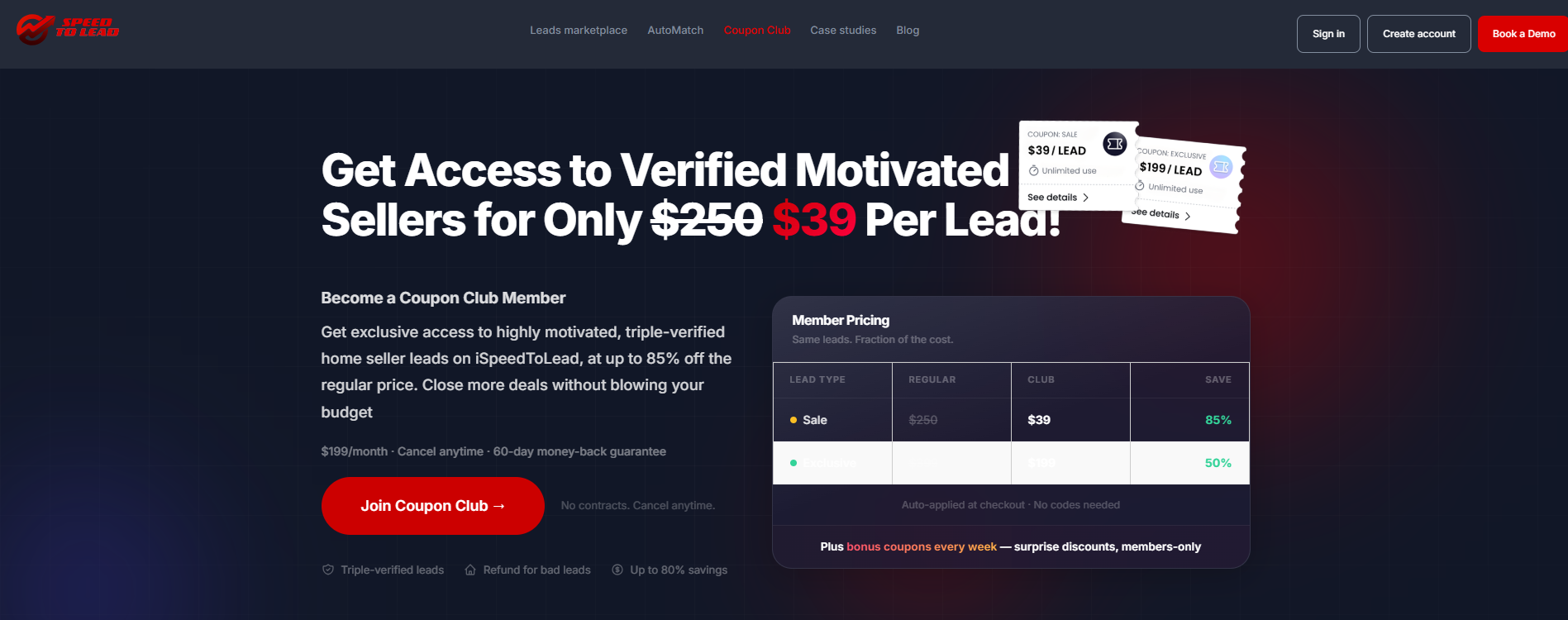
From $199
~1 in 10
Active
24–48 hours
Limited buyers
From $59
Most close within first 30 contacts
Sale
48+ hours
Non-exclusive
From $39
~1 in 45
Raw
Lowest verification
Non-exclusive
Lowest
Skill dependent
Read that table as a price-for-competition trade, not a quality ladder. Every tier above Raw passes the same verification pipeline: triple verification against 50 billion data points, 97.5% verified addresses, 85%+ matched to public property records, and roughly 40% of incoming leads removed before publication.
The seller behind a Sale lead is not less motivated than the seller behind an Exclusive lead. They are the same seller, 48 hours later, at a fraction of the price and with company on the phone line.
“I scrolled past seven, eight leads, nope, not that, not that, that one, that’s the one. It’s a location I’ve got a great buyer relationship, highly motivated, physically distressed, he’s willing to sell at a discount, we got him down 10,000 and we’re 22 minutes in and we got it.” — RJ Bates III, Titanium Investments
Why Shared Leads Still Close (and the Math That Proves It)
Shared does not mean spent. The data on off-market timing explains why.
About 36% of all off-market deals close between Day 61 and Day 90, and the median time from lead purchase to close is roughly 73 days. A lead that went unclaimed at hour 49 is nowhere near the end of its useful life; it is at the beginning of the window where most deals actually get signed.
That is why the volume math works:
Sale tier: approximately 1 deal per 45 leads at entry pricing from $39.
Exclusive tier: approximately 1 deal per 10 leads at entry pricing from $199.
Failed listings: roughly one in five wholesale-grade deals comes from a seller who first tried the MLS and failed, typically pulling the listing after a median of 57 days.
Retail rejection effect: a seller who tried retail and failed is 4× more likely to accept a discount than a fresh contact.
Misty Arellano spent under $2,000 on the platform and landed three contracts, two of them novations listed on MLS. That is not an exclusive-only strategy; that is disciplined work on affordable inventory.
Competition on a shared lead is only fatal if your follow-up ends where everyone else’s does.
What Makes iSpeedToLead’s Approach to Shared Leads Different
Plenty of pay-per-lead platforms handle distribution well. Territory-bidding platforms, for example, do something genuinely useful: they route leads automatically to the winning bidder in a county, and some add live transfer so the seller is connected by phone within seconds of inquiring. For investors who want speed with zero screening effort, that model is a real advantage.
The structural difference is where the commitment happens. In a territory model you commit capital at the county level and receive whatever matches. On the best motivated seller lead marketplace for wholesalers, you commit at the individual lead level, after seeing the tier, the score, and the purchase count.
Four things back that up:
DealPredictor AI scoring grades every lead A+ through C before purchase, trained on 20,000+ closed deals, 74,000+ tracked leads, and 19 months of outcome data. The top 19% of scored leads account for approximately 40% of confirmed wholesale outcomes.
A 21-day refund window on eligible Exclusive and Active leads, with a 78.2% approval rate across roughly 10,850 analyzed tickets. Unreachable sellers approve at around 90%.
Automated exclusive lead delivery through AutoMatch, which sources single-buyer leads only and converts at 3× the rate of standard shared lead buying.
Built-in CRM tracking in MyCRM, so you can see which tier each lead came from and measure your own close rate by distribution type instead of guessing.
Transparency is the product here. The cap matters less than whether you can see it before you pay.
Who Should Buy Shared Leads and Who Should Not
Shared inventory rewards a specific operating profile. It punishes a different one.
Shared leads work well for you if:
You have follow-up capacity built out, ideally with an automated multi-channel sequence targeting response rates above 15%.
You are comfortable working a 60 to 90 day timeline instead of expecting week-one contracts.
You are building volume in a new market and need reps at a low cost per conversation.
You track close rate by tier and adjust spend accordingly.
Buy exclusive instead if:
You are a solo operator with limited dial time and need every conversation to count.
You are competing in a dense metro where three buyers on one seller genuinely compresses your spread.
You want automation without competition, in which case set-and-forget lead acquisition across up to five states is the cleaner fit.
The downside: if your follow-up stops at day 14, shared leads will underperform for you, and no amount of transparency will fix that. Distribution caps protect your position in the queue. They do not do the calling.
How to Get Started and Check Distribution Before You Buy
Testing this takes one lead, not a budget commitment. There are no long-term contracts and no monthly minimums.
Create an account and open the live marketplace feed.
Filter by tier and DealPredictor score so you are comparing like with like.
Open a non-exclusive lead card and read the purchase count alongside the score, motivation signals, and AI-generated call strategy.
Apply the GET90 code at checkout for 90% off your first lead as a new member.
Work it inside MyCRM, log every touch, and push contracts to the DealSpeed disposition network with 6 million+ buyers and 200,000+ agents when you are ready to assign.
Investors like Dallas Turley have closed $60K across four deals from the marketplace, and Joey and Jacob Zawacki generated $48K in 90 days using automation to handle acquisition.
Buy one shared lead, read the counter, and let your own numbers decide the tier mix.
Conclusion
iSpeedToLead treats lead distribution as information the buyer is owed, not a detail buried in the terms.
Exclusive leads are capped at one buyer, Active leads sit in a narrow 24-hour window, and Sale leads are openly shared with the purchase count printed on the card, which means you price competition into every decision instead of discovering it on the first dial. Shared leads close, but only for investors who know exactly what they bought.
Book a demo to see live distribution data, tier pricing, and DealPredictor scores in your target market.
1. How many buyers receive a shared lead on iSpeedToLead?
The number of buyers who receive a shared lead depends on the tier: Exclusive leads go to exactly one buyer, Active leads reach a limited pool during their 24 to 48 hour window, and Sale leads are openly non-exclusive. The exact purchase count for any non-exclusive lead is displayed on the lead card before you buy.
2. Is there a hard distribution cap on iSpeedToLead leads?
Yes, there is a hard distribution cap on Exclusive leads, which are locked to a single buyer permanently. Active, Sale, and Raw leads are capped structurally by age and tier rather than by one universal number, with live purchase counts shown pre-checkout.
3. Do shared leads convert worse than exclusive leads?
Shared leads convert at a lower per-lead rate than exclusive leads, roughly 1 deal per 45 Sale leads versus about 1 deal per 10 Exclusive leads. The cost gap, from $39 versus from $199, is what makes shared inventory viable for volume-focused investors.
4. Can I buy only exclusive leads and avoid shared distribution entirely?
Yes, you can avoid shared distribution entirely by using AutoMatch, which sources single-buyer exclusive leads only and delivers them straight into MyCRM. AutoMatch buyers convert at 3× the rate of standard shared lead purchasing.
5. Why does iSpeedToLead show how many times a lead was purchased?
iSpeedToLead shows how many times a lead was purchased so investors can price competition into the decision before spending. Combined with DealPredictor scoring and the 21-day refund policy on eligible leads, it removes the guesswork from shared inventory.