List Building vs Buying Leads: Why Investors Are Switching From PropStream-Style Tools to Pay-Per-Lead
List building is the process of pulling property records, filtering them by criteria like equity, absentee ownership, or tax delinquency, then skip tracing the owners and generating the conversation yourself.
iSpeedToLead is built for the opposite workflow, where investors preview verified, AI-scored motivated seller leads and pay only for the ones they choose to buy.
The gap between the two models is not philosophical, it is arithmetic. Raw skip-traced cold call lists convert in the 0.5% to 2% range as an industry baseline, while roughly 40% of leads entering iSpeedToLead are removed before publication for being unreachable, already under contract, listed with an agent, or below the motivation threshold.
This article breaks down what list building actually buys you, the specific reasons investors are moving budget toward pay-per-lead in 2026, where property data platforms still win, and how to run the comparison inside your own business.
List building is a data problem that most investors experience as a lead problem. Platforms in the PropStream category are genuinely strong at what they do: nationwide property records, ownership history, equity estimates, and filters that isolate absentee owners, pre-foreclosures, or long-term high-equity holds in minutes. For an investor who wants to define their own universe of properties, that access is real, useful, and hard to replicate.
What a list does not tell you is whether a single one of those owners wants to sell.
That distinction is the entire argument. A filtered list gives you property characteristics. A closed deal comes from seller circumstance. Those are two different datasets, and only one of them predicts a contract.
The export is free in the sense that it is included in the subscription. Everything after the export is where the real spend lives.
None of this is wasted work when it is executed well. Plenty of the best acquisition teams in the country are built exactly this way, and they should be. The point is simply that all of that cost is incurred before you know whether a motivated seller exists on the other end of the line.
Jerry Norton frames the underlying job clearly:
“Our job isn’t to create motivation, it’s to uncover motivation.”
— Jerry Norton, Flipping Mastery
The question is not whether uncovering motivation works. It is who absorbs the cost of uncovering it, and how much of your operating week that consumes.
Motivation is circumstance, not emotion, and the circumstances that actually produce discounted contracts fall into five categories drawn from the 20,000-deal dataset behind DealPredictor:
A property database can flag some proxies for these. It can show you equity, absentee status, or a recorded lien. What it cannot show you is the conversation where a seller says out loud that they need this resolved in 60 days.
That is the layer investors are now choosing to buy instead of build. For a deeper breakdown of the difference, see what makes a motivated seller actually motivated.
Buying leads inverts the sequence. Rather than starting with a list and working toward a conversation, you start with a conversation that already happened and work toward a contract.
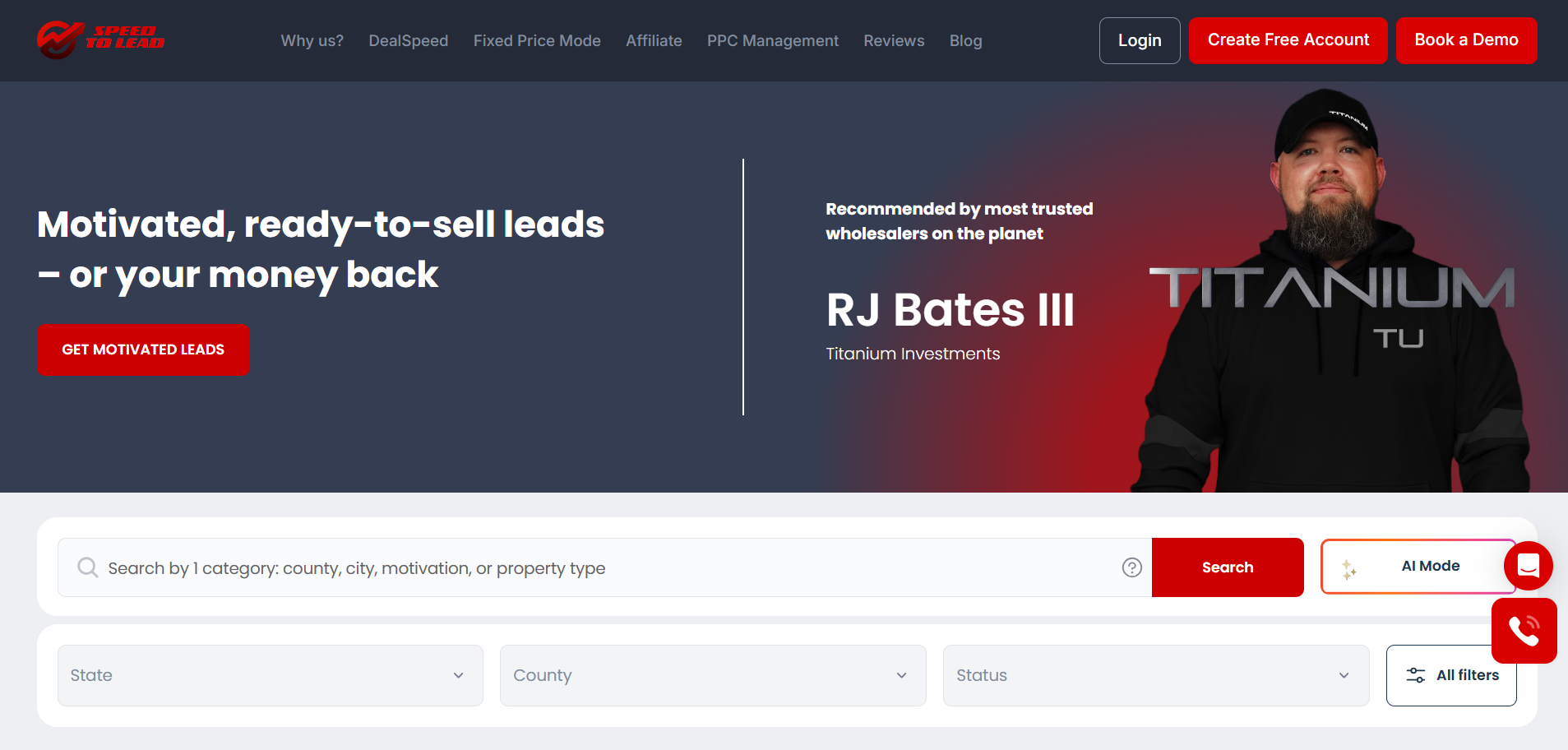
On the live lead marketplace, the workflow is preview, buy or pass, then close or refund. Each lead card shows the property details, seller motivation, timeline, lead source, an AI summary, comparable sales, and the DealPredictor score before any money moves. For non-exclusive leads, the card also shows how many other investors have already purchased it.
You are not bidding on a territory or committing to a monthly delivery volume. You are looking at one specific seller situation and deciding whether it fits your buy box.
That single structural change is what pulls investors out of pure list building, and the reasons stack up quickly.
Below are the specific drivers behind the shift, in roughly the order investors tend to encounter them.
On a pay-per-lead marketplace, verification happens before publication rather than after you have burned a week on the phone. Every lead on iSpeedToLead runs through triple verification against 50 billion data points, and the output is measurable:
Then the filter runs. Roughly 40% of incoming leads are removed before they ever reach the marketplace, including unreachable sellers, properties already under contract, homes listed with an agent, and inquiries that fall below the motivation threshold.
An investor working a self-built list performs that filtering personally, one dial at a time. An investor buying leads inherits the result of it.
This is the cleanest way to state the difference. Bedrooms, bathrooms, ownership records, and equity estimates are useful inputs, but they are not predictive of a discounted contract on their own.
DealPredictor was built specifically to close that gap. It was trained on 20,000+ closed deals and validated against 74,000+ tracked leads across 19 months of platform outcome data, and it scores the seller’s situation rather than the property’s specifications.
Signals include motivation indicators, timeline urgency, property distress factors, ownership context, pricing expectations, and geographic demand. The score, from A+ down to C, is visible before purchase.
Seller behavior follows a predictable emotional arc, and the first 72 hours are the most compliant window a seller will ever be in. That is the moment a foreclosure notice arrives, a relative passes, or a medical bill lands, and it is the moment the form gets filled out.
List building cannot compete on that clock by design. You are contacting owners on your schedule, not theirs, which means you are almost never talking to someone at the peak of their urgency.
Pay-per-lead flips that. Leads on iSpeedToLead are delivered in real time rather than in overnight batches, and Exclusive tier leads sit in a 0 to 24 hour freshness window with a single buyer. When a motivated seller is warmest, you are the first call rather than the fortieth.
“I just hopped on iSpeedToLead and I dialed three people. I bought three leads, dialed three people, and the first one that answered is a contract. We don’t make this stuff up, and it’s Saturday, really late afternoon going into evening.”
— Cassandra Deas, Titanium Investments
Every row on an exported list looks identical until you dial it. That is why list-driven operations depend so heavily on raw volume: with no internal ranking, the only lever is more attempts.
Scored inventory changes the allocation problem entirely:
Lower tiers still convert. They simply convert at a different rate, which lets you decide how much effort a lead deserves before you spend a dollar on it. A one-person operation with three good hours a day gets far more out of those hours when the order of the call list is informed by outcome data.
List building costs roughly the same whether the month produces four contracts or none. Subscriptions, skip trace credits, dialer seats, and caller hours are fixed inputs against a variable output, which is exactly the wrong shape for a business with lumpy revenue.
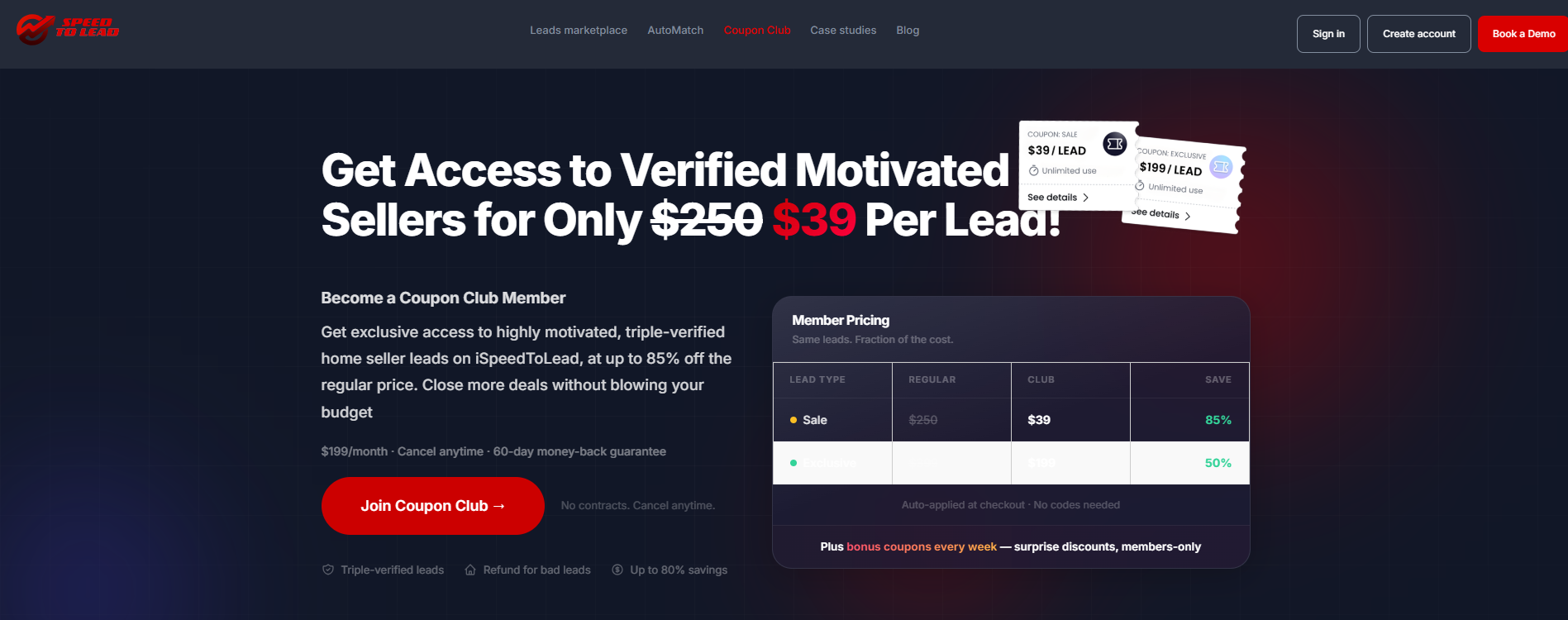
Pay-per-lead pricing tracks freshness and exclusivity instead:
| Tier | Freshness | Exclusivity | Entry pricing | Close ratio |
|---|---|---|---|---|
| Exclusive | 0 to 24 hours | One buyer only | From $199 | ~1 in 10 |
| Active | 24 to 48 hours | Limited buyers | From $59 | Most close within first 30 contacts |
| Sale | 48+ hours | Non-exclusive | From $39 | ~1 in 45 |
| Raw | Lowest verification | None | Lowest | Skill-dependent |
There are no long-term contracts and no monthly minimums, so a slow month genuinely costs less. Deposit packages carry 40% to 50% additional purchasing power in bonus balance, and financing through Affirm, Klarna, and Afterpay is available, often at 0% interest, with full account value credited on approval.
The cost-per-contract comparison is where this lands for most operators:
“From an investment perspective, how often would you spend $4,500 to make $15,000 over and over again? In 2025, anytime you can be under $5,000 in cost per contract, you are way ahead of the game.”
— Jerry Norton, Flipping Mastery
In competitive metros, marketing cost per contract has run considerably higher than that. Buying qualified conversations at $39 to $199 per lead changes the input side of that equation without requiring a testing budget or a campaign ramp.
Most investors underestimate how long an off-market deal takes to mature. Only about 1 in 20 deals closes inside the first month, and roughly 80% close between Day 31 and Day 180.
The single highest-volume closing window is Day 61 to Day 90, which accounts for about 36% of all off-market deals. Median time from lead purchase to close on iSpeedToLead runs approximately 73 days, which sits squarely inside that window.
Here is what stopping early actually costs:
| If you stop following up at… | Share of eventual closings you forfeit |
|---|---|
| Day 7 | ~99% |
| Day 30 | ~94% |
| Day 60 | ~78% |
| Day 90 | ~43% |
| Day 120 | ~27% |
Most investors quit between Day 14 and Day 30, which is precisely when the deal starts to ripen. Sustaining six months of structured touches across hundreds of self-generated records is an operations problem; sustaining it across a smaller set of pre-qualified leads inside MyCRM with automated SMS, email, call, and voicemail sequences is a settings problem.
The AI Follow-Up System targets response rates above 15% and conversion rates above 5%, which matters most for exactly the leads that need repeated contact.
If you skip trace a bad number, that money is gone. If the owner has already sold, listed, or has no interest whatsoever, that call time is gone too. Nobody reimburses a dead record.
Purchased leads carry a 21-day refund window on eligible Exclusive and Active leads, covering sellers who are unreachable, already under contract, or listed with an agent. The approval rate across roughly 10,850 analyzed tickets is 78.2%, and inability to contact the seller approves at close to 90%.
That single mechanism reframes lead spend from a bet into a controlled cost.
For a long time, the argument for building your own lists was control: your criteria, your cadence, your market. Automation on the buy side has largely absorbed that.
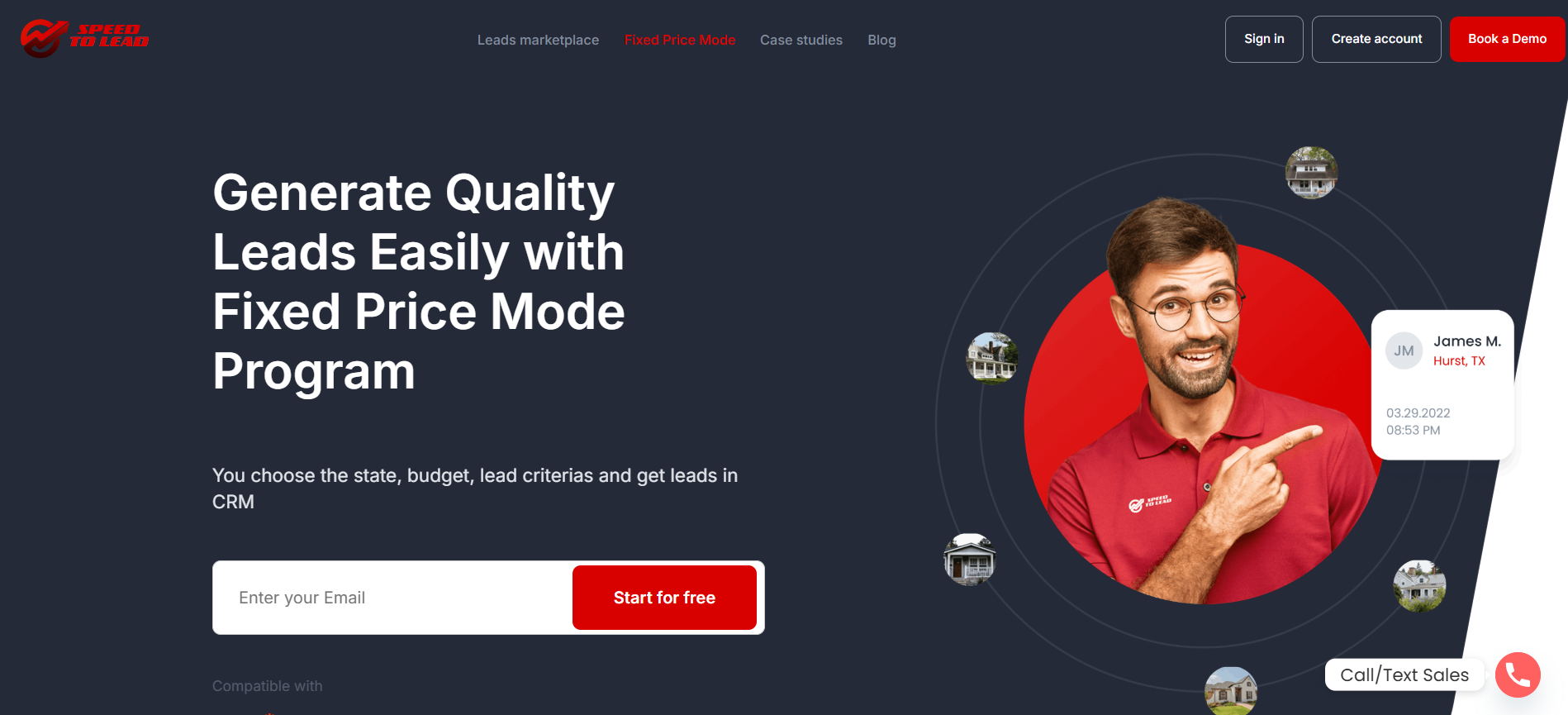
AutoMatch is a three-step setup. You set a bid price starting at $100 per lead plus a monthly budget cap, choose your geography down to the county, then configure parameters including property type, square footage, year built, seller motivation, and timeline urgency. Matching exclusive leads are delivered straight into MyCRM as they clear verification.
AutoMatch members convert at 3× the rate of standard shared lead buyers.
Fixed Price Mode offers the same set-and-forget model across up to five states with DealPredictor score thresholds baked into the filters, charging account balance first and the card on file second. Your buy box still defines what arrives; you just stop performing the acquisition labor yourself.
Acquisition is only half the business, and a contract you cannot assign is not income. This is where a data subscription simply has nothing to offer.
DealSpeed opens 6 million+ active buyers and 200,000+ agents across 48 states, plus title company resources, compressing the time between signed contract and assignment close.
“Honestly, if you have a really good deal in a really good market, you can sell it. Our disposition process is no longer about ‘we’ve got to find a buyer,’ it’s about finding the highest paying buyer.”
— Jordan Budd, Joe Home Buyer Winston-Salem
The switch is easier to justify when the outcomes are attached to real operators rather than to averages.
None of those investors stopped being investors. They stopped being lead generation departments.

An honest comparison has to acknowledge what property data platforms do better, because for several use cases they are simply the right tool.
These are model differences, not quality differences. A data platform is a research tool that can produce leads; a marketplace is a lead supply that includes research context. Choosing one does not invalidate the other.
In practice, very few experienced investors go all in on either side. The pattern that shows up repeatedly looks like this:
The hybrid works because it assigns each channel the job it is actually good at instead of forcing one system to do everything.
Running the comparison honestly takes one month and four numbers.
Most investors find the contact-rate line moves first. Purchased leads produce conversations per hour at a rate that a raw list cannot match, because the seller already raised their hand. Contracts follow within the 60 to 90 day maturation window described above, which means a fair test needs at least a quarter before you draw conclusions on closings.
Track it by lead tier as well. Exclusive inventory closes near 1 in 10 while Sale inventory runs near 1 in 45, and the correct mix depends on whether your constraint is budget or time.
The reasons compound rather than sitting side by side.
“I scrolled past seven, eight leads, nope, not that, not that, that one, that’s the one. It’s a location I’ve got a great buyer relationship, highly motivated, physically distressed, he’s willing to sell at a discount, we got him down 10,000 and we’re 22 minutes in and we got it.”
— RJ Bates III, Titanium Investments
For a wider view of the buying landscape, the guide to the 10 best ways to buy real estate leads in 2026 covers how the marketplace model compares to live transfers, territory bidding, and agent referral channels.
Testing the model against your current list-building workflow takes less setup than most investors expect.
Keep your data platform for underwriting. The goal is not to replace research; it is to stop paying twice for qualification.
List building and buying leads solve the same problem from opposite ends. One gives you total control over the universe of properties and asks you to fund the qualification; the other hands you qualified seller conversations and asks you to fund the close.
Investors are switching because the qualification layer is now cheaper to buy than to build, because scored inventory beats an unranked list on every hour of calling time, and because refund protection, automation, and disposition support did not exist on the self-built side of the ledger.
The best motivated seller lead marketplace delivers all of that in one workflow across 48 states, with verification, AI scoring, and outcome data behind every lead.
Book a demo to see how DealPredictor scores live leads in your target market before you spend a dollar on one.
Read Next:
Buying leads is better than list building for wholesalers who want predictable cost per contract and immediate deal flow, because verification, scoring, and qualification happen before purchase. List building remains the stronger choice for investors with an existing call center or a proprietary filter strategy they want to protect.
Investors are switching from PropStream-style tools to pay-per-lead because property databases describe houses while marketplaces deliver seller situations. Most keep the data platform for comps and underwriting and use the marketplace for actual deal flow, rather than replacing one with the other.
iSpeedToLead qualifies leads through triple verification against 50 billion data points, removing roughly 40% of incoming leads that are unreachable, under contract, listed with an agent, or below the motivation threshold. Every surviving lead then receives a DealPredictor score from A+ to C.
Yes. You can automate lead buying with AutoMatch or Fixed Price Mode by setting a bid price, monthly budget, geography, and filter criteria, then receiving matching leads directly in MyCRM. AutoMatch members convert at 3× the rate of standard shared lead buyers.
A motivated seller lead on iSpeedToLead starts from $39 for Sale tier, $59 for Active, and $199 for Exclusive, with no contracts or monthly minimums, while a self-built list carries subscription, skip tracing, dialer, and labor costs regardless of output. New members can use the GET90 code at checkout for 90% off their first lead.

August 13, 2026

August 12, 2026

August 11, 2026

August 10, 2026
August 9, 2026

August 8, 2026

August 7, 2026

August 6, 2026

August 5, 2026
Select the type of leads you're interested in.

