Speed to Lead for Real Estate Investors: How Response Time Changes Contract Rates (2026 Data)
Speed to lead for real estate investors has a data problem: the most quoted number in the field, a 21x lift for calling inside 5 minutes, never measured a contract. The 2007 study behind it says so directly: “This study did not address close ratios.”
That doesn’t make speed a myth. It means “call first, win the deal” skips every step between a fast dial and a signed agreement. This report shows what the research proves, where it stops, and which response targets are worth building your acquisitions around in 2026.
Every widely cited speed-to-lead number measures contact, qualification, or response. None of the four sources below measures a signed contract, and none studies wholesalers calling distressed homeowners.
| Source | Sample | What it measured | Headline finding | Measured contracts? |
|---|---|---|---|---|
| Lead Response Management Study (Oldroyd and Elkington, 2007) | 15,000+ web leads, 100,000+ call attempts, six companies | Contact and qualification | Contact odds drop 100x and qualification odds drop 21x between 5 and 30 minutes | No |
| Harvard Business Review lead study (2011) | 1.25 million leads, 42 companies | Qualification | Contact within an hour was nearly 7x likelier to qualify than an hour later | No |
| Harvard Business Review audit (2011) | 2,241 U.S. companies | Response behavior | 37% replied within an hour, 23% never replied, average 42 hours | No |
| Pied Piper Lead Handling Effectiveness Study (2026) | 2,198 inquiries, 21 real estate brands | Response behavior | 68% of web inquiries got no response within 24 hours | No |
Here’s why that matters. The first three rows are 15 to 19 years old, and they cover general sales leads, not homeowners. They’re still the best-known evidence on response decay, so this report uses them, but they describe the shape of the curve, not your contract rate.
For this report, “contract rate” means signed contracts per lead bought. iSpeedToLead’s review of public sources found no study that ties investor response time to that number, and this report doesn’t invent one.
Contact odds fall fastest in the first few minutes, then keep falling for hours. The Lead Response Management Study and Harvard Business Review’s 2011 research show the same pattern at very different scales.
So the decision that matters isn’t “today or tomorrow.” It’s whether your first dial happens before the seller puts the phone down and moves on.
There’s a second finding that rarely gets quoted. The 2007 study reported that after 20 hours, “every additional dial” hurt the ability to make contact and qualify a lead.
That result comes from sales teams working web leads, so don’t copy it onto homeowners, but it’s a warning against blind redialing. Changing the channel, the time of day, or the message is a better use of your second day than hitting redial.
Real estate’s own 2026 benchmark is low, and that’s the opening for investors. Pied Piper tested 2,198 phone and website inquiries across 21 large real estate brands in June and July 2026, scoring responses over the following 24 hours.
Of course, those were general consumer inquiries to brokerage offices, not distressed sellers calling investors. They still matter because agents are your real competition for most sellers. The 2026 Texas Homebuyers and Sellers Report, built on Texas responses to the National Association of Realtors survey, found 70% of sellers contacted only one agent before choosing, while 3% sold to a homebuying company.
That means the first credible person to reach a seller often faces no real runoff. Texas isn’t the whole country, and retail sellers aren’t motivated sellers, so treat this as direction rather than proof.
Response time changes your contract rate indirectly, by changing how many real conversations you get. A contract is the end of a four-step chain, and speed has strong evidence behind only the first two links.
Sellers don’t decide on the same clock you dial on. Zillow’s 2025 seller research found sellers typically spent 3 to under 4 months seriously considering a sale before listing, and 58% ranked maximizing profit first while 33% ranked selling within their timeframe first.
Distress runs on a long clock as well. ATTOM’s 2026 mid-year report counted 227,548 properties with foreclosure filings in the first half, up 21% year over year, and foreclosures completed in Q2 2026 averaged 563 days. In August 2026, filings hit 40,277 properties, up 13% year over year.
So there’s a mismatch: the race for the first conversation lasts minutes, while the decision to sell can take months.
True seller motivation comes from circumstance, and a fast call can’t manufacture it.
Here’s the cleanest way to put it. Speed raises the number of real conversations in your pipeline, and everything after that has to convert them.
Speed pays differently depending on who you’re racing. On iSpeedToLead’s marketplace, the lead type tells you.
| Lead type | Buyers on the lead | Who you’re racing | Response priority |
|---|---|---|---|
| Exclusive | One buyer only | The seller’s other options, such as an agent or another cash buyer | Dial immediately to protect the premium |
| Sale | Up to 5 buyers | Other buyers holding the same lead, plus the seller’s other options | Dial immediately, then win on preparation |
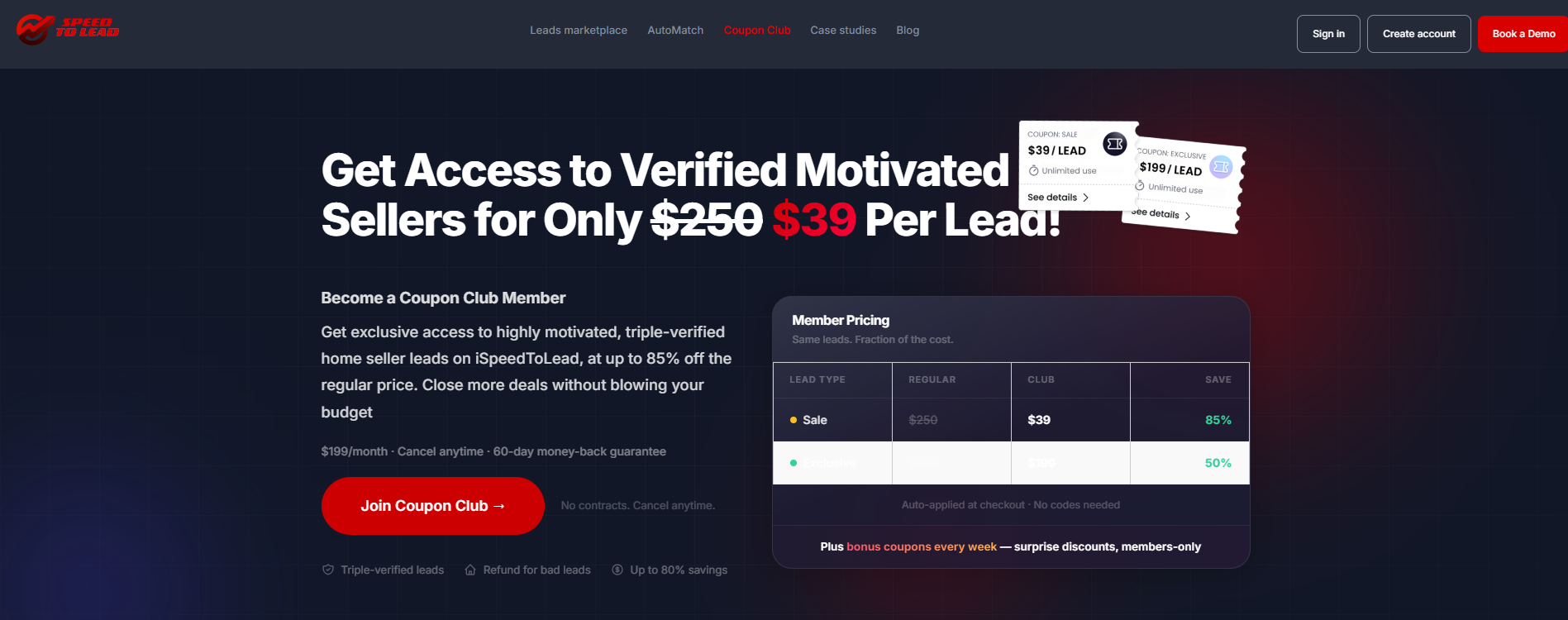
As of October 2026, the cost per signed contract over the last 12 months is about $2,300 overall, about $1,500 with member pricing, and about $6,900 with Exclusive leads. That Exclusive figure is roughly three times the overall number.
Exclusivity removes other buyers on that lead from the race. It doesn’t reach the seller for you, so a slow dial on an Exclusive lead wastes the most expensive part of the purchase. Speed itself costs nothing but attention, which makes it the cheapest lever you’ve got.
Lead quality decides which fast dial comes first. DealPredictor, iSpeedToLead’s AI lead scoring system, shows a grade from A+ down before you buy, so you can put your fastest effort on the sellers with the strongest signals. A grade is a prioritization tool, not a guarantee.
Named investor stories show what the numbers can’t: the moment a fast dial turns into a deal. Cassandra Deas of Titanium Investments was working leads late on a Saturday afternoon when this happened:
“I just hopped on iSpeedToLead and I dialed three people. I bought three leads, dialed three people, and the first one that answered is a contract.”
Cassandra Deas, Titanium Investments
RJ Bates III, also of Titanium Investments, described a purchase from the Lead Marketplace where he skipped seven or eight leads before choosing one:
“It’s a location I’ve got a great buyer relationship, highly motivated, physically distressed, he’s willing to sell at a discount, we got him down 10,000 and we’re 22 minutes in and we got it.”
RJ Bates III, Titanium Investments
Each story adds something different. Deas shows how little volume a fast dial needed on that day: three leads bought, and the first seller who answered became a contract. Bates shows selection, passing on several leads before picking a motivated seller in a market where he already had a buyer.
Anecdotes aren’t averages, and results depend on your skill, your follow-up, and your market. You’ll find more success stories on the iSpeedToLead site, but the lesson from these two is to choose carefully, then move fast.

The team at iSpeedToLead recommends the targets below. They’re an operating opinion built from the research above, not measured contract-rate results.
| Window | Target | Why |
|---|---|---|
| 0 to 5 minutes | First dial, using the seller’s details from the lead card | Contact odds fall fastest here |
| 5 to 60 minutes | Second dial, plus a voicemail | Odds are still falling, and a missed call isn’t a no |
| Same day | Text or email, where you have the right to send it | Reaches sellers who screen unknown numbers |
| Day 2 | Try a different time of day and a different message | Repeating the same failed dial adds little |
| Week 1 onward | Scheduled follow-up tied to the seller’s situation | The seller’s decision runs on a longer clock |
These targets have real limits, and three of them matter most.
Automation closes part of the gap. AutoMatch applies your filters and delivers matching Exclusive leads, from $150, into MyCRM, the platform’s built-in CRM, so you aren’t refreshing a feed. The AI Follow-Up System handles multi-channel outreach across SMS, email, calls, and voicemail, which protects the same-day and week-one windows when you’re on another call.
Fast also shouldn’t mean unprepared. Every lead card includes an AI-generated call script and approach built around that seller’s motivation signals, so you know what to say before you dial. A fast dial that opens with the wrong question burns the advantage you just earned.
The missing dataset can start with your own pipeline. No public study gives you a contract rate by response time, but your CRM can give you one for your market and your script.
One warning. Fast responders are often better operators in other ways too, so a gap between buckets isn’t proof that speed alone caused it. That same limit applies to the published studies, because observing faster companies doing better doesn’t isolate speed as the cause.
Even so, a few hundred logged leads will show you your own contact curve, and that’s worth more than any headline multiplier. If you’re still choosing where those leads come from, this guide to buying real estate leads covers the options.
Speed to lead doesn’t sign contracts; it earns the conversations that contracts come from. The evidence supports dialing in minutes, but it stops short of a contract-rate multiplier. Investors who log their own numbers in 2027 will know something the published research doesn’t.
iSpeedToLead is the largest motivated seller leads marketplace in the US, with 16,000+ investors having bought leads and 1,000+ contracts signed by its buyers every month, including 1,028 in July 2026. New members can use code GET90 at checkout for 90% off their first lead and start testing response windows on real sellers.
Book a demo to see how lead grades, AutoMatch delivery, and MyCRM fit your response process.
Read Next:
The data in this report came from the 2007 Lead Response Management Study, Harvard Business Review’s 2011 research, Pied Piper’s 2026 Lead Handling Effectiveness Study, Zillow, ATTOM, and the 2026 Texas Homebuyers and Sellers Report. Cost-per-contract and contract-volume figures come from iSpeedToLead.
Responding within 5 minutes does increase your odds of reaching and qualifying a lead, with contact odds 100x higher than at 30 minutes in the 2007 study. iSpeedToLead found no public study showing how much it increases contract rates for investors.
Speed is important on both Exclusive leads and Sale leads, for different reasons. Sale leads can be shared with up to 5 buyers, and Exclusive leads cost about $6,900 per signed contract, so a slow dial wastes more money.
You can measure your own speed-to-lead contract rate by logging when each lead arrived, when you first dialed, and whether it signed, then comparing response-time buckets. Split the results by lead type and DealPredictor grade to keep the comparison fair.
A signed contract on iSpeedToLead costs about $2,300 overall over the last 12 months as of October 2026. That figure is about $1,500 with member pricing and about $6,900 with Exclusive leads.
November 6, 2026
November 4, 2026

November 2, 2026
October 30, 2026

October 28, 2026
October 26, 2026

October 23, 2026
October 21, 2026

October 19, 2026
Select the type of leads you're interested in.

