Average Assignment Fee in 2026: What Wholesale Deals Pay vs. What a Contract Costs
The average assignment fee in 2026 is about $13,000 per deal, according to Real Estate Bees’ wholesaler survey, last updated in June 2026.
On iSpeedToLead, the average cost to land a signed contract over the last 12 months was about $2,300. On paper, that’s a fee worth roughly 5.7 times what the contract cost to acquire.
Most wholesalers treat the assignment fee as the number that matters. The more useful number is the spread between the fee and what it costs to get a seller to sign. That spread swings widely by lead type and by state.
This report sets national fee benchmarks against marketplace cost-per-contract data. It also covers the fall-through risk that sits between them.
The national average assignment fee is $13,000, based on Real Estate Bees’ outreach to more than 1,000 professional wholesalers across the U.S. The survey was published in October 2025 and updated in June 2026. That makes it one of the few recent, wholesaler-sourced fee benchmarks.
Three caveats matter before you plan around that figure:
Treat $13,000 as a national reference point, not a forecast for your next deal. Your local fee benchmark matters more than the national one.
iSpeedToLead’s pay-per-lead marketplace gives a second side of the equation that most fee reports leave out: acquisition cost. Over the last 12 months, the average cost per signed contract on the platform was about $2,300.
The marketplace now supports a volume that makes the figure meaningful. More than 16,000 investors have bought leads on iSpeedToLead, and buyers sign more than 1,000 contracts every month. In July 2026, the count was 1,028.
Cost per contract breaks down very differently by how investors buy:
| Buying approach | Cost per signed contract (last 12 months) |
|---|---|
| All iSpeedToLead buyers | About $2,300 |
| Investors on member pricing | About $1,500 |
| Investors buying Exclusive leads | About $6,900 |
Those three numbers frame everything that follows. A $13,000 fee looks very different at $1,500 per contract than at $6,900.
The spread is the assignment fee minus what it cost to get the contract signed. At the national average fee, all three buying approaches show a positive spread, but the size differs by more than 4x.
| Buying approach | Cost per contract | Spread at $13,000 fee | Fee as a multiple of cost |
|---|---|---|---|
| Member pricing | $1,500 | $11,500 | About 8.7x |
| All buyers | $2,300 | $10,700 | About 5.7x |
| Exclusive leads | $6,900 | $6,100 | About 1.9x |
Calculations by iSpeedToLead, using Real Estate Bees’ $13,000 national average fee and iSpeedToLead’s last-12-month cost per signed contract. Lead cost only; excludes marketing, closing, and overhead.
There’s a second way to read the same data: what share of signed contracts must actually close for lead spend to break even?
That’s the number to track in your own pipeline. If fewer contracts reach the closing table than your break-even rate, your lead mix or your markets need adjusting.
“From an investment perspective, how often would you spend $4,500 to make $15,000 over and over again? In 2025, anytime you can be under $5,000 in cost per contract, you are way ahead of the game.”
Jerry Norton, Flipping Mastery / Joe Home Buyer
By that standard, all three iSpeedToLead buying approaches except Exclusive-only buying come in well under the $5,000 line.
The counterintuitive finding is that the lowest-priced leads produced the cheapest contracts. Investors on member pricing signed contracts at about $1,500 each. Exclusive buyers paid about $6,900.
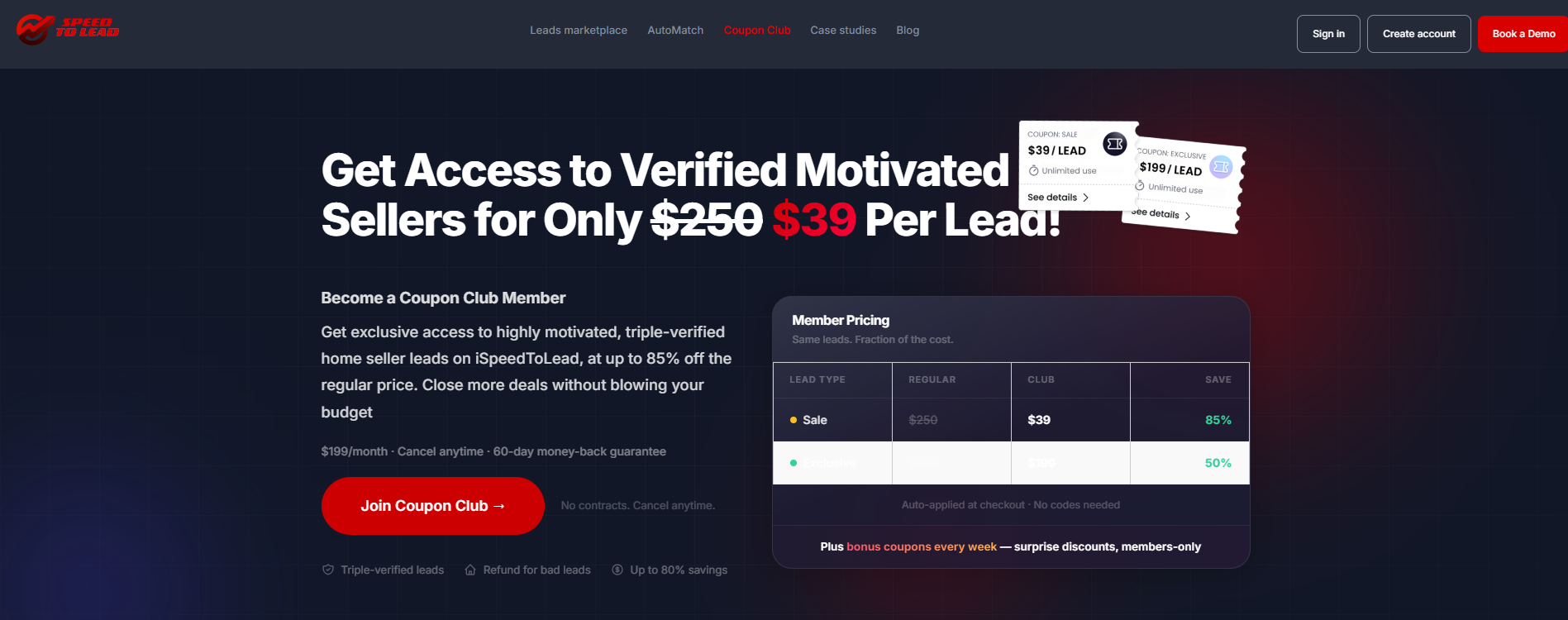
The reason is pricing math, not lead quality alone. Member Sale leads start at $39, and Sale leads delivered automatically start at $29. Exclusive leads start at $150 through AutoMatch and $199 on member pricing, so each Exclusive attempt costs several times more.
The trade-offs run both ways:
Exclusive leads aren’t the wrong choice; they’re a high-fee-market choice. A $6,900 contract makes sense when local fees run near $22,000. It strains when they run near $5,000.
A signed contract isn’t an assignment fee until the deal closes. Every contract that falls through raises the real cost of the ones that do.
Retail data shows how common cancellations are even in the conventional market. Redfin reported that 14% of U.S. home-purchase agreements that went under contract in July 2026 fell through, the highest seasonally adjusted share in nearly three years. In Atlanta and Houston, the rate was close to 20%.
Wholesale deals carry more points of failure than retail sales, including seller hesitation, title issues, and finding an end buyer. Here’s how cost per closed deal rises as fall-through increases:
| Fall-through rate | Member pricing | All buyers | Exclusive leads |
|---|---|---|---|
| 14% (Redfin retail, July 2026) | About $1,744 | About $2,674 | About $8,023 |
| 30% (illustrative) | About $2,143 | About $3,286 | About $9,857 |
| 50% (illustrative) | About $3,000 | About $4,600 | About $13,800 |
Cost per signed contract divided by the share of contracts that close. The 30% and 50% rows are scenarios, not measured rates.
Even at a 50% fall-through rate, the all-buyer average stays under $5,000 per closed deal. Exclusive-only buying at that rate would cost more than the $13,000 national average fee. That’s why fall-through control belongs in your fee math.
Timing matters too. The median time from lead purchase to close on iSpeedToLead is about 73 days. Plan cash flow for roughly 10 weeks between lead spend and the assignment check.
State averages in the Real Estate Bees survey show how much geography moves the fee side of the equation:
Apply the marketplace’s cost-per-contract figures to those benchmarks and break-even rates diverge sharply:
| Market fee level | Member pricing break-even | All-buyer break-even | Exclusive break-even |
|---|---|---|---|
| $22,000 (NC, GA) | 6.8% | 10.5% | 31.4% |
| $13,000 (national) | 11.5% | 17.7% | 53.1% |
| $5,000 (AZ) | 30.0% | 46.0% | Above 100% |
Share of signed contracts that must close for lead spend to break even. Calculations by iSpeedToLead.
In a $5,000-fee market, an average Exclusive contract costs more than the fee it produces. In a $22,000-fee market, Exclusive buying needs fewer than a third of contracts to close.
Low-fee markets can also carry high acquisition costs through other channels. Jerry Norton has said that, according to Brent Daniels, cost per contract in Phoenix can reach $12,000 or more.
“I don’t know if you guys know this, but in some markets like Phoenix, I was talking to Brent Daniels and he was telling me cost per contract is up to $12,000, maybe even higher.”
Jerry Norton
For lead volume by geography, see iSpeedToLead’s motivated seller lead volume by state report.
Your fee comes out of the end buyer’s profit, so flipper margins cap what you can charge. Those margins are tightening.
ATTOM’s Q2 2026 home flipping report, released October 1, 2026, found a typical gross flipping profit of $60,526. The typical profit margin fell to 21.5%, down from 27.6% a year earlier. Gross profit was down more than $10,000 year over year, and that figure excludes rehab and holding costs.
That squeeze has two practical effects:
“You do a handful of deals every month and you increase your spread by five or ten grand on each one, that’s pretty tremendous.”
Jordan Budd, Joe Home Buyer Winston-Salem
DealSpeed gives iSpeedToLead users access to 6M+ buyers and 200K+ agents. That’s buyer reach for shopping a contract before you accept the first offer.
The average assignment fee is a starting point, not a plan. Run your numbers in this order:
The investors getting the most from these numbers pair low acquisition cost with fees near the national average. Dallas Turley closed $60K across four deals from the marketplace, an average of $15,000 per deal. Christopher, another marketplace buyer, wholesaled a New Orleans duplex for a $15,000 assignment fee on a lead that cost $29.
Two platform features help with the cost side:
iSpeedToLead’s take: Wholesalers spend too much energy chasing a bigger fee and too little lowering cost per contract. Tighter flipper margins make bigger fees harder to win, while acquisition cost is a lever you control. Expect fees to stay under pressure while flip margins sit near 21%, and plan around protecting the spread.
To test the math on a single lead first, use code GET90 at checkout for 90% off your first lead purchase.
The average assignment fee in 2026 sits near $13,000, but the spread is what pays your bills. On iSpeedToLead, the average signed contract cost about $2,300 over the last 12 months, and about $1,500 for investors on member pricing.
iSpeedToLead is the largest motivated seller leads marketplace in the U.S., which makes it one of the few places where cost per contract can be measured at scale. More than 1,000 contracts are signed every month by buyers who chose each lead before paying for it.
Book a demo to see what a signed contract costs in your target market, and how that compares to the fees your local buyers pay.
Read Next:
The average assignment fee in 2026 is about $13,000, according to Real Estate Bees’ survey of U.S. wholesalers, last updated in June 2026. State averages range from $5,000 in Arizona to $22,000 in North Carolina and Georgia.
It costs about $2,300 on average to get a signed wholesale contract on iSpeedToLead, based on the last 12 months of marketplace data. Investors on member pricing averaged about $1,500, and Exclusive-lead buyers averaged about $6,900.
Exclusive leads cost more per contract than Sale leads because each Exclusive lead is priced several times higher, starting at $150 versus $29 to $39 for Sale leads. Exclusive leads go to one buyer only, so the higher cost buys an uncontested seller, which pays off most in high-fee markets.
You can calculate your break-even close rate by dividing your cost per signed contract by your expected assignment fee. At $2,300 per contract and a $13,000 fee, 17.7% of contracts need to close for lead spend to break even.
No, a higher assignment fee doesn’t always mean more profit for wholesalers, because profit depends on the spread between the fee and acquisition cost. A $5,000 fee in Arizona can still beat a pricier contract elsewhere if the cost per contract stays low and fewer deals fall through.
October 21, 2026

October 19, 2026

October 15, 2026

October 14, 2026
October 12, 2026

October 10, 2026
October 9, 2026

October 8, 2026
October 7, 2026
Select the type of leads you're interested in.

