Is Cold Calling Motivated Sellers Legal in Georgia? TCPA, Mini-TCPA Rules, and Penalties in 2026
Cold calling motivated sellers in Georgia is legal in 2026, but every dial falls under two overlapping rulebooks: the federal Telephone Consumer Protection Act (TCPA) and Georgia’s telephone solicitation statute, O.C.G.A. § 46-5-27, the state’s “mini-TCPA.”
iSpeedToLead is the motivated seller lead marketplace built for this environment, giving 12,000+ active investors verified, AI-scored sellers across 48 states before they ever pick up the phone.
The stakes went up recently. Georgia’s SB 73 took effect in July 2024 and extended liability to businesses that have calls made on their behalf. For class actions, the amendment removes the $1,000 actual-damages-per-violation cap.
This article breaks down what federal and Georgia law require, what violations cost, and how Georgia investors can keep dialing without inheriting a lawsuit.
This article is general information, not legal advice. Talk to a Georgia-licensed attorney about your specific calling program.
Most investors ask the wrong question. “Is cold calling legal?” has an easy answer: yes. The better question is whether you can prove, call by call, that you followed the rules.
In Georgia, legality comes down to five variables:
Here’s why that matters: Georgia’s statute now reaches the business behind the call, not just the person dialing. A wholesaler who hires an offshore calling team is exposed to the same claims as the caller.
iSpeedToLead’s take: compliance isn’t a checklist you finish once. It’s a record you keep on every seller conversation.
The TCPA is the baseline for every call into Georgia. Federal rules apply whether you’re dialing from Atlanta or Arizona.
The federal DNC rules restrict “telephone solicitations” to registered numbers. A call to a number on the National Do Not Call Registry, or an automated or prerecorded call to a cell phone without prior express consent, exposes the caller to federal TCPA liability of $500 to $1,500 per violation.
That range adds up fast. A campaign of 500 non-compliant calls can create six-figure exposure before a single contract gets signed.
Real estate investors have a genuine legal argument here. In Cofey v. Fast Easy Offer (D. Az. June 5, 2025), the court held that calls asking whether the owner had given up on selling their property were not telephone solicitations, because they did not offer to sell or rent anything to the call recipient. In Aussieker v. Aghazadeh (E.D. Cal. July 18, 2025), another court followed Coffey and concluded offers to buy property do not trigger the TCPA’s DNC protections.
Of course, there are limits. Courts have distinguished a pure offer to buy a property from an offer to buy tied to a hidden service the consumer is charged for, which is treated as a solicitation. Agents calling to list a property are in a different position entirely, since the consumer in that scenario is effectively buying help selling their property.
Neither ruling came from a Georgia court or an appellate court. Commentators have cautioned that contrary rulings could appear, and that investors should proceed carefully until an appellate court weighs in. Treat this as a defense, not a business plan.
The DNC question and the technology question are separate. Even if your offer isn’t a “solicitation,” prerecorded or automated calls to cell phones without consent create their own federal exposure.
For Georgia investors, that means ringless voicemail drops, AI-voice dialers, and blast campaigns need consent documentation, full stop.
The TCPA limits delivery to 8 a.m. to 9 p.m. in the recipient’s local time. Georgia is entirely in Eastern Time, but your dialer should still key on the lead’s location, not your office clock.
Georgia sits in the Eleventh Circuit, which reshaped national TCPA consent rules:
The bottom line: fewer new federal rules took effect than expected, but the statute itself hasn’t softened. Private plaintiffs still enforce it aggressively.

Georgia layers its own statute on top of federal law. SB 73 was signed by Governor Brian Kemp on May 6, 2024, and took effect July 1, 2024.
You don’t need a separate state scrub. Numbers on the Georgia Do Not Call List were merged into the federal registry after it was established in 2003, and the FTC-maintained registry is now the sole registration site for Georgians (Source: Georgia Attorney General’s Consumer Protection Division).
Georgia defines a telephone solicitation as any voice communication over a telephone line for the purpose of encouraging the purchase or rental of, or investment in, property, goods, or services. That wording tracks the federal definition the Coffey court analyzed, though no Georgia court has ruled on offers to buy under the state statute.
The exemptions matter for lead buyers. The definition excludes calls made with the subscriber’s prior express invitation or permission, and calls from someone with whom the subscriber has a prior or current business or personal relationship.
This is the biggest shift from SB 73. A private plaintiff can sue the person who made the solicitation, the person or entity it was made on behalf of, or both.
Ignorance is no longer a shield. It isn’t a defense that the defendant didn’t make the call or wasn’t aware of the violation if the call was made on its behalf under an agreement, contract, request, or employment relationship. It is a defense if the defendant established policies and procedures to prevent violations and mandated and enforced compliance with them.
That’s the practical takeaway for any investor using a VA team or calling vendor: written policies, enforced and documented.
Georgia also regulates automatic dialing and recorded message equipment separately. The ADAD statute makes it unlawful to use automated dialing and prerecorded message equipment for advertising or offering property for sale, lease, or rental without prior consent, or outside 8:00 a.m. and later hours set by the statute.
It also requires a permit from the Public Service Commission before connecting ADAD equipment to a Georgia phone line. Violations are misdemeanors and can lead to disconnection of telephone service.
Georgia’s statute is written around “voice communication,” which raises open questions about texts. Federal law is unsettled too: federal courts are openly split on whether unwanted texts violate the Do Not Call Registry. Until that split resolves, treat texts with the same care as calls.
| Enforcement path | Who brings it | Maximum exposure |
|---|---|---|
| Federal TCPA private action | Individual or class | $500 per violation, up to $1,500 if willful |
| Georgia private action | Individual (more than one call in 12 months) | Greater of actual loss or up to $1,000 per violation, plus fees |
| Georgia class action | Class of Georgia subscribers | No per-violation damages cap |
| Georgia Attorney General | State | Up to $2,000 per violation, plus cease and desist |
| Georgia ADAD statute | PSC / criminal | Misdemeanor, service disconnection |
The Georgia figures come straight from the statute. The Attorney General can impose a civil penalty up to $2,000 per violation, and a person who received more than one solicitation within any 12-month period can recover actual loss or up to $1,000 per violation, whichever is greater, plus attorney’s fees and costs.
Class actions aren’t subject to that damages limit. Claims generally must be brought within two years of when the plaintiff knew or should have known of the violation.
One sentence to remember: in Georgia, the class action is the real risk, not the individual complaint.
Cold calling remains one of the most direct ways to reach sellers who never fill out a form. The investors who keep doing it successfully treat compliance as part of the workflow.
Scrub before every campaign, not once a quarter. Keep the scrub date on file with each list.
State your name and company in the first sentence. Never spoof or block caller ID.
Build the window into your dialer settings so no one on your team can override it on a busy Saturday.
Live, manual dialing carries far less risk than voicemail drops or autodialers. If you use automation, document consent first and check Georgia’s ADAD permit rule.
Process “stop calling me” requests immediately and record them. A clean call log is your best evidence if a complaint ever lands.
If a VA team or calling firm dials for you, SB 73 makes their mistakes your problem. Written procedures, training, and audits are what the statute’s defense actually requires.
As Jerry Norton puts it:
“Our job isn’t to create motivation, it’s to uncover motivation.”
Jerry Norton, Flipping Mastery / Joe Home Buyer
Compliance protects the conversations where that motivation gets uncovered.

Georgia investors have several ways to build pipeline, each with a different compliance profile:
The marketplace model changes the starting point. Instead of dialing a homeowner who’s never heard from anyone, you’re following up with a seller who already expressed interest in selling. That’s a different conversation, and usually a better documented one. For a deeper breakdown of channels, see these 7 proven lead sources for real estate investors.
Georgia is one of iSpeedToLead’s top-volume states, alongside Texas, Florida, Illinois, and California. Here’s why investors working Georgia markets choose it.
iSpeedToLead sources sellers through six channels: cold calling, Google PPC, Facebook and Meta, YouTube and TikTok, email outreach, and SEO. On the cold calling side, trained callers hold real conversations with homeowners before the lead is qualified and scored, so the seller you reach has already talked about selling.
Approximately 40% of incoming leads are removed before publication. Of the leads that remain:
Fewer wrong numbers means fewer calls to people who never should have been on your list.
DealPredictor AI scoring was built on 74,000+ tracked leads over 19 months of wholesale outcomes. The top 19% of scored leads account for approximately 40% of confirmed wholesale outcomes, so you spend your dial time where the probability is highest.
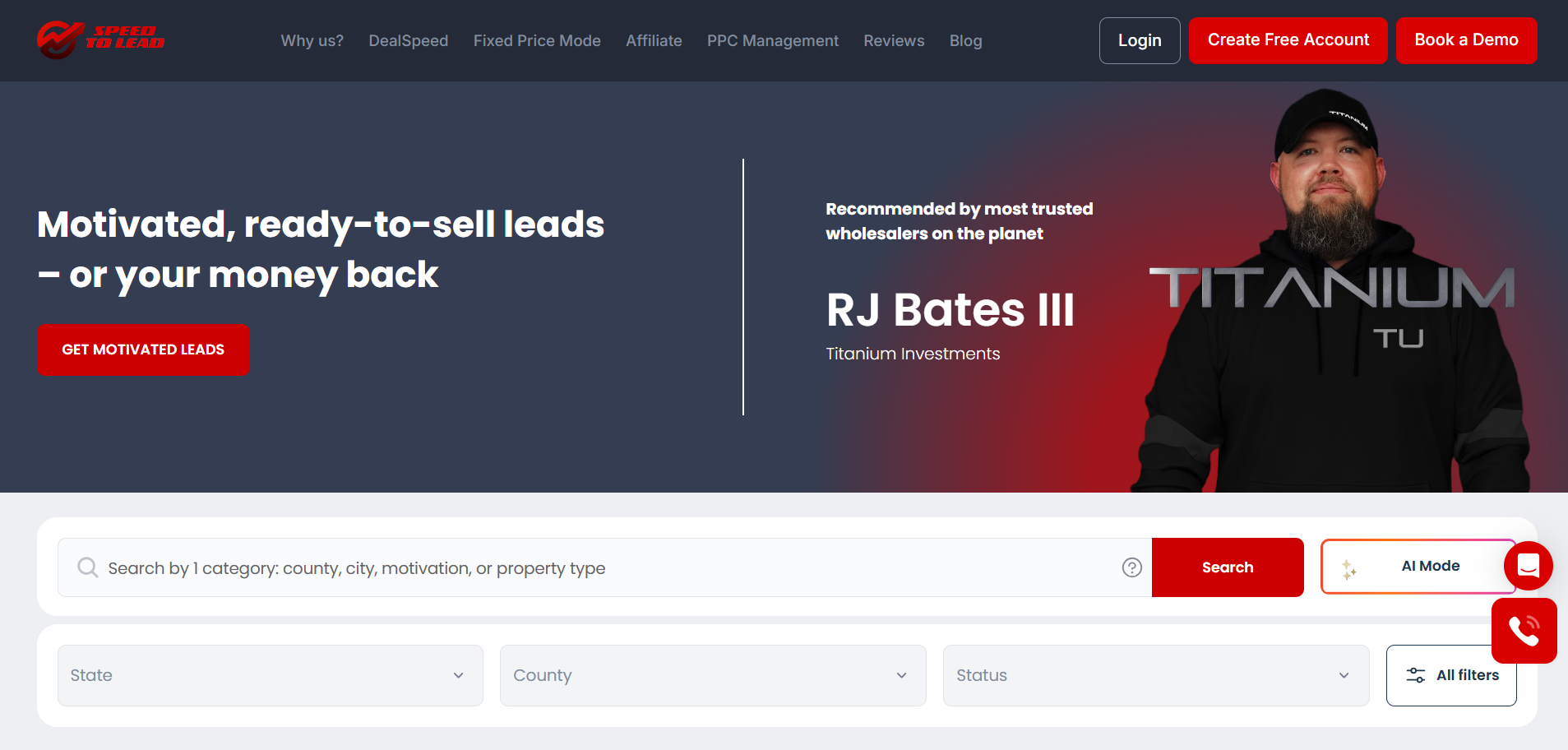
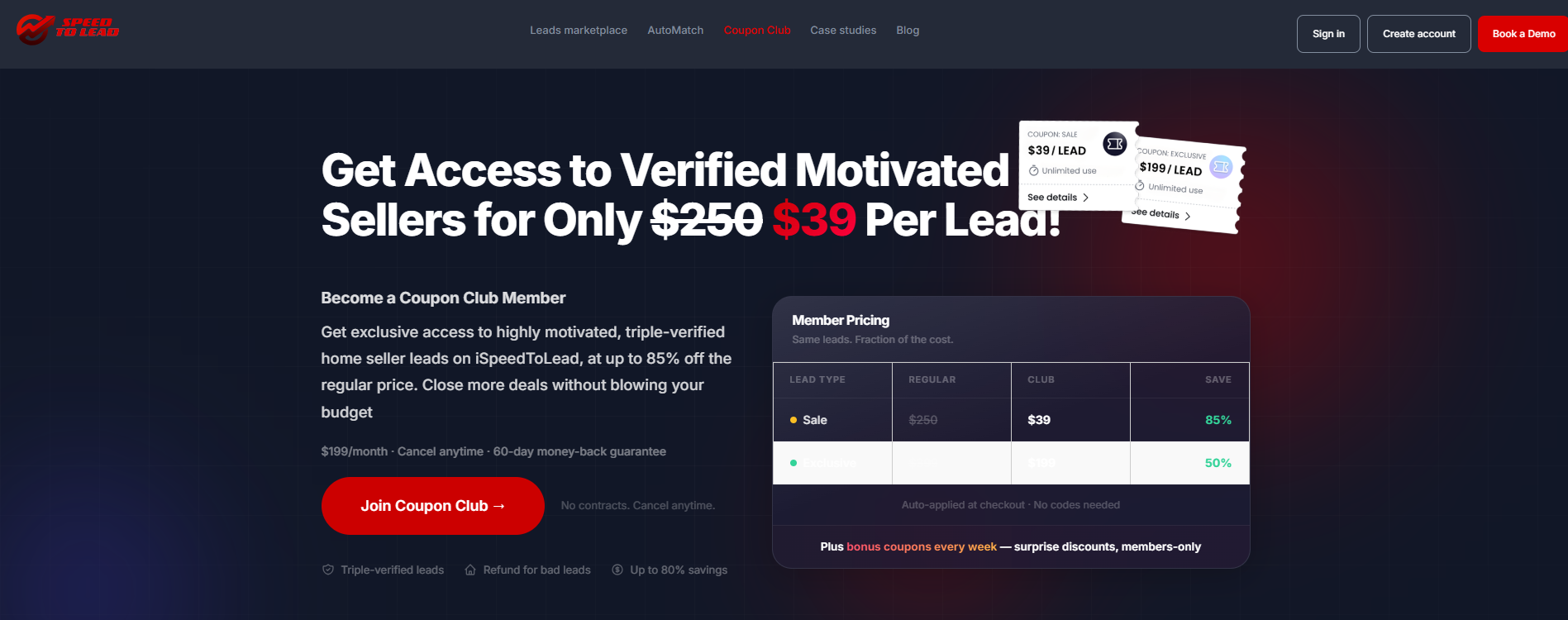
The live lead marketplace shows lead source, seller motivation, timeline, and an AI summary before purchase. Exclusive leads (0 to 24 hours old) go to one buyer only, while Active and Sale tiers offer lower-cost entry points starting at $59 and $39 with member pricing.
iSpeedToLead’s MyCRM logs calls, messages, notes, reminders, and status for every lead. The AI Follow-Up System automates outreach across SMS, email, calls, and voicemail, with opt-out detection and DNC handling built into its workflows, and it targets response rates above 15%.
AutoMatch automated lead delivery lets you set a bid, budget, and Georgia counties once, then receive matching exclusive leads straight into MyCRM. AutoMatch members convert at 3× the rate of standard shared lead buyers.
Eligible Exclusive and Active leads carry a 21-day refund window with a 78.2% approval rate. Once you’re under contract, the DealSpeed disposition network connects you with 6M+ buyers and 200,000+ agents.
Speed still wins when the seller is real:
“I just hopped on iSpeedToLead and I dialed three people. I bought three leads, dialed three people, and the first one that answered is a contract. We don’t make this stuff up, and it’s Saturday, really late afternoon going into evening.”
Cassandra Deas, Titanium Investments
Getting set up takes minutes:
Plan for follow-up. About 36% of off-market deals close between Day 61 and Day 90, so the investors who stay organized and persistent collect the contracts.
iSpeedToLead turns Georgia lead generation into lead selection, so your team spends time on sellers who’ve already engaged instead of building call lists from scratch.
Cold calling in Georgia is legal, but SB 73’s uncapped class actions and vicarious liability mean every dial needs a documented process behind it.
Book a demo to see verified, AI-scored motivated seller leads available in your Georgia markets today.
Read Next:
Yes. It is legal to cold call motivated sellers in Georgia as long as you follow federal TCPA rules and Georgia’s O.C.G.A. § 46-5-27, including DNC scrubbing, calling hours, and identifying yourself at the start of each call.
iSpeedToLead helps Georgia investors reduce cold calling risk by delivering sellers who have already engaged through one of six channels, filtering out roughly 40% of leads before publication, and logging every conversation in MyCRM. It doesn’t replace legal advice, but it means fewer blind dials and cleaner records.
Buying pay-per-lead leads is better than cold calling a skip-traced list for Georgia investors who want to skip list building and qualification, because every iSpeedToLead lead is verified and DealPredictor-scored before you see it. Both approaches still require compliant follow-up.
You can text motivated sellers in Georgia, but federal courts are split on whether unwanted texts violate the Do Not Call Registry, so treat texts with the same consent, opt-out, and timing discipline as calls.
A TCPA violation in Georgia can cost $500 to $1,500 per violation under federal law, plus up to $1,000 per violation in a Georgia private action, up to $2,000 per violation in an Attorney General action, and uncapped damages in a Georgia class action.

October 2, 2026

October 1, 2026
September 30, 2026
September 29, 2026
September 28, 2026

September 27, 2026

September 26, 2026

September 25, 2026

September 24, 2026
Select the type of leads you're interested in.

