How Real Estate Lead Marketplaces Work in 2026 (And When Buying Leads Beats Generating Them)

Real estate lead marketplaces are platforms where investors preview and purchase individual motivated seller leads that were already generated, verified, and scored by someone else.
iSpeedToLead is the most transparent real estate lead marketplace available in 2026, showing 12,000+ active investors across 48 states the seller’s motivation, timeline, source, and DealPredictor grade before they spend a dollar.
Roughly 40% of the leads that enter iSpeedToLead’s pipeline are filtered out before publication, which is the practical difference between buying a qualified conversation and buying a name on a list.
This article breaks down how a lead marketplace works from seller inquiry to closed deal, when buying leads beats generating them, and how to choose the buying model that fits your acquisition style.

A real estate lead marketplace turns lead generation into lead selection. Someone else runs the ad campaigns, the call teams, and the verification; you inspect the finished lead and decide whether it’s worth your money.
That definition rules out three things the industry lumps together as “buying leads”:
The distinction matters because wholesalers don’t make money on property specs. They make money on seller situations: a pre-foreclosure deadline, an inherited house sitting in probate, a landlord who’s done with tenants.
A marketplace is worth exactly as much as the work that happened before you saw the lead.
Every lead on iSpeedToLead moves through six stages, four before purchase and two after.
The platform sources through six channels: trained cold-calling teams, Google PPC, Facebook and Meta paid social, YouTube and TikTok, email outreach, and organic search.
Every channel feeds the same verification and scoring pipeline, so a cold-call lead and a PPC lead reach you with the same data attached. Across all six, the platform delivers 153,000+ leads per year, and the lead sources ranked by closing rate don’t all perform the same.
Before a lead publishes, its contact details, address, and motivation signals are cross-referenced against 50 billion data points. The results:
That’s the filter you’d otherwise be running yourself, one dial at a time.
Each surviving lead gets a DealPredictor grade from A+ down to C. The model was built on 74,000+ tracked leads and 19 months of platform outcomes, and it scores situations rather than houses: motivation indicators, timeline urgency, distress factors, ownership context, and pricing expectations.
The concentration effect is the whole point. The top 19% of scored leads account for roughly 40% of confirmed wholesale outcomes, and A+ leads close at about 4× the platform average. You see the grade before you buy, so you know whether you’re looking at a priority call or a volume play.
Leads publish into four tiers, and the price drops as a lead ages and loses exclusivity. They go live as soon as the seller finishes the form, because lead value falls fast in the first week.
| Tier | Age | Exclusivity | Starting price | Typical close ratio |
|---|---|---|---|---|
| Exclusive | 0–24 hours | One buyer only | From $199 | ~1 in 10 |
| Active | 24–48 hours | Limited buyers | From $59 | Most close within first 30 contacts |
| Sale | 48+ hours | Non-exclusive | From $39 | ~1 in 45 |
| Raw | Lowest verification | None | Lowest tier | Skill-dependent |
Standard non-member rates run higher, roughly $325, $250, $150, and $30 respectively, with member pricing bringing them down to the starting prices above. Either way, the price is tied to the tier, not to a bidding war.
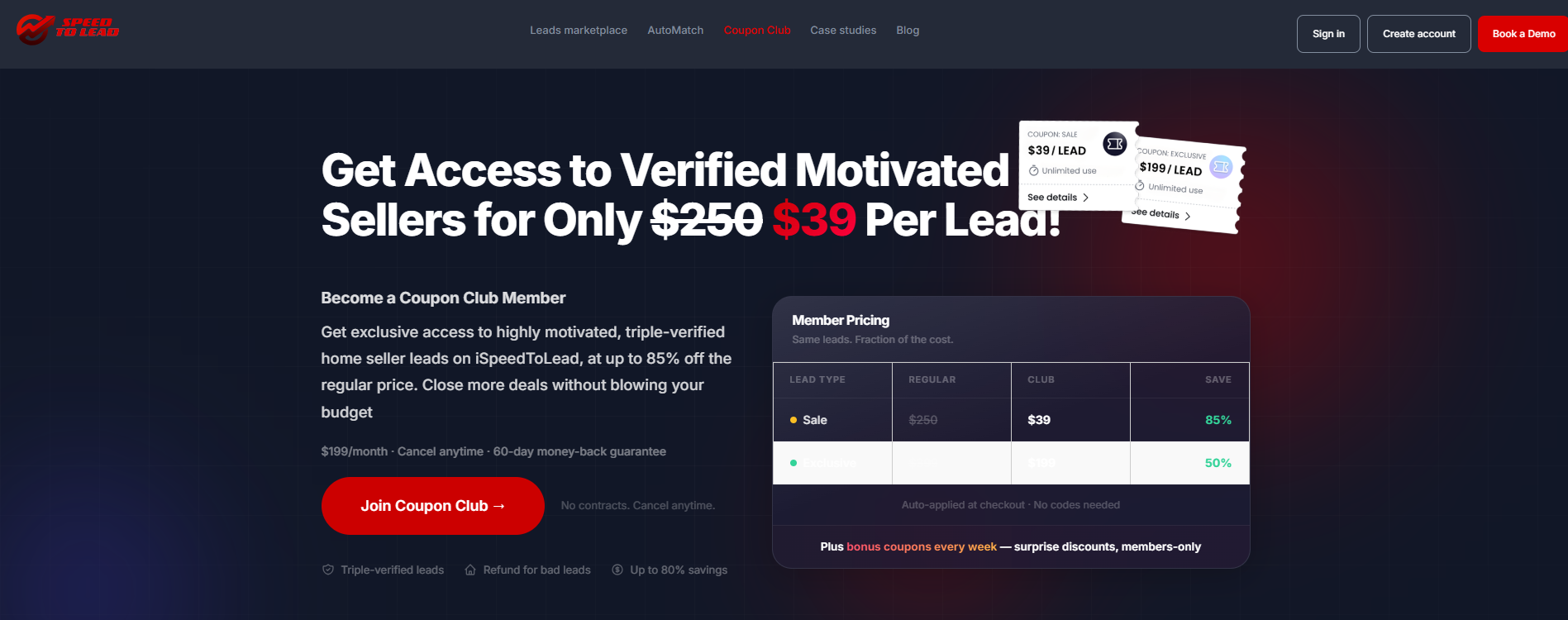
This is the step that separates a marketplace from every other buying model. On the LeadFeed Marketplace, each lead card shows:
You filter by geography, price, property type, grade, and status, then buy directly, add to cart, or pass. That’s a 30-second decision, not a 30-day campaign.
“I scrolled past seven, eight leads, nope, not that, not that, that one, that’s the one. It’s a location I’ve got a great buyer relationship, highly motivated, physically distressed, he’s willing to sell at a discount, we got him down 10,000 and we’re 22 minutes in and we got it.”
RJ Bates III, Titanium Investments
A purchased lead lands in MyCRM, the built-in CRM that tracks status, notes, reminders, and call and message history, and syncs to outside tools through Zapier and webhooks. Every lead arrives with an AI-generated call script tuned to that seller’s motivation signals, and the AI Follow-Up System runs SMS, email, call, and voicemail sequences targeting response rates above 15% and conversion rates above 5%.
Two mechanisms protect the downside. Exclusive and Active leads carry a 21-day refund window if the seller is unreachable, already under contract, or listed with an agent; across roughly 10,850 analyzed refund tickets, 78.2% were approved, and about 90% when the reason was an unreachable seller.
Once a contract is signed, DealSpeed opens a disposition network of 6 million+ buyers and 200,000+ agents, and the median time from lead purchase to close is about 73 days.
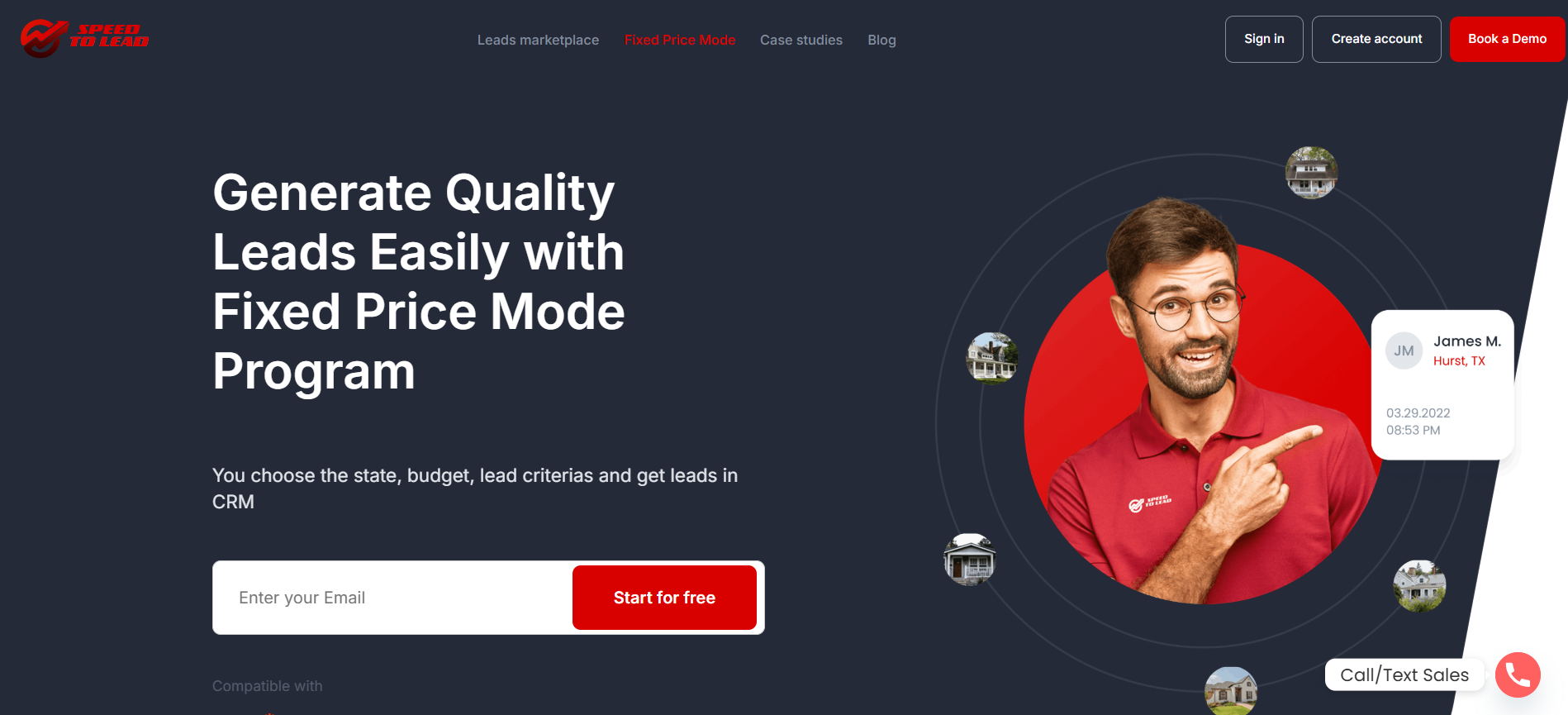
Buying leads beats generating them when the thing you’re short on is time, testing budget, or a team. Generating beats buying when you already own a channel that produces contracts cheaper than you can buy them.
Here’s the structural difference. Generating means you fund the front of the funnel: lists, skip tracing, dialer seats or VA management, ad creative, landing pages, and weeks of testing. A raw skip-traced list converts at roughly 0.5% to 2% by industry baseline, so self-generated volume is a staffing decision as much as a marketing one.
Buying means you fund only the leads you select, after the qualification work is done. On iSpeedToLead there are no long-term contracts and no monthly minimums, so your cost scales with what you actually buy.
Buy when:
Generate when:
The tradeoff nobody should skip: a marketplace removes generation, not follow-up. About 36% of off-market deals close between Day 61 and Day 90, and the median purchased lead takes about 73 days to close. If nobody on your side will make the fifth call, buying leads won’t fix that.
Misty Arellano is the cleanest proof of the trade. She split-tested iSpeedToLead against two other pay-per-lead vendors, chose it on lead quality and customer service, and spent under $2,000 to land three contracts, two of them novations.
The team at iSpeedToLead’s take: most solo operators and small teams should buy first and generate later, once they know which markets and which motivations they actually close.
If you decide to buy, you’re choosing a model before you choose a vendor, and each model puts the purchase decision in a different place.
A marketplace reduces the need for skip tracing, cold outreach, and manual qualification compared with a data platform. It doesn’t replace the work of closing.
For a ranked look at specific vendors, see the 10 best ways to buy real estate leads in 2026. Pick the model that matches how you make decisions, then pick the vendor.
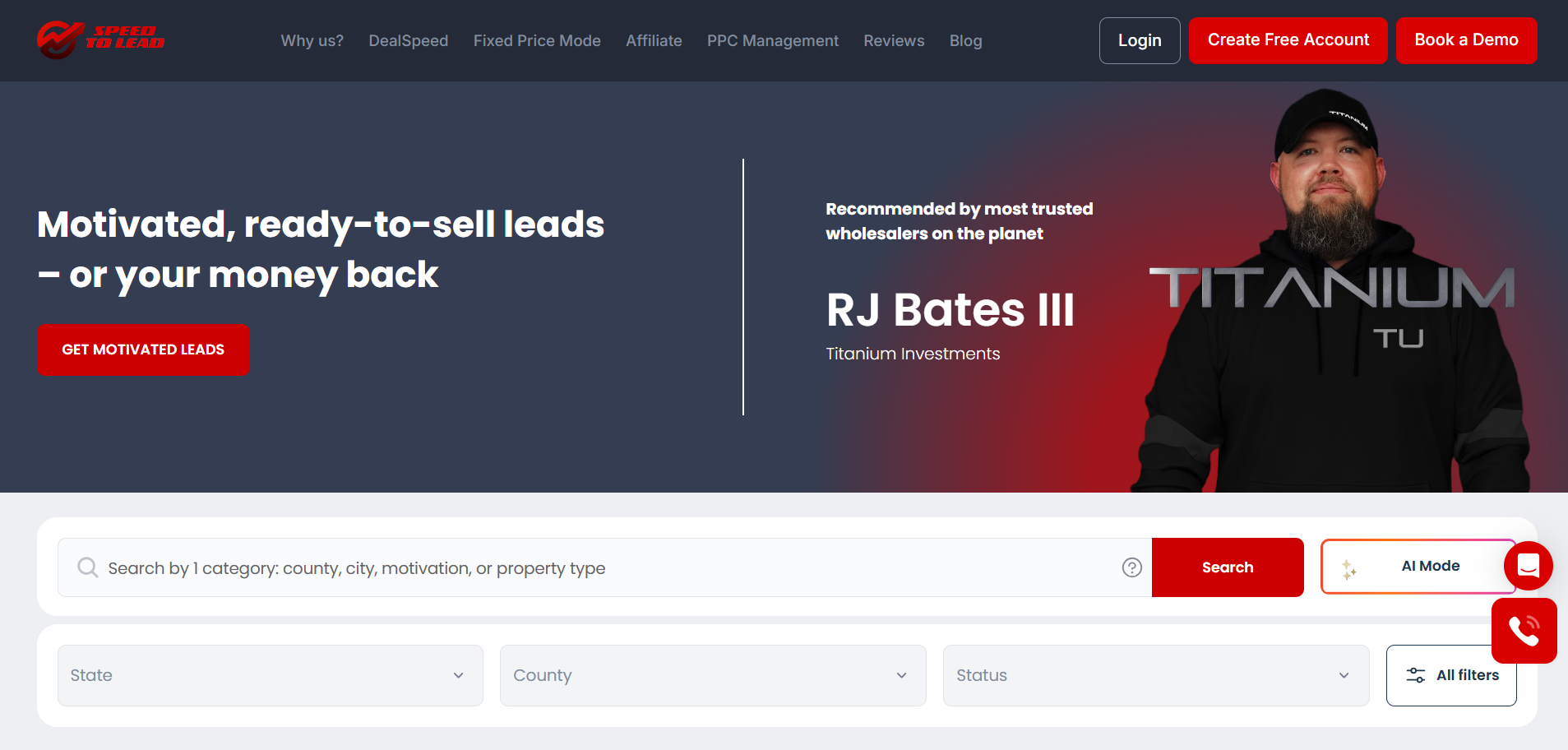
The best motivated seller lead marketplace is the one that does the filtering, scoring, and risk protection before you pay, and iSpeedToLead does all three.
Joey and Jacob Zawacki generated $48K in 90 days using AutoMatch to automate acquisition, and more success stories follow the same pattern.
Seven reasons, one pattern: the risk sits on the platform’s side of the purchase, not yours.
Getting started takes minutes.
The GET90 code exists so the first decision is cheap and the second one is informed.
iSpeedToLead is the real estate lead marketplace built around a single decision loop: preview the lead, then buy, pass, or refund. Buying beats generating when time, testing budget, or team is your constraint, and a marketplace only earns that trade when the filtering, scoring, and refund protection happen before you pay.
That’s the model 12,000+ investors use across 48 states.
Book a demo to see how the marketplace, DealPredictor, and AutoMatch would work in your target market.
Read Next:
Yes. iSpeedToLead is the best real estate lead marketplace for wholesalers in 2026 because every lead is verified against 50 billion data points, graded by DealPredictor before purchase, and covered by a 21-day refund window on Exclusive and Active tiers.
A real estate lead marketplace like iSpeedToLead verifies leads by cross-referencing contact details, addresses, and motivation signals against 50 billion data points, then removing roughly 40% of incoming leads before publication.
The difference between a lead marketplace and a territory-bidding pay-per-lead platform is where the purchase decision happens. A marketplace like iSpeedToLead lets you evaluate each lead before buying, while territory bidding commits your budget to a county or state and delivers whatever matches your bid.
Yes. You can buy real estate leads without a monthly contract or minimum on iSpeedToLead, paying only for the leads you select, with Affirm, Klarna, and Afterpay financing available on larger deposit packages.
Buying leads often costs less than generating them, because generation requires lists, skip tracing, staffing, and testing before the first real conversation. On iSpeedToLead, starting prices run from $39 for Sale leads to $199 for Exclusive leads, and GET90 takes 90% off your first one.
September 27, 2026
September 26, 2026

September 25, 2026

September 24, 2026
September 23, 2026

September 22, 2026

September 21, 2026
September 20, 2026

September 19, 2026
Select the type of leads you're interested in.

