Cost Per Motivated Seller Lead by Channel: Cold Calling, Direct Mail, SMS, PPC, Paid Social, and Marketplace
The advertised cost per motivated seller lead in 2026 spans roughly $15 on the low end for SMS to $400 or more for self-managed search ads, a gap of more than 25x.
Once labor, list, software, and follow-up costs are loaded in, the cost per signed contract on every channel compresses into a band between about $500 and $5,000, and the ranking of channels changes completely.
Most investors still choose channels by the sticker price of a lead. iSpeedToLead, a pay-per-lead marketplace serving more than 12,000 active investors across 48 states, sources leads through cold calling, PPC, paid social, and other channels, then tracks what each one costs to turn into a contract across 20,000+ closed deals.
This report combines that platform data with published 2026 benchmarks for all six major channels and works the math through to cost per contract, where the real comparison lives.
Cost per lead is easy to measure and almost impossible to compare across channels, because each channel defines “lead” differently. A cold call lead is a live conversation that passed a script; a direct mail lead is an inbound call from a postcard; a PPC lead is a form fill; a marketplace lead is a verified seller with a score attached.
Three cost layers sit outside the advertised number on most channels:
The last layer is the one that swings the math. iSpeedToLead’s own pipeline removes approximately 40% of incoming leads before publication because they’re unreachable, already under contract, listed with an agent, or below the motivation threshold. Any channel where you do that filtering yourself has a true cost per workable lead roughly 1.6x higher than its raw cost per response.
The number that survives all of this is cost per contract. As Jerry Norton of Flipping Mastery puts it:
“From an investment perspective, how often would you spend $4,500 to make $15,000 over and over again? In 2025, anytime you can be under $5,000 in cost per contract, you are way ahead of the game.”
— Jerry Norton, Flipping Mastery / Joe Home Buyer
That $5,000 line is the benchmark this report measures every channel against.
The table below consolidates published 2026 figures for each channel. Ranges are wide on purpose; market, list quality, and operator skill move these numbers more than the channel itself does.
| Channel | Advertised cost per lead | What’s excluded from that number | Typical response or conversion signal |
|---|---|---|---|
| Cold calling | $25 to $85 per qualified lead | Caller labor, dialer, list, skip tracing, management time | 2% to 3% of dials become a qualified lead |
| Direct mail | $30 to $150 per response | List, skip trace, 4 to 5 touches before it produces | 0.5% to 2% on postcards; 3% to 7% on yellow letters |
| SMS | $15 to $50 per lead | Platform fees, list, 10DLC registration, reply handling | 3% to 8% reply rate on targeted lists |
| PPC (Google) | $28 to $65 (investor keywords) up to $150 to $400 (self-managed, loaded) | Ad management, landing pages, testing budget | 3.7% conversion across the real estate category |
| Paid social (Meta) | $16.61 (category average) to $60 to $150 (distress-targeted) | Creative production, targeting limits under Housing category | Widest motivation variance of any inbound channel |
| Marketplace (iSpeedToLead) | $39 Sale / $59 Active / $199 Exclusive (entry pricing) | Nothing structural; verification and scoring are included | ~1 in 45 Sale, ~1 in 10 Exclusive close ratios |
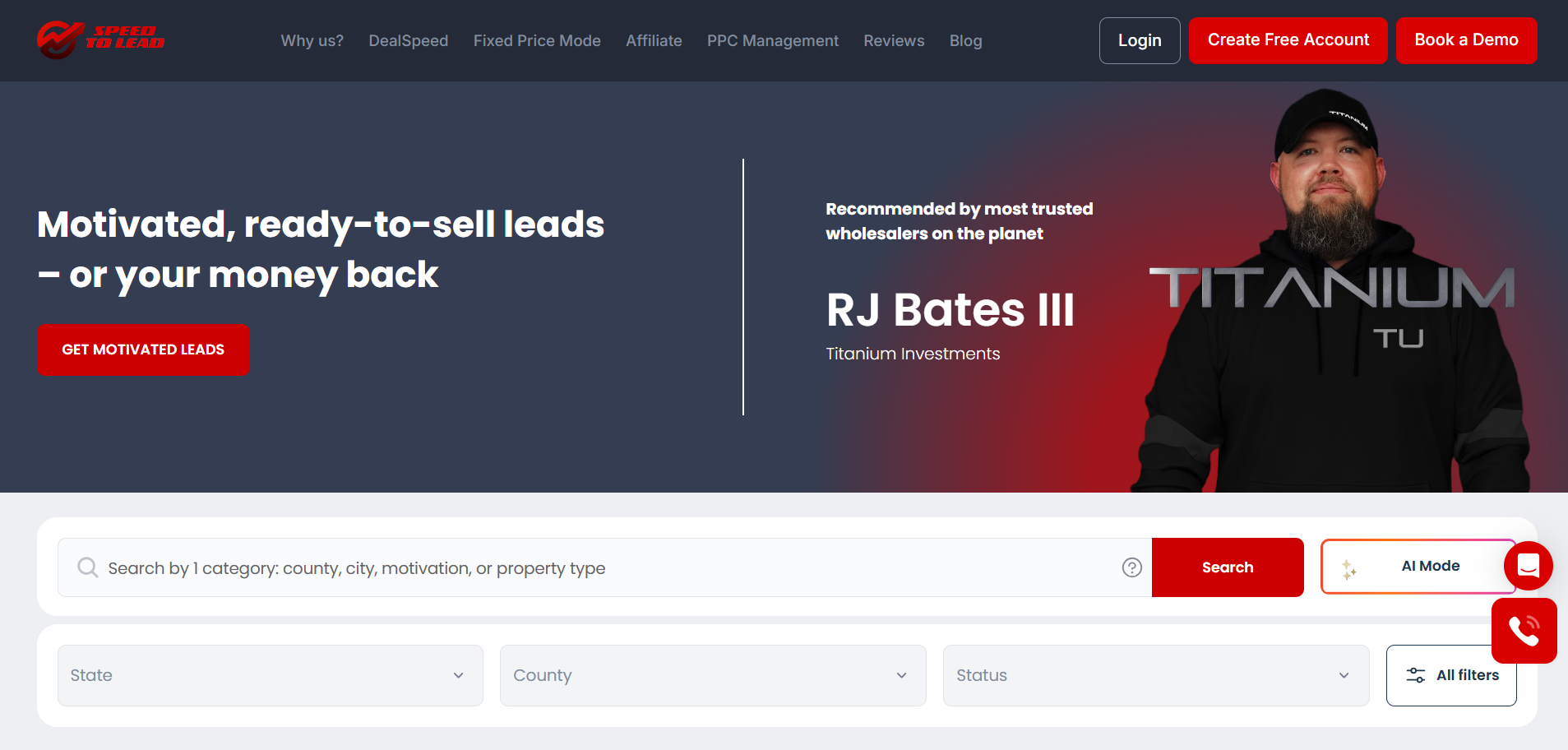
Every channel below gets its own section with sources. Marketplace pricing comes from iSpeedToLead’s Lead Marketplace; everything else is cited inline.
Cold calling produces some of the cheapest workable conversations in real estate, which is exactly why iSpeedToLead runs it as a sourcing channel. The cost problem isn’t the channel; it’s the operation wrapped around it.
Published 2026 pricing puts the pieces at:
Televista’s campaign data gives the clearest all-in picture: a solid monthly setup runs about $1,170 for dialer, caller, list, and management, producing roughly 1,200 contacts and 15 to 25 qualified leads. That’s $47 to $78 per qualified lead, and the same source lands cold calling’s cost per deal at $800 to $2,500.
The hidden variable is data quality. Raw skip-traced lists convert at just 0.5% to 2%, and teams using verified contact data see 340% better ROI than those calling raw skip-trace lists (Televista, April 2026). Cold calling works; unverified cold calling is what burns budgets.
Direct mail’s per-piece price is the most misleading number in this report. The mailer is cheap, but the list, the skip trace, and the four or five touches it takes before a motivated seller picks up the phone are not.
Current per-piece benchmarks:
Response rates in the investor niche sit well below the general average. Standard real estate postcards targeting motivated sellers typically see 0.5% to 2% response rates, while yellow letters and handwritten-style mail typically see 3% to 7% on motivated seller lists (REmail, April 2026). For context, the ANA/DMA 2025 report shows a 4.4% average response rate for direct mail across all industries.
Run the math on a 5,000-piece postcard drop at $0.80: $4,000 in mail cost at a 1% response is 50 calls, or $80 per response before any of them is qualified. That’s why REmail’s economics for investors show cost per lead at $30 to $150 and cost per closed deal at $500 to $2,000.
Direct mail rewards patience and repetition. It punishes anyone who mails once and judges the channel on week one.
Text outreach has the lowest advertised cost per lead of any channel because the message itself costs almost nothing. One 2026 setup lists $100 per month for the platform, $0.00125 per SMS segment with the first 10,000 included, and $30 per sending number, putting a 5,000-message campaign at roughly $6.25 in message fees (VA Horizon, March 2026).
Layer in the list and the reply handling, and published investor benchmarks land at $15 to $50 per lead, with the caveat that SMS works best as a follow-up channel rather than a primary source (REmail via Televista, June 2026). SMS response rates of 3% to 8% make texting one of the highest-ROI channels, and TCPA compliance is mandatory with consent-documented platforms only (LeadsuiteNow, June 2026).
The fragility comes from two places:
SMS is a strong second touch behind a purchased or cold-called lead. As a standalone acquisition channel, its true cost per contract depends almost entirely on who is answering the replies. iSpeedToLead’s AI Follow-Up System uses SMS this way, as one of four automated channels working leads that already passed verification, with targets above a 15% response rate.
Search is where a seller types “sell my house fast” and raises their own hand, so it produces the highest-intent inbound lead of any channel. It’s also where costs are rising fastest.
The 2026 category benchmarks from LocaliQ, based on nearly 900 real estate search campaigns running April 2025 through March 2026, show an average cost per click of $3.22, a conversion rate of 3.70%, and a cost per lead of $102.51, with real estate ads continuing to rank among the lowest-converting of any industry.
Those figures blend brokerages, apartments, and agents, so they overstate the investor picture. Separately, real estate was the industry with the biggest year-over-year CPC increase in WordStream’s 2026 report, up 27.27%.
Investor-specific campaigns behave differently:
The gap between $28 and $400 is the cost of expertise. A dialed-in campaign with negative keywords, call tracking, and a landing page that converts lives near the bottom of that range; a new advertiser learning on the job lives near the top. Jerry Norton’s field report on what that looks like in a hot market:
“In some markets like Phoenix, I was talking to Brent Daniels and he was telling me cost per contract is up to $12,000, maybe even higher.”
— Jerry Norton, Flipping Mastery / Joe Home Buyer
PPC is the channel most likely to produce a contract from the very first lead, and the channel most likely to blow past the $5,000 cost-per-contract line while you learn it.
Meta remains the cheapest scaled inbound channel and the one with the widest spread in seller motivation. LocaliQ’s 2025 Facebook benchmark placed real estate lead-ad CPL at $16.61, although Facebook and search benchmarks use different campaign objectives and should not be compared as equivalent lead types.
Investor campaigns targeting distress signals cost more and produce more usable leads: Facebook and Instagram ads using distress-signal audience targeting deliver leads at $60 to $150 each in most markets (LeadsuiteNow, June 2026). The ISTL benchmark report on lead costs puts the 2026 paid social average near $65 per lead, and it’s worth reading alongside this one for the full motivated seller lead cost benchmarks.
Two structural limits keep paid social from being a set-and-forget channel:
That qualification burden is why paid social leads benefit most from a scoring layer. iSpeedToLead sources from Facebook and Instagram and runs every one of those leads through DealPredictor AI scoring before an investor sees it, so the wide motivation spread gets sorted into grades instead of landing in your CRM unsorted.
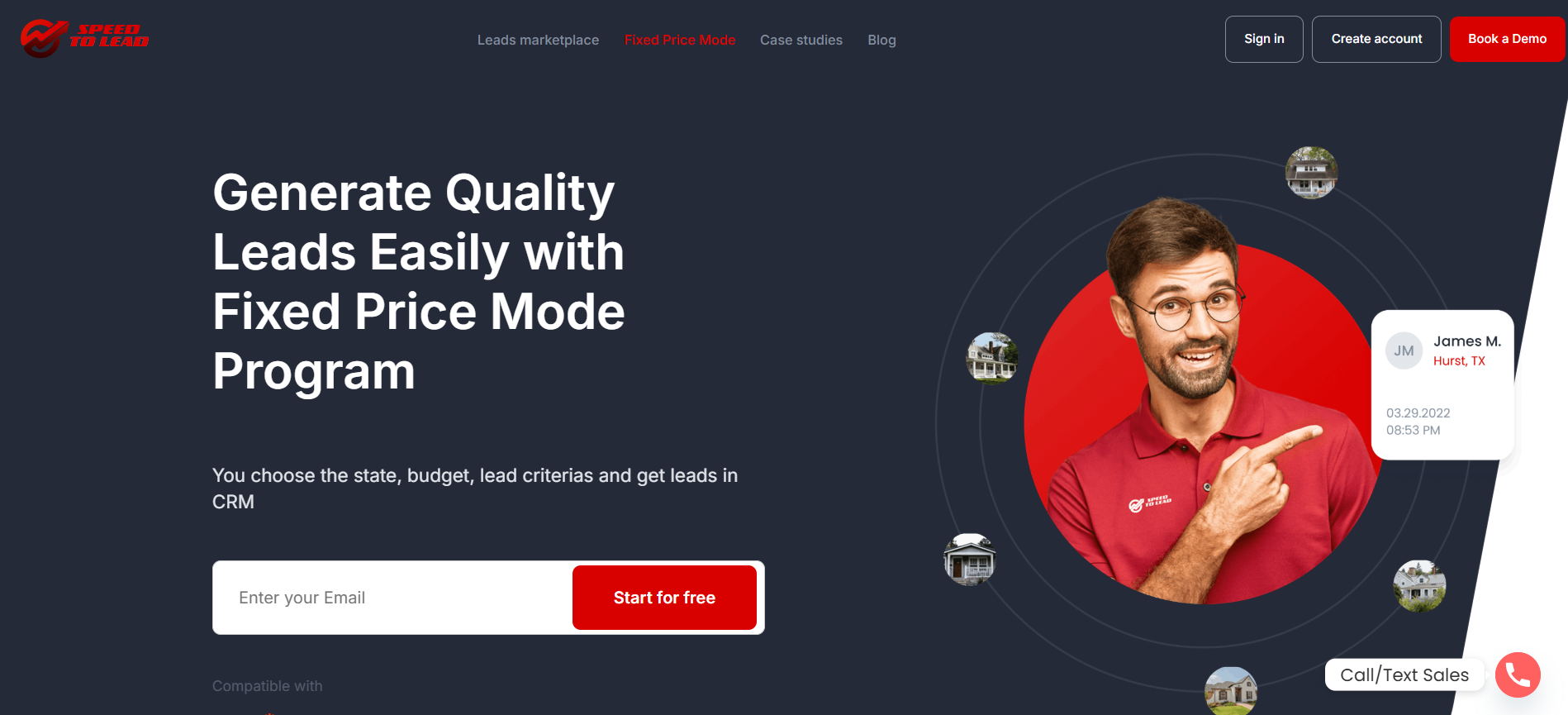
A pay-per-lead marketplace is the only channel in this report where the advertised price and the loaded price are the same number. Sourcing, verification, scoring, and the 40% pre-publication filter all happen before the price tag is set.
iSpeedToLead’s current tier pricing, from the best motivated seller lead marketplace for investors:
| Tier | Freshness | Exclusivity | Entry pricing | Standard pricing | Close ratio |
|---|---|---|---|---|---|
| Exclusive | 0 to 24 hours | One buyer only | From $199 | ~$325 | ~1 in 10 |
| Active | 24 to 48 hours | Limited buyers | From $59 | ~$250 | Most close within first 30 contacts |
| Sale | 48+ hours | Non-exclusive | From $39 | ~$150 | ~1 in 45 |
| Raw | Lowest verification | None | Lowest | ~$30 | Skill-dependent |
For an external benchmark, exclusive pay-per-lead providers publish prices from $300 per lead, while self-built lists cost $99 to $199 per month plus skip tracing (Rezora, July 2026). ISTL’s Exclusive tier sits inside that range at standard pricing and well under it at entry pricing.
What the price includes on every marketplace lead:
The platform delivers 153,000+ leads per year across 48 states to more than 12,000 active investors, and the top 19% of scored leads account for approximately 40% of confirmed wholesale outcomes. That concentration is the reason the score matters more than the tier: A+ leads close at roughly 4x the platform average, so a $325 A+ Exclusive can carry a lower cost per contract than a $39 C-grade Sale lead.
Jordan Budd of Joe Home Buyer Winston-Salem described the pricing shift plainly:
“I’ve never before been able to pay $29 for a lead, ever. They are typically at least a couple hundred dollars, sometimes up to four or five hundred. So you can actually get in that game without some of the huge spend.”
— Jordan Budd, Joe Home Buyer Winston-Salem
The marketplace is the only channel where the buyer sees the seller’s situation and the grade before spending a dollar, and can pass without cost.
Cost per lead ranks the channels one way. Cost per contract ranks them another. The table below uses each channel’s published cost per lead and published or implied conversion rate; the marketplace rows use iSpeedToLead’s documented close ratios.
| Channel | Cost per lead used | Conversion assumption | Cost per contract |
|---|---|---|---|
| Cold calling (managed) | $47 to $78 | Published cost-per-deal range | $800 to $2,500 (Televista) |
| Direct mail | $30 to $150 | Published cost-per-deal range | $500 to $2,000 (REmail) |
| SMS | $15 to $50 | Reply-to-contract highly operator-dependent | Vendor claims near $347 exist but exclude labor; treat as unverified |
| PPC (investor keywords, well-run) | $28 to $65 | 1 in 10 to 1 in 15 form fills | $280 to $975 |
| PPC (self-managed, loaded) | $150 to $400 | 1 in 10 to 1 in 15 form fills | $1,500 to $6,000 |
| Paid social (distress-targeted) | $60 to $150 | 1 in 15 to 1 in 25, given wider motivation spread | $900 to $3,750 |
| Marketplace Sale tier (entry) | $39 | ~1 in 45 | ~$1,755 |
| Marketplace Exclusive tier (entry) | $199 | ~1 in 10 | ~$1,990 |
| Marketplace Exclusive tier (standard) | $325 | ~1 in 10 | ~$3,250 |
The PPC and paid social conversion assumptions are illustrative and stated so you can substitute your own numbers. The marketplace rows are the platform’s tracked ratios, not estimates.
Three findings stand out:
Misty Arellano’s numbers show what the marketplace math looks like in practice. She split-tested iSpeedToLead against two other pay-per-lead vendors, spent under $2,000 on the platform, and landed three contracts, two of them novations that went on to be listed on MLS. That’s under $700 per contract, well inside the $5,000 line, with a scoring and refund layer the other two vendors didn’t provide.
Devin Anderson’s case runs the same direction on a smaller budget: 40 member-priced leads, $1,200 spent, two deals closed, and $10,000 in revenue. His cost per contract came in at $600.
The channel decision is a decision about which cost you want to carry: labor, expertise, or price per lead. Each of the six channels trades those three against each other differently.
A practical allocation framework:
Whatever you run, route everything into one CRM. Leads from iSpeedToLead land in MyCRM with their score, source, and call strategy attached, and closed contracts move to DealSpeed for disposition across 6 million+ buyers and 200,000+ agents. Median time from lead purchase to close on the platform is approximately 73 days, which means a channel test needs at least one full quarter before the cost-per-contract number is real.
To benchmark the marketplace against your current channel without committing budget, new members can enter the code GET90 on the checkout payment page for 90% off their first lead. Buy one scored lead, work it, and compare the loaded cost against what your last contract actually cost you.
Cost per motivated seller lead is a starting point, not a decision. Once labor, data, and qualification waste are counted, every major channel in 2026 lands within a few thousand dollars of each other per contract, and the channels that look cheapest on the sticker are the ones that quietly charge you in hours.
iSpeedToLead is the only channel in this report where the price you see is the price you pay, with verification, a DealPredictor grade built on 20,000+ closed deals, and a 21-day refund policy already inside the number. That’s what makes its cost per contract a figure you can plan around: roughly $1,755 at the Sale tier and $1,990 at the Exclusive tier, before a single dial.
Book a demo to see how the marketplace’s cost per contract compares to your current channel in your target market.
Read Next:
The cost per motivated seller lead by channel in 2026 ranges from about $15 to $50 for SMS, $25 to $85 for cold calling, $30 to $150 for direct mail, $16.61 to $150 for paid social, $28 to $400 for PPC, and $39 to $325 for marketplace leads on iSpeedToLead. The wide ranges reflect how much labor and data cost sits outside the advertised number on most channels.
Cost per contract is calculated by dividing the loaded cost per lead by the share of leads that convert to a signed contract, so a $39 Sale lead closing at roughly 1 in 45 produces a cost per contract near $1,755. Loaded cost should include labor, lists, software, and the roughly 40% of raw responses that never become workable sellers.
Yes, a marketplace is cheaper than cold calling for motivated seller leads once labor is counted, because managed cold calling costs about $1,170 per month for 15 to 25 qualified leads while marketplace leads on iSpeedToLead start at $39 with verification and scoring included. Cold calling remains a strong sourcing channel, which is why iSpeedToLead runs it internally and publishes the resulting leads with a DealPredictor grade.
Yes, you can test the marketplace cost per lead before switching channels by entering the code GET90 on the checkout payment page for 90% off your first lead on iSpeedToLead. Working one scored lead through to outcome gives you a direct comparison against your current channel’s loaded cost per contract.
The data in this report came from published 2026 benchmarks including LocaliQ and WordStream search advertising reports, the ANA/DMA response rate report, REmail, DirectMail.io, CallingAgency, Televista, and VA Horizon, alongside iSpeedToLead’s own platform data of 20,000+ closed deals, 74,000+ tracked leads, and 19 months of outcome tracking. Conversion assumptions for PPC and paid social cost per contract are illustrative and labeled as such.
September 6, 2026
September 5, 2026
September 4, 2026

September 3, 2026
September 2, 2026

September 1, 2026
August 31, 2026
August 30, 2026
August 29, 2026
Select the type of leads you're interested in.

