AI Lead Scoring vs Predictive Seller Analytics: Two Different Things
AI lead scoring is the process of ranking real seller inquiries by their likelihood of turning into a closed deal, using outcome data from deals that actually closed.
iSpeedToLead built DealPredictor on exactly that principle, training it on 20,000+ closed deals and 74,000+ tracked leads across 19 months of platform outcomes.
Predictive seller analytics is something else entirely: a model that guesses which homeowners in a market might list or sell at some point, before anyone has spoken to them.
This article breaks down what each system actually does, where investors confuse the two, and how to tell which one belongs in your acquisition stack in 2026.
AI lead scoring only exists after a seller has raised their hand. Someone filled out a form, answered a call, or replied to an outreach message, and the model’s job is to rank that specific conversation against thousands of prior conversations that either became contracts or didn’t.
DealPredictor assigns every published lead a grade from A+ down to C, and the grade is visible before you spend a dollar. It weighs:
The concentration effect in the data is the part investors should care about. The top 19% of scored leads account for roughly 40% of confirmed wholesale outcomes, and A+ leads close at about 4× the platform average, with A-grade leads at roughly 2×.
That is not a prediction about houses. It is a prediction about people who are already talking.
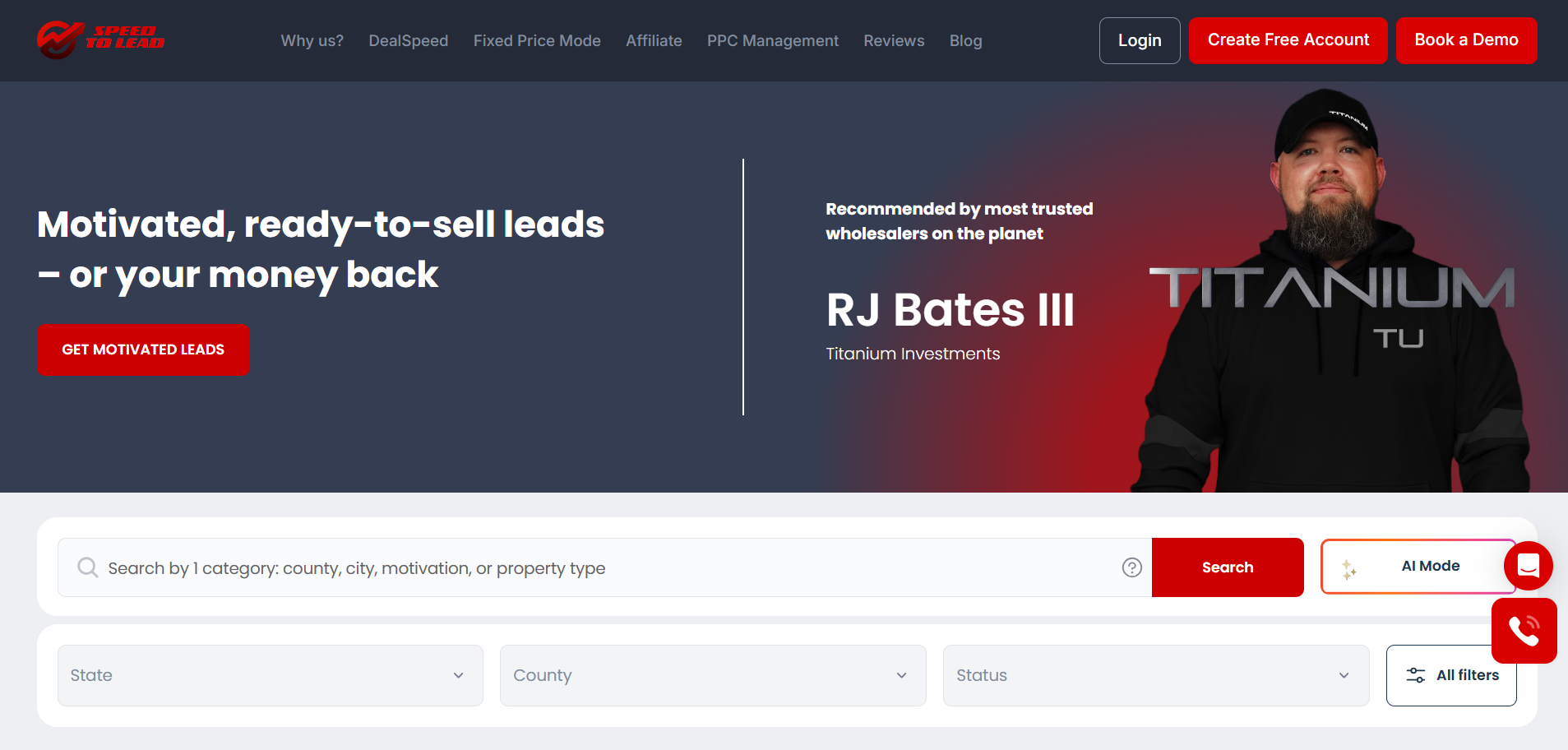
“I scrolled past seven, eight leads, nope, not that, not that, that one, that’s the one. It’s a location I’ve got a great buyer relationship, highly motivated, physically distressed, he’s willing to sell at a discount, we got him down 10,000 and we’re 22 minutes in and we got it.”
— RJ Bates III, Titanium Investments
Scoring compresses judgment. It does not manufacture motivation.
Predictive seller analytics works in the opposite direction. It starts with a database of every property in a market and estimates which owners are statistically likely to sell, based on public records and modeled attributes.
The inputs are almost entirely property-level:
Platforms in this category do something genuinely useful. Tools like PropStream and BatchLeads are strong list-building and data enrichment engines, and for investors running their own outbound operation, that filtering layer meaningfully improves list quality over pulling a raw county list.
But the output is a name and an address, not a conversation. Everything expensive still sits downstream: skip tracing, dialing, qualifying, follow-up, and the team required to run all of it.
Both systems use machine learning. Both output a ranked list. That surface similarity is why investors buy one expecting the other.
Predictive analytics answers “which property might transact.” AI lead scoring answers “which seller situation is likely to become a discounted contract.”
The 20,000-deal dataset behind DealPredictor points to five circumstance categories that actually drive closings: financial pressure, life events, property condition, landlord fatigue, and timeline urgency. Property condition is the instructive one, because it only converts when it appears alongside another trigger.
A distressed roof on a paid-off house owned by someone with no reason to move is not a deal. It is a photo.
Predictive models score cold. They have no conversation to read, no stated timeline, no answer to “why are you thinking about selling.”
Every lead in the live lead marketplace has already been through triple verification against 50 billion data points, with 97.5% carrying verified addresses and 85%+ matching public property records. Roughly 40% of incoming leads are removed before publication for being unreachable, already under contract, listed with an agent, or below the motivation threshold.
Scoring what survived that filter is a fundamentally different math problem than scoring a county file.
Here’s the practical version. Predictive analytics reduces how many doors you knock on. AI lead scoring reduces how many conversations you waste.
| Predictive seller analytics | AI lead scoring | |
|---|---|---|
| Input | Public property records | Verified seller inquiry |
| Output | Target list | Ranked purchase decision |
| Timing | Before contact | Before you dial |
| What it optimizes | List quality | Time allocation |
| Cost that follows | Skip tracing, dialing, staffing | The lead price only |
Raw skip-traced cold calling converts in the 0.5% to 2% range as an industry baseline. A better list moves that number. It does not remove the call center behind it.
The common mistake is paying for probability twice: buying a predictive list, then buying leads, and treating both as the same line item on the marketing budget.
They aren’t. A list is an input to a lead generation operation you still have to run. A scored lead is the finished output of someone else’s operation.
Jerry Norton frames the underlying point well.
“Our job isn’t to create motivation, it’s to uncover motivation.”
— Jerry Norton, Flipping Mastery
Predictive analytics guesses where motivation might exist. Scoring measures motivation that has already surfaced. If you have a dialing team and a tolerance for volume, the first is worth funding. If you have limited hours and want your next three calls to matter, the second is where the leverage is.
Most solo operators and small teams pick wrong, fund a list-building stack, and then discover the real cost was never the data.
Scoring is only as good as the outcome data behind it and the inventory it sits on top of. Here’s what separates the best motivated seller lead marketplace from a model bolted onto public records.
Results follow the prioritization. Misty Arellano spent under $2,000 and landed three contracts, two of them novations listed on MLS. Dallas Turley closed $60K across four deals, and Joey and Jacob Zawacki generated $48K in 90 days.
None of that requires you to become a data platform operator first.
You can test scored inventory against whatever list-based system you’re running now, without a contract or a monthly minimum.
Then track your own close rate by grade. That’s the only benchmark that settles the argument for your market.
AI lead scoring and predictive seller analytics solve different problems, and the difference is not academic. One narrows a list you still have to work. The other ranks conversations that already exist, using outcomes from deals that actually closed.
iSpeedToLead runs the second model across 48 states for more than 12,000 active investors, with scoring, verification, built-in CRM workflow, and DealSpeed disposition access sitting in one place. Median time from lead purchase to close sits around 73 days, which is a pipeline you can plan a quarter around.
Book a demo to see how DealPredictor scores live inventory in your target market.
Read Next:
The difference between AI lead scoring and predictive seller analytics is what each one evaluates: lead scoring ranks real seller inquiries by likelihood to close, while predictive analytics estimates which properties might transact before any contact happens. One prioritizes conversations, the other builds lists.
iSpeedToLead’s DealPredictor scores leads by grading each verified inquiry from A+ to C using seller motivation, timeline urgency, property distress, ownership context, and geographic signals. It was trained on 20,000+ closed deals and 74,000+ tracked leads over 19 months.
Yes, AI lead scoring is better than buying a predictive seller list for investors who don’t want to run their own call center, because a scored lead arrives verified and ready to contact, while a predictive list still requires skip tracing, dialing, and qualification.
Yes, you can use DealPredictor scores to automate lead buying through AutoMatch or Fixed Price Mode, where you set score thresholds, geography, and a monthly budget, and matching leads are delivered into MyCRM automatically. AutoMatch buyers convert at roughly 3× the rate of standard shared lead buyers.
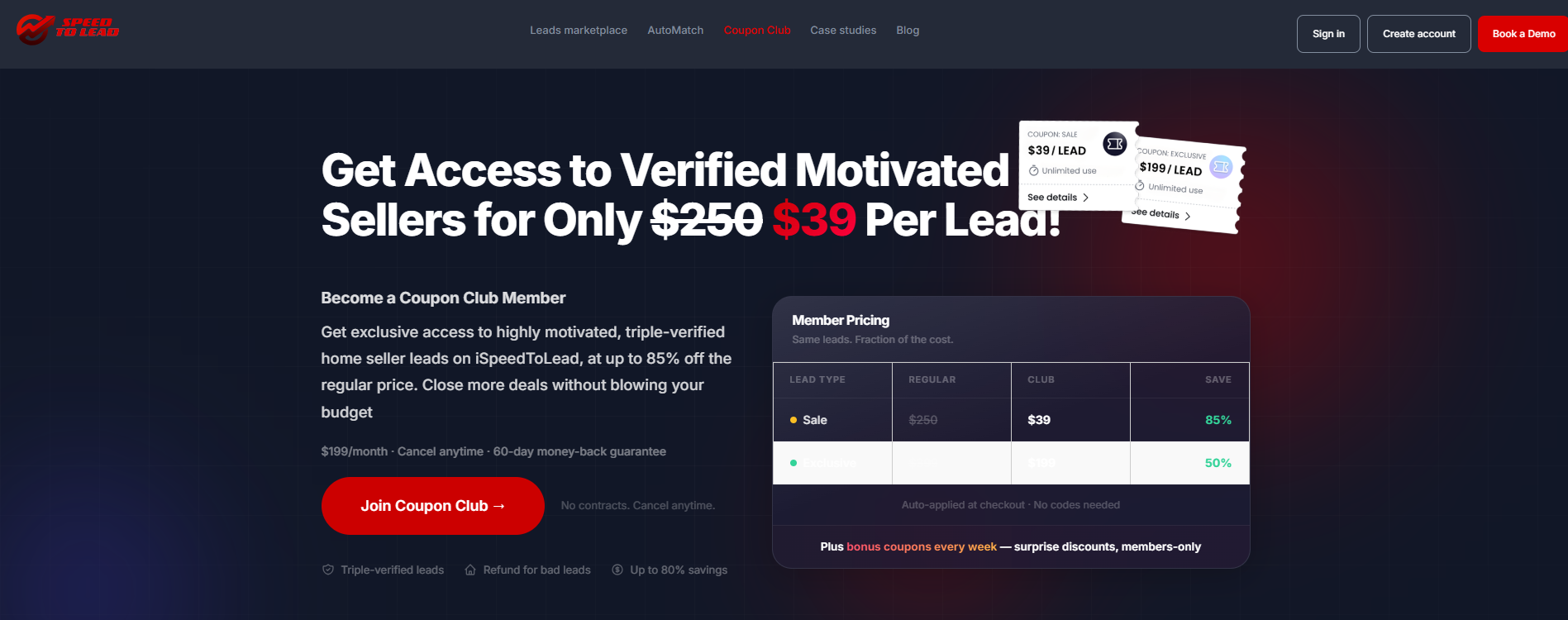
AI-scored motivated seller leads on iSpeedToLead start from $199 for Exclusive leads, $59 for Active leads, and $39 for Sale leads, with member discounts available. New members can apply GET90 at checkout for 90% off their first lead.

October 19, 2026
October 15, 2026
October 14, 2026
October 12, 2026

October 10, 2026
October 9, 2026
October 8, 2026
October 7, 2026

October 6, 2026
Select the type of leads you're interested in.

