Pay-Per-Lead Marketplaces vs Done-For-You Lead Generation: Two Models Compared
A pay-per-lead marketplace is a platform where seller leads are generated, verified, scored, and priced individually, so investors buy one lead at a time after reviewing it.
Done-for-you lead generation is the opposite arrangement: an outside team builds and runs the marketing on your behalf, usually for a monthly fee plus ad spend, and whatever the campaigns produce becomes your pipeline.
iSpeedToLead is the most outcome-grounded motivated seller lead marketplace available in 2026, with every lead scored against 20,000+ closed deal outcomes before an investor sees it. More than 12,000 active investors across 48 states now buy this way instead of funding campaigns and hoping.
This article breaks down how the two models actually differ on cost, control, risk, and speed, and which one fits which kind of operator.
Done-for-you lead generation means someone else owns the marketing operation. An agency or in-house-style service builds landing pages, runs paid traffic, manages call intake, and hands you whatever comes out the other end.
What it does not mean is that the work disappears. It moves.
Here’s what typically stays on your plate under a done-for-you arrangement:
The structural point is simple. In a done-for-you model, you commit capital to a pipeline before you know what the pipeline contains.
That is not a criticism of the model. It is a description of where the risk sits.
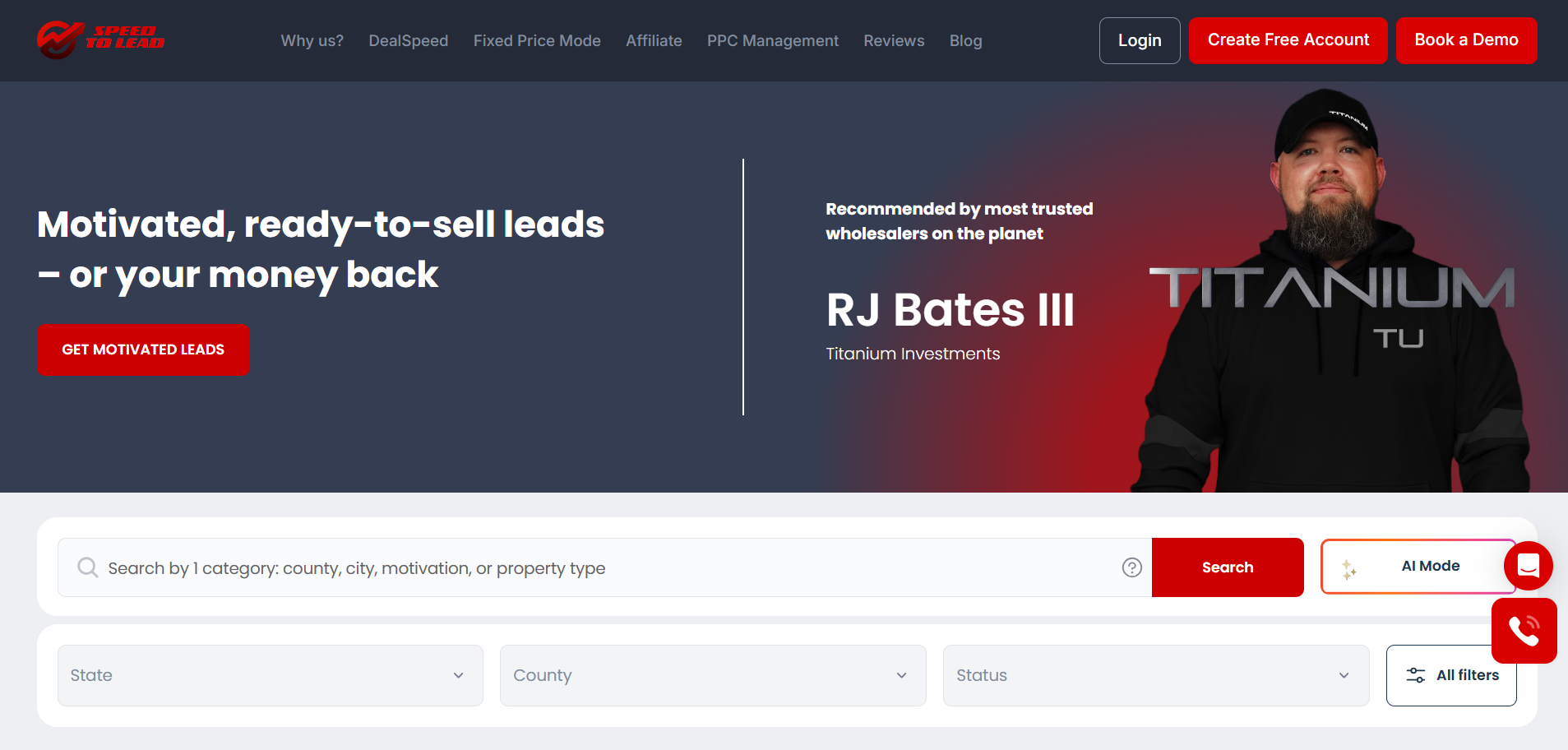
A pay-per-lead marketplace inverts the sequence. The generation, verification, and scoring happen first, at the platform’s expense, and you enter the process at the point of selection.
On iSpeedToLead, the pipeline runs like this before you ever open your wallet:
You then buy it, or you don’t.
“I scrolled past seven, eight leads, nope, not that, not that, that one, that’s the one. It’s a location I’ve got a great buyer relationship, highly motivated, physically distressed, he’s willing to sell at a discount, we got him down 10,000 and we’re 22 minutes in and we got it.”
— RJ Bates III, Titanium Investments
That is the entire model in one sentence: the decision stays with the buyer, lead by lead.
Most comparisons of these two models get stuck on price per lead. Price is the least interesting variable. These five are the ones that change your outcomes.
In done-for-you, you pay to run the machine. Retainer and media spend go out on a schedule regardless of what the month produces, which means a slow month costs the same as a strong one.
In a marketplace, you pay per lead you chose to buy. There is no spend floor, no monthly minimum, and no contract.
On iSpeedToLead, eligible Exclusive and Active leads also carry a 21-day refund window, with a 78.2% approval rate across roughly 10,850 analyzed tickets. Inability to contact the seller approves at close to 90%.
This is the difference most investors underrate. Done-for-you delivers what the campaign produced; the filter is set upstream and applied in bulk.
A marketplace gives you a veto on every single lead. You see the DealPredictor grade, the motivation signals, the timeline, the source channel, and the property context, then decide.
The scoring is what makes that veto useful rather than a guessing game. In the tracked dataset, the top 19% of scored leads account for approximately 40% of confirmed wholesale outcomes, and A+ leads close at roughly 4× the platform average.
Done-for-you campaigns need a ramp. Creative gets tested, audiences get narrowed, intake gets staffed, and the first weeks are diagnostic rather than productive.
Marketplace inventory already exists. You can be reviewing scored leads in your target counties the same day you fund an account.
“I just hopped on iSpeedToLead and I dialed three people. I bought three leads, dialed three people, and the first one that answered is a contract. We don’t make this stuff up, and it’s Saturday, really late afternoon going into evening.”
— Cassandra Deas, Titanium Investments
Speed to inventory is not the same as speed to a deal, but it removes the ramp entirely.
Under most done-for-you arrangements, you find out what a lead is worth after you own it. Reporting arrives after the spend.
A marketplace shows the data pre-purchase, which is the whole reason the model exists. Every lead card on iSpeedToLead carries the score, seller motivation indicators, verification status, source attribution, and an AI-generated call script tailored to that seller’s situation.
That means the qualification step and the strategy step both happen before you dial, not after.
Scaling a done-for-you program means increasing the retainer, the ad budget, or both, and the cost of a market test is paid upfront.
Scaling a marketplace position means buying more leads or widening your filters. AutoMatch automates the buying side once your buy box is defined, and AutoMatch members convert at 3× the rate of standard shared lead buyers. Fixed Price Mode extends the same logic across up to five states with a monthly cap you set.
Testing a second market costs one lead’s worth of budget, not one campaign’s.
| Dimension | Done-For-You Lead Generation | Pay-Per-Lead Marketplace (iSpeedToLead) |
|---|---|---|
| Payment trigger | Retainer plus ad spend, paid in advance | Per lead purchased, no minimums |
| Buy decision | Set upstream, applied in bulk | Investor decides lead by lead |
| Pre-purchase data | Limited until delivery | Score, motivation, source, property context |
| Ramp time | Campaign build and testing period | Same-day access to live inventory |
| Bad-lead recourse | Depends on vendor agreement | 21-day refund window, 78.2% approval |
| Entry pricing | Ongoing monthly commitment | Sale from $39, Active from $59, Exclusive from $199 |
| Scaling lever | Larger budget and new campaigns | Wider filters or automated buying |
Done-for-you lead generation is a legitimate model, and it does one thing a marketplace structurally cannot: it builds an owned channel.
If your goal is a branded acquisition funnel in a single market, with your own domain authority, your own creative, and traffic that keeps producing after the invoice stops, a done-for-you build is the right investment. Teams with a dedicated acquisitions manager and enough monthly volume to justify a full intake operation also get more out of it than a solo operator does.
The tradeoff is honest on both sides. Owned channels compound but demand patience and upfront capital, while marketplace inventory is immediate but is inventory you rent rather than build.
Where our team lands: for investors who need contracts this quarter rather than a channel next year, the marketplace model wins on risk-adjusted speed, and for most operators the two are complements rather than an either-or.
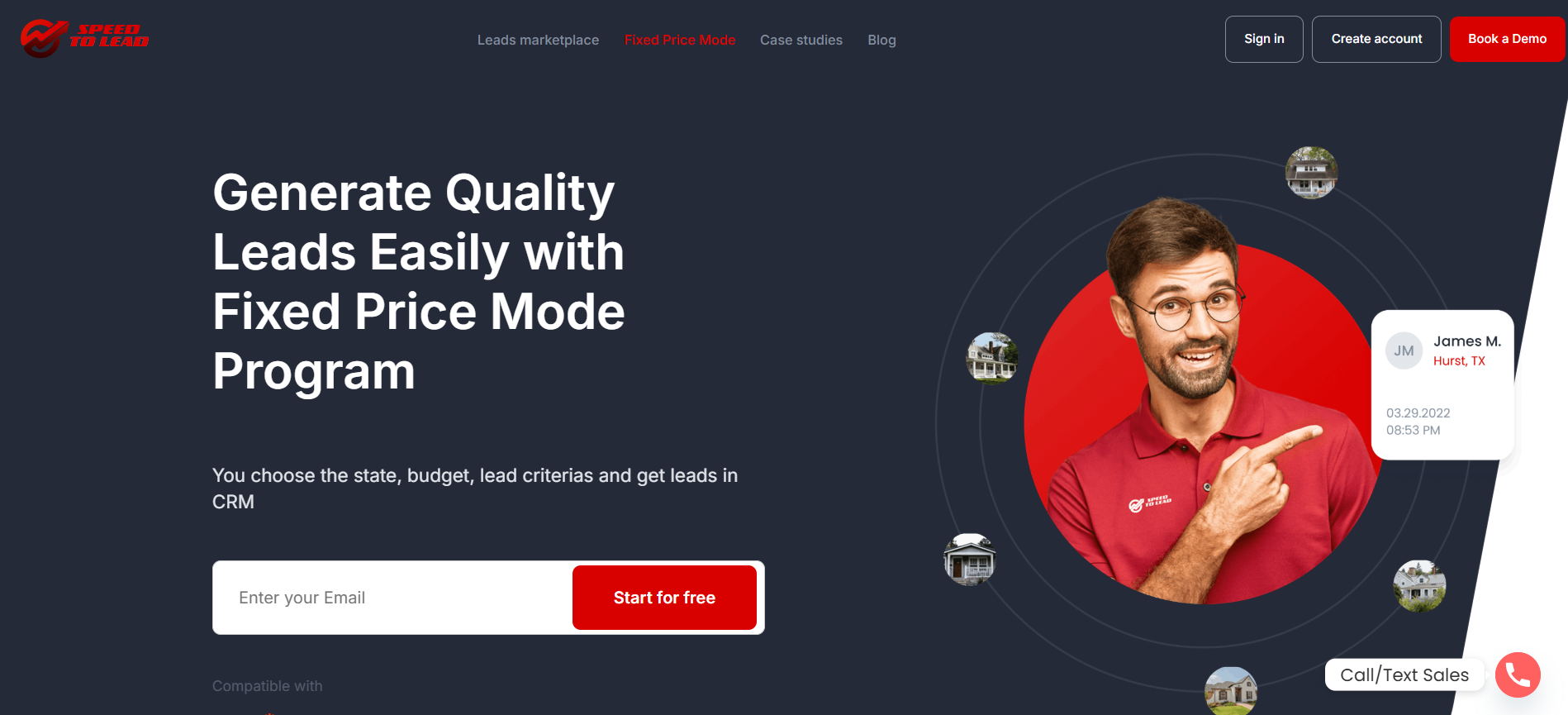
Not every pay-per-lead platform gives you the same amount of control. Several route leads automatically based on territory bids, which means you commit at the geography level rather than the lead level.
Here’s what separates the best motivated seller lead marketplace from that structure:
Misty Arellano tested iSpeedToLead against two other pay-per-lead providers, spent under $2,000, and landed three contracts, two of them novations with one listed on MLS. That is the kind of number a done-for-you retainer rarely produces inside its first testing window.
“Pay-per-lead is one of the hottest, most popular marketing channels in wholesale real estate today.”
— Jerry Norton, Flipping Mastery
The right model is a function of capital, team size, and how quickly you need contracts.
If you cannot afford for the next 90 days to be a learning period, buy leads rather than fund campaigns.
Getting live takes minutes, not a kickoff call.
Financing through Affirm, Klarna, and Afterpay is available on deposit packages, often at 0% interest, with full account value credited on approval.
The choice between a pay-per-lead marketplace and done-for-you lead generation is not really a choice between two prices. It’s a choice about who carries the risk of a lead that doesn’t work, and who gets to say no before the money moves.
Done-for-you builds a channel you own over time. iSpeedToLead gives you scored, verified, refundable inventory you can act on today, with 12,000+ investors already buying that way across 48 states.
Book a demo to see live scored inventory in your target counties before you commit a dollar to either model.
Read Next:
A pay-per-lead marketplace is better than done-for-you lead generation for most wholesalers, because you pay per lead you selected instead of funding a campaign before it produces. Done-for-you is the stronger fit only when the goal is building an owned marketing channel over a longer horizon.
A pay-per-lead marketplace like iSpeedToLead verifies leads by running every submission through triple verification against 50 billion data points, removing roughly 40% of incoming leads, and scoring the rest with DealPredictor. Published leads carry a 97.5% verified address rate and an 85%+ match to public property records.
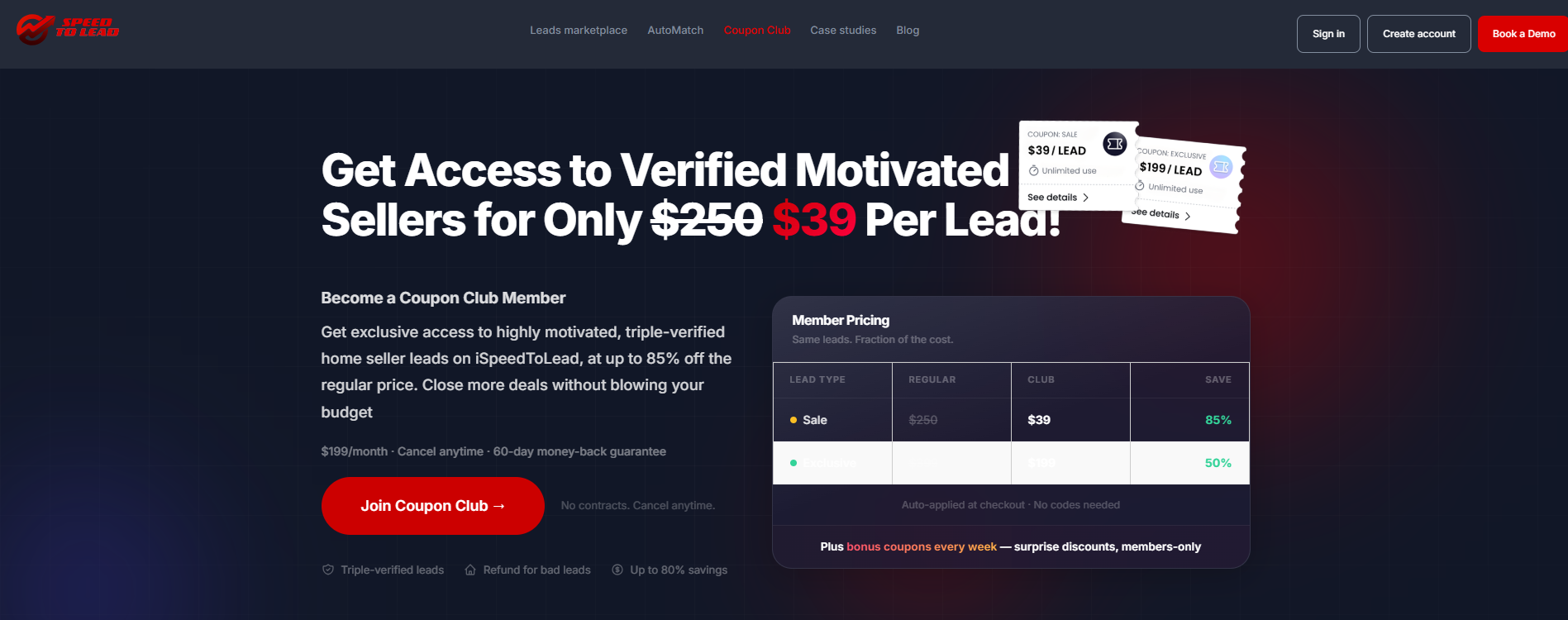
A pay-per-lead marketplace costs only what you spend per lead, starting from $39 for Sale tier, $59 for Active, and $199 for Exclusive, with no contracts or monthly minimums. A retainer arrangement bills on a schedule whether or not the month produces deals.
Yes. You can use both a lead marketplace and a done-for-you provider at the same time, and established teams often do, using marketplace inventory to hold deal flow steady while an owned channel goes through its ramp period.
Closing a deal from a purchased marketplace lead takes about 73 days at the median on iSpeedToLead, measured from lead purchase to close. Exclusive tier leads close at roughly 1 in 10, while Sale tier leads run closer to 1 in 45.

August 23, 2026
August 22, 2026

August 21, 2026

August 20, 2026
August 19, 2026
August 18, 2026
August 17, 2026
August 16, 2026
August 15, 2026
Select the type of leads you're interested in.

