How Ping Post Works: The Two-Stage Auction Behind Every Lead Marketplace
Ping post is a two-stage lead distribution method where a lead source first sends buyers a stripped-down, anonymized version of a lead, collects instant bids on it, then delivers the full contact record only to the winner.
iSpeedToLead is built on the opposite principle, where an investor sees the lead’s property data, motivation signals, and AI score before any money moves.
The distinction matters more than most investors realize, because in a ping post auction the thing you are bidding on is a profile, not a person.
This article breaks down how ping post works stage by stage, what the model does well, where it leaves buyers guessing, and how a preview-first marketplace changes the economics of buying motivated seller leads.
Ping post came out of the insurance, mortgage, and home services lead industries, where a single consumer form fill can be worth wildly different amounts to different buyers. The model exists to solve a real timing problem: a lead loses value by the minute, so the sale has to happen in the seconds between the form submission and the first phone call.
It solves three problems for the lead seller at once:
For buyers, the appeal is that acquisition becomes a set-and-forget system. You define your filters once, connect your endpoint, and leads arrive without anyone on your team touching a dashboard.
Ping post works by splitting a single transaction into two separate technical events, roughly a second apart. The first event asks buyers whether they want the lead. The second event delivers it to whoever said yes at the highest price.
The ping is a partial record broadcast simultaneously to every buyer connected to the source. It deliberately contains enough information to price the lead and not enough to contact the seller.
A typical real estate ping includes:
What it excludes is the part that matters most: the seller’s name, phone number, exact address, and the actual texture of the conversation. Each buyer’s system evaluates the ping against stored filters and returns an accept or decline plus a bid, usually within a few hundred milliseconds.
The post is the delivery event. The auction logic ranks the accepted bids, picks a winner based on price and any tier rules the source has set, and posts the complete record straight into that buyer’s CRM or dialer.
Everyone else receives nothing and pays nothing, which is why the model feels low risk on the surface. In many systems the record does not stop there. If the top buyer’s endpoint errors out or rejects the post, the lead cascades down what the industry calls a ping tree, and depending on the source’s rules it may be posted to a second and third buyer as a shared lead rather than an exclusive one.
The whole cycle looks like this:
Steps two through four typically happen faster than a page refresh. That speed is the model’s greatest strength and the source of its central trade-off.
Ping post deserves credit for what it solved. Before it existed, lead buying meant batch files, next-day delivery, and no way to decline inventory that did not fit.
The model genuinely delivers on:
For high-volume operations with a staffed call center and a wide buy box, that combination is hard to beat. The question is whether it fits an investor who cares about which specific seller they end up talking to.
The structural limitation of ping post is that the buying decision happens before the buyer can see what they are buying. You are committing to a category, then discovering the actual lead after the money is spent.
That produces four recurring frustrations:
Jerry Norton frames the underlying job clearly:
“Our job isn’t to create motivation, it’s to uncover motivation.”
— Jerry Norton, Flipping Mastery
Uncovering motivation is far easier when you can read the motivation signals before you pay for the phone number.
iSpeedToLead’s marketplace reverses the sequence. The lead is sourced, verified, and scored first, then published so investors can evaluate it and choose, which turns the purchase into a selection decision rather than a bet on a profile.
Before a lead is ever published, it passes through three layers:
That score is not a marketing badge. DealPredictor was trained on 20,000+ closed deals and 74,000+ tracked leads across 19 months of outcome data, and the top 19% of scored leads account for approximately 40% of confirmed wholesale outcomes. A+ leads close at roughly 4× the platform average, and A-grade leads at roughly 2×.
The result is a lead card you can actually read before deciding, which is exactly how experienced buyers use it:
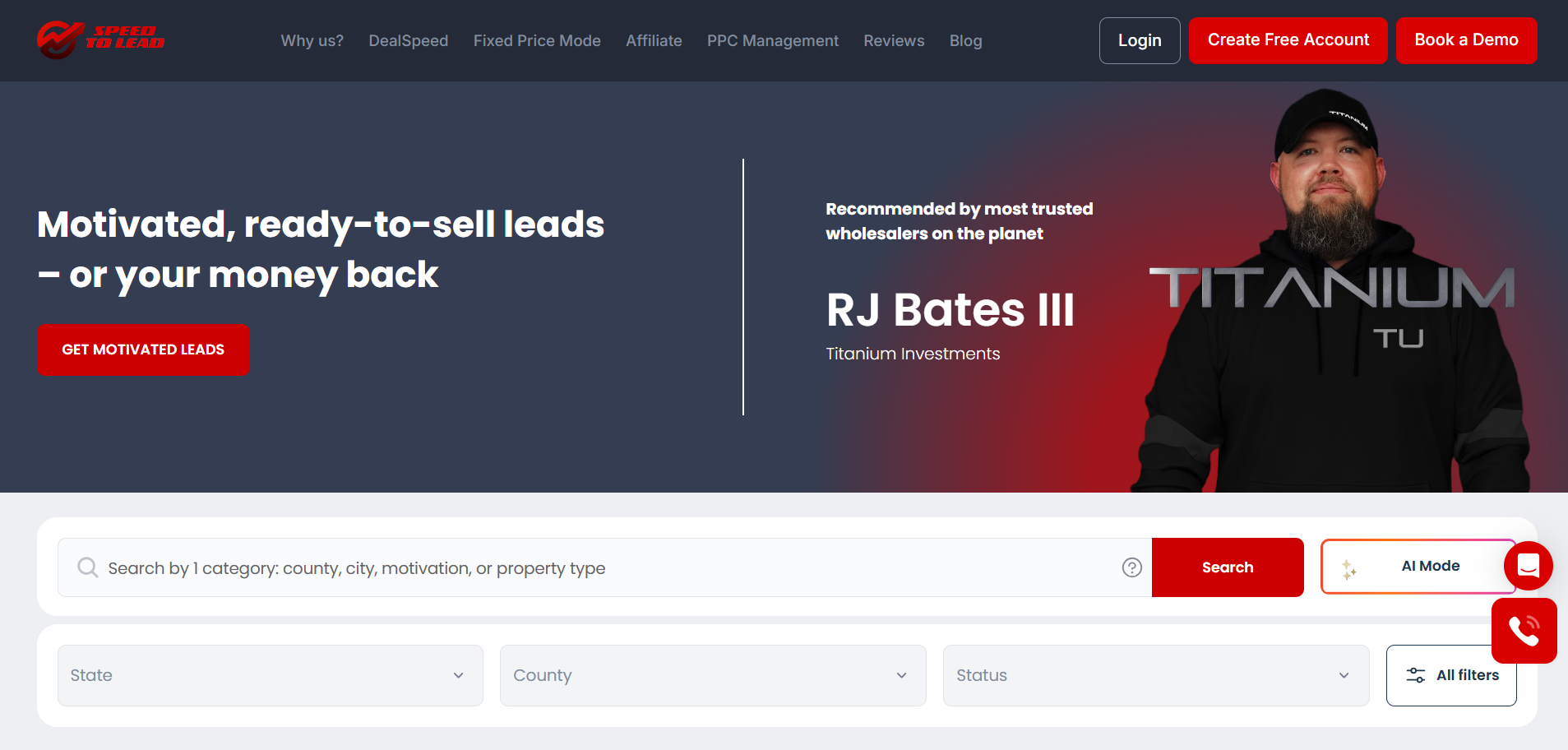
“I scrolled past seven, eight leads, nope, not that, not that, that one, that’s the one. It’s a location I’ve got a great buyer relationship, highly motivated, physically distressed, he’s willing to sell at a discount, we got him down 10,000 and we’re 22 minutes in and we got it.”
— RJ Bates III, Titanium Investments
Pricing follows freshness rather than auction heat:
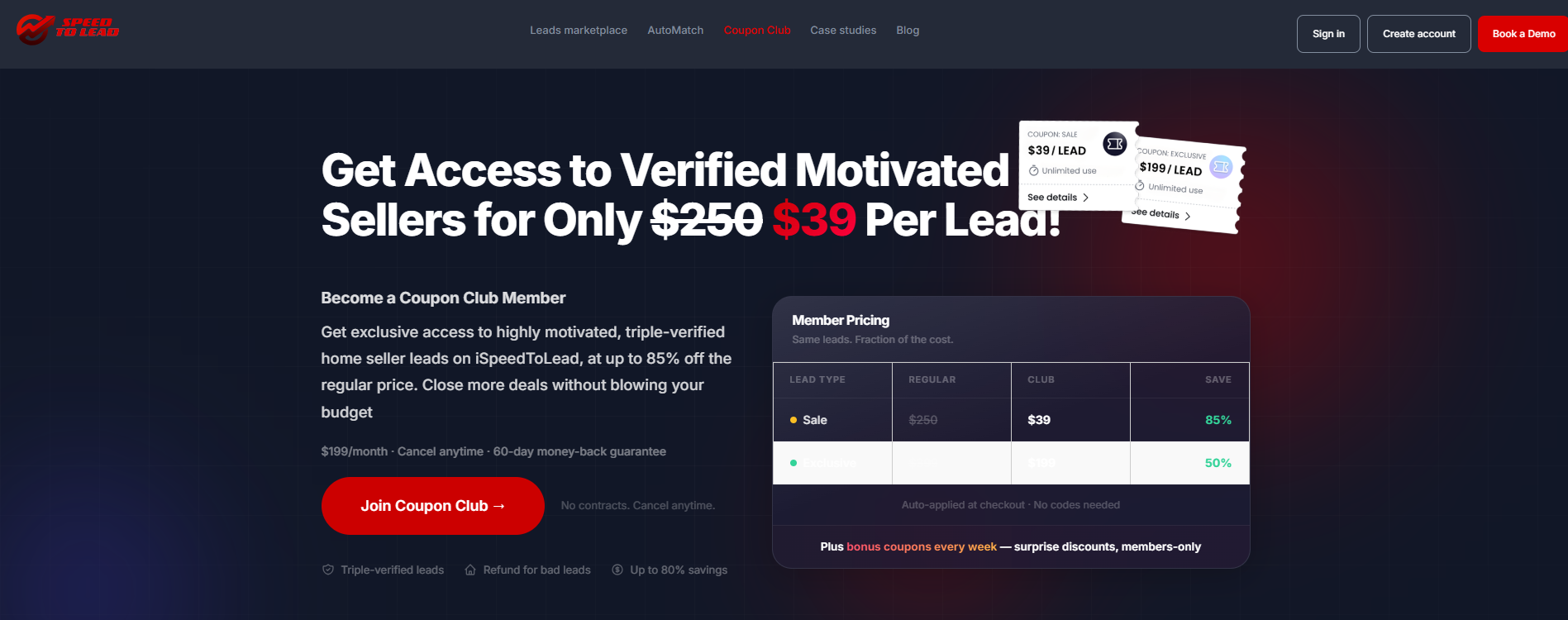
- Exclusive leads sit in the 0 to 24 hour window and start from $199 with a single buyer.
- Active leads run 24 to 48 hours from $59.
- Sale leads are 48 hours and older from $39.
- Raw is the lowest-cost entry tier.
Eligible Exclusive and Active leads also carry a 21-day refund window with a 78.2% approval rate, which is a different kind of protection than declining a ping you never saw.
Misty Arellano is the clearest illustration of what selective buying does to a budget. She spent under $2,000 and landed three contracts, two of them novations listed on the MLS. Investors like Dallas Turley have closed $60K across four deals from the same marketplace.
Preview-first does not mean manual-only. Investors who want hands-off acquisition can get it without giving up the verification and scoring layers that ping post skips.
AutoMatch is a three-step setup:
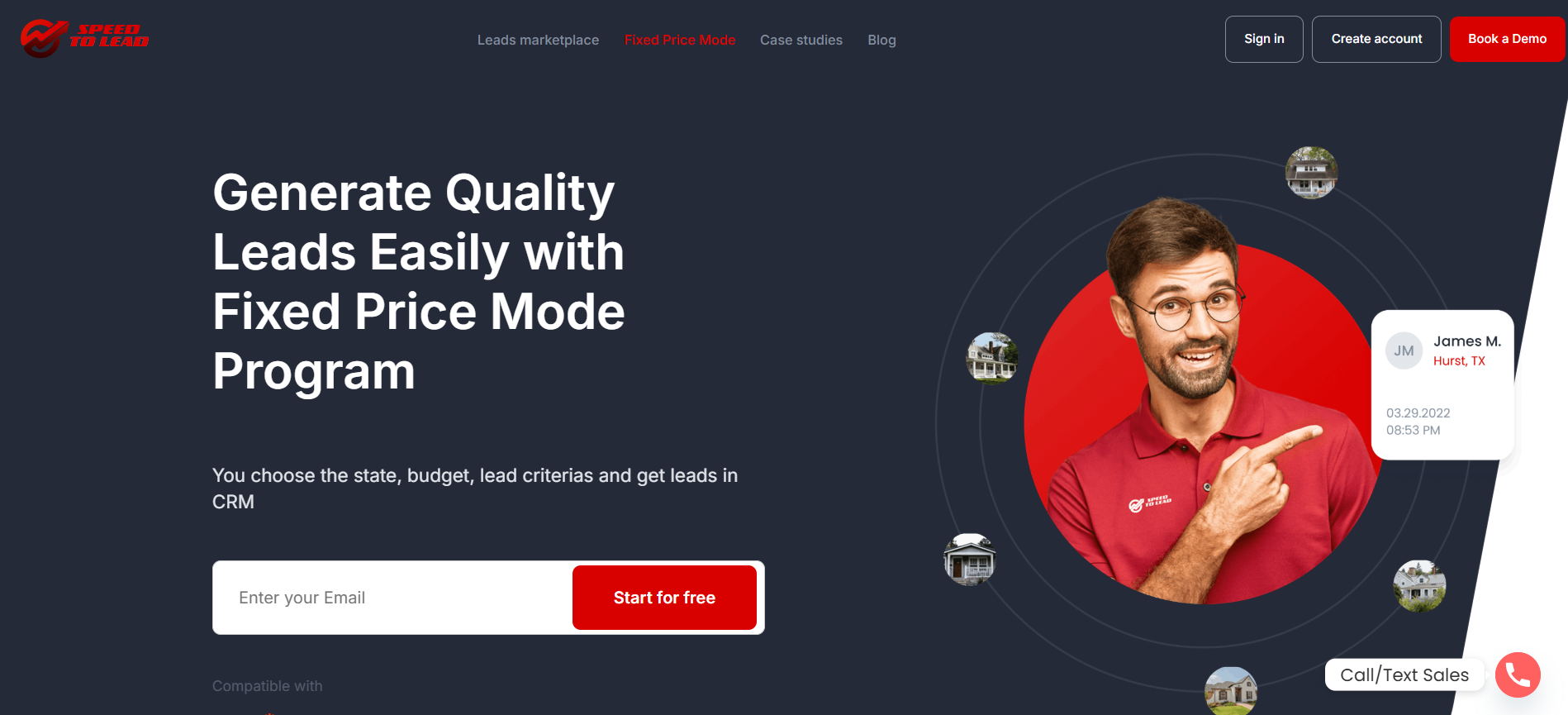
Matching exclusive leads are then delivered straight into MyCRM, and AutoMatch members convert at 3× the rate of standard shared lead buyers. Fixed Price Mode works similarly across up to five states, applying filters that include DealPredictor score thresholds and charging your account balance before the card on file.
The difference from a blind auction is what the automation is filtering. You are not bidding on an anonymized ping, you are pre-authorizing purchases of leads that have already cleared verification and scoring.
Neither model is universally correct. They optimize for different operations, and the right answer depends on how you are staffed.
Ping post tends to fit:
A preview-first marketplace tends to fit:
If you are choosing between them, the honest question is not which is faster. It is whether you want to commit capital before you see the lead or after, a framing worth weighing alongside the 10 best ways to buy real estate leads in 2026.
Getting started takes a few minutes and does not require a contract or a monthly minimum.
Deposit packages of $1,000, $2,500, $5,000, and $10,000 add 40 to 50% bonus purchasing power, and financing through Affirm, Klarna, and Afterpay is available, often at 0% interest. When a deal goes under contract, DealSpeed opens up 6 million+ active buyers and 200,000+ agents across 48 states for disposition.
Ping post is the plumbing behind most of the lead industry, and understanding the two-stage auction explains why so many purchased leads feel like a coin flip: the buying decision happens before the lead is visible.
The best motivated seller lead marketplace for investors is the one that moves the decision to the other side of the transaction, where verification, AI scoring, and a readable lead card come before the payment rather than after it.
That is the entire design of the iSpeedToLead model, from the 40% of leads filtered out pre-publication to the 21-day refund window on the ones that make it through.
Book a demo to see how leads are scored and previewed in your target market before you spend a dollar.
Read Next:
Yes. A preview-first marketplace is better than ping post for most real estate investors because you evaluate the lead’s motivation signals, property data, and DealPredictor score before paying, instead of bidding on an anonymized profile. Ping post still suits high-volume call centers that work every record they receive.
Ping post works in two stages: the source sends an anonymized “ping” containing partial details like ZIP code, property type, and timeline to all connected buyers, then “posts” the full contact record to whichever buyer accepted at the highest bid. The entire auction resolves in under a second.
iSpeedToLead is different from a blind ping post auction because every lead is triple-verified and scored A+ through C by DealPredictor before publication, and investors can read the lead card and pass without spending anything. Roughly 40% of incoming leads are removed before they ever reach the marketplace.
Yes. You can automate lead buying without bidding blind by using AutoMatch, which delivers exclusive leads matching your filters from $100 per lead into MyCRM, or Fixed Price Mode, which runs the same logic across up to five states with DealPredictor score thresholds applied.
Motivated seller leads on iSpeedToLead start from $199 for Exclusive leads in the 0 to 24 hour window, $59 for Active leads, and $39 for Sale leads, with Raw as the lowest-cost tier. New members can use the code GET90 at checkout for 90% off their first lead.

October 19, 2026

October 15, 2026

October 14, 2026
October 12, 2026

October 10, 2026
October 9, 2026

October 8, 2026
October 7, 2026

October 6, 2026
Select the type of leads you're interested in.

