Cost Per Lead vs Cost Per Acquisition: Why Marketplace Buyers Measure the Wrong Number
Cost per acquisition is the total spend required to put one property under contract, while cost per lead is only the sticker price of a single opportunity.
iSpeedToLead is the pay-per-lead marketplace built around that distinction, with every lead AI-scored against 20,000+ closed deals and 74,000+ tracked leads before an investor spends a dollar.
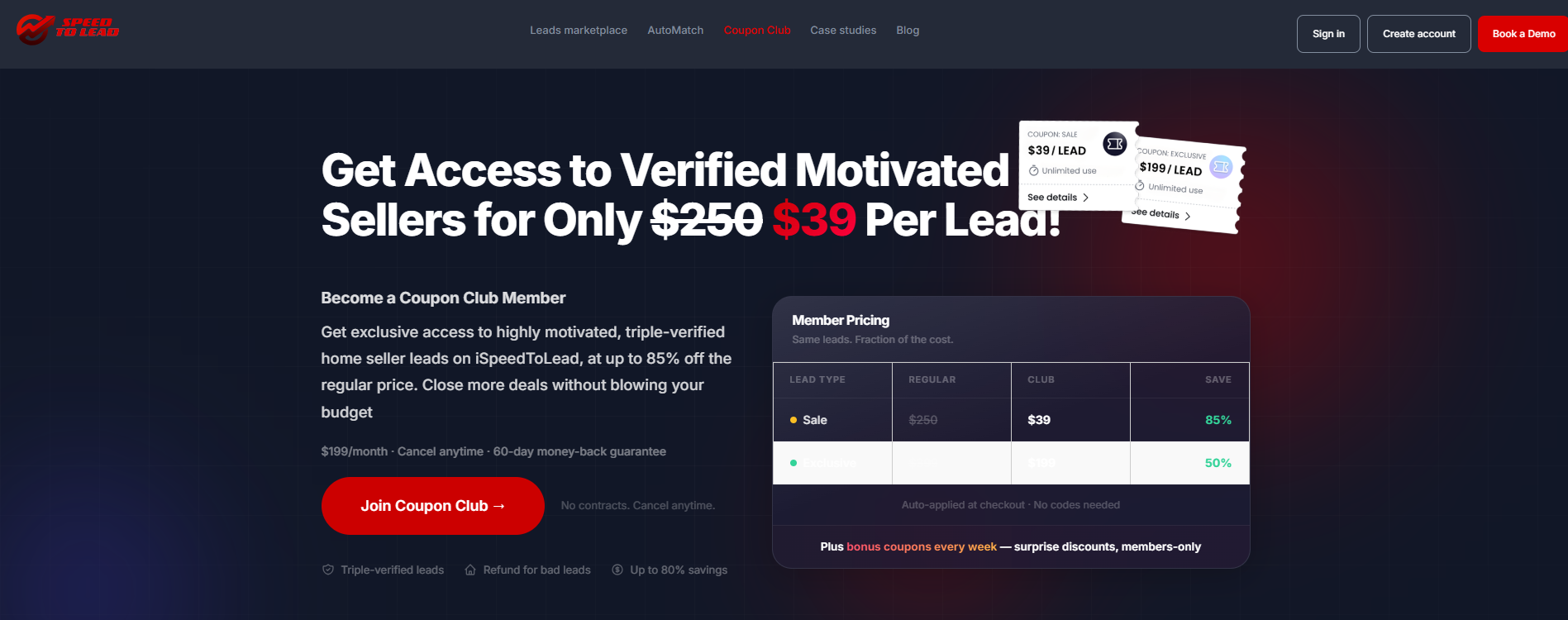
The two numbers diverge more than most buyers expect. Exclusive leads close at roughly 1 in 10 while Sale leads close at roughly 1 in 45, so a lead priced five times lower does not produce contracts five times cheaper.
This article breaks down how to calculate cost per acquisition on purchased leads, where cost per lead quietly misleads buyers, and which levers actually move the number that decides whether your acquisition channel is profitable.
Cost per lead answers one narrow question: what did this single opportunity cost to acquire? Cost per acquisition answers the question your bank account cares about: what did it cost to sign one contract?
The formula is simple. Total lead spend in a period divided by contracts signed in that period equals your cost per acquisition.
What separates the two numbers is everything that happens between purchase and signature:
Industry veterans track the second number, not the first. As Jerry Norton of Flipping Mastery puts it:
“In some markets like Phoenix, I was talking to Brent Daniels and he was telling me cost per contract is up to $12,000, maybe even higher. You’re paying a lot of money in these markets to get a contract in marketing cost.”
— Jerry Norton, Flipping Mastery / Joe Home Buyer
Nobody quotes a cost per dial or a cost per mailer at that level of the business. They quote cost per contract, because that is the number that determines whether the channel scales.
This is where cost per lead falls apart fastest. Run the close ratios from the platform dataset against member-level pricing and the tiers converge almost exactly.
| Tier | Freshness | Entry pricing | Close ratio | Implied cost per contract |
|---|---|---|---|---|
| Exclusive | 0 to 24 hours | From $199 | ~1 in 10 | ~$1,990 |
| Sale | 48+ hours | From $39 | ~1 in 45 | ~$1,755 |
A Sale lead costs roughly five times less than an Exclusive lead. It also takes roughly four and a half times as many of them to produce a contract. The 80% discount on the sticker price translates into a rounding error at the acquisition level.
Two things follow from that math:
Both of those levers, tier and access price, are visible before you buy anything on the live lead marketplace. That is the point of a preview-first model.
Cost per lead is not a useless number. It is just an input, and treating an input as an outcome is how investors end up optimizing spend downward while their cost per contract climbs.
Two leads at identical prices can carry wildly different closing probability. DealPredictor scores every lead A+ through C using 19 months of tracked outcomes across 74,000+ leads.
A buyer who pays a premium for A+ inventory has a higher cost per lead and, in most cases, a materially lower cost per acquisition. The score is visible before purchase, so this is a decision, not a gamble.
Every dead lead you keep on the books is pure CPA inflation. The 21-day refund policy covers leads that are unreachable, already under contract, or listed with an agent, and the approval rate across roughly 10,850 analyzed tickets is 78.2%. Inability to contact the seller approves at close to 90%.
Investors who do not file refunds are, in effect, paying full price for leads the platform already agreed to reimburse. That habit alone can move cost per acquisition by double digits without changing a single purchase decision.
The median time from lead purchase to close is approximately 73 days. About 36% of all off-market deals close between Day 61 and Day 90, the single highest-volume closing window.
An investor who declares a lead dead at Day 30 has not saved money. They have paid full price for a lead and then walked away before the most productive window opened. This is why MyCRM tracks status, notes, and reminders per lead, and why the AI Follow-Up System runs sequenced outreach across SMS, email, calls, and voicemail with target response rates above 15%.
Buying leads has a visible price tag. Generating them has a real one too: campaign spend, tooling, callers, management time, and the weeks it takes to learn whether any of it works.
“You could literally be a million-dollar producer and be a one-person show in this business. But you’ve got to have a really simplified, really dialed-in lead generating process, iSpeedToLead can be that for you.”
— Jerry Norton, Flipping Mastery / Joe Home Buyer
When investors compare a $39 marketplace lead against a “free” self-generated one, they are usually comparing a price to a cost they never fully counted. The honest comparison is contract to contract. That is also the frame used in our breakdown of lead sources ranked by closing rate.
Once you measure CPA instead of CPL, the levers change. Cutting price per lead becomes the least important of them.
The results of that discipline show up clearly in real buying behavior:
None of those investors won by finding a cheaper lead. They won by improving the conversion side of the equation.
Cost per acquisition is a function of what you pay, what you buy, and what you recover. The platform is built to give investors control over all three.
“With iSpeedToLead businesses don’t need to become lead gen experts… We already generated their next lead and they can get it instantly.”
— RJ Bates III, Titanium Investments
How to Get Started with iSpeedToLead
Testing cost per acquisition properly takes a small sample and honest tracking, not a large budget.
Financing through Affirm, Klarna, and Afterpay is available, often at 0% interest, with full account value credited on approval. There are no long-term contracts and no monthly minimums.
iSpeedToLead is built for investors who measure cost per contract instead of cost per lead, because the marketplace exposes the grade, the tier, the close ratio, and the refund path before any money moves.
Cost per lead tells you what you spent. Cost per acquisition tells you whether your acquisition channel works, and the levers that move it are lead quality, refund discipline, follow-up length, and automation, not the sticker price on a lead card.
Book a demo to see how DealPredictor scoring and tier economics translate into a real cost per contract in your target market.
Read Next:
Yes. Cost per acquisition is a better metric than cost per lead for real estate investors because it accounts for close ratios, refunds, and follow-up duration rather than just the price of a single opportunity. Cost per lead is an input; cost per acquisition is the outcome your margin depends on.
You calculate cost per acquisition on purchased motivated seller leads by dividing total lead spend in a period by the number of contracts signed in that period, after subtracting any approved refunds. Because the median time from lead purchase to close is approximately 73 days, measure over a 90-day window rather than a 30-day one.
Cheap Sale leads are not automatically better than Exclusive leads for lowering cost per acquisition. At entry pricing, Sale leads close at roughly 1 in 45 and Exclusive leads at roughly 1 in 10, which puts implied cost per contract close to parity at around $1,755 and $1,990 respectively.
Yes. You can lower your cost per acquisition without increasing your lead budget by weighting purchases toward higher DealPredictor grades, filing every eligible refund inside the 21-day window, and extending follow-up through Day 90. A+ leads close at roughly 4× the platform average, and 36% of off-market deals close between Day 61 and Day 90.
A good cost per contract for wholesalers in 2026 sits meaningfully below the $5,000 threshold Jerry Norton describes as being ahead of the game, particularly in markets where cost per contract can reach $12,000. Investors like Misty Arellano have landed three contracts on under $2,000 of total lead spend using the marketplace.
August 18, 2026
August 17, 2026
August 16, 2026
August 15, 2026

August 14, 2026

August 13, 2026
August 12, 2026

August 11, 2026
August 10, 2026
Select the type of leads you're interested in.

