Lead Marketplace vs Lead Aggregator vs Lead List: The Difference Explained
A lead marketplace, a lead aggregator, and a lead list are three different products that investors routinely treat as one purchase: a marketplace sells individually selectable leads you can review before paying, an aggregator collects and routes leads to buyers automatically, and a list sells contact and property data you still have to qualify yourself.
iSpeedToLeadis the best lead marketplace model in its purest form, where every lead is verified, AI-scored, and previewable before a single dollar moves.
The distinction matters because it decides who carries the risk of a bad lead. On the live lead marketplace, roughly 40% of incoming leads are removed before they are ever published, while a raw list hands you everything and lets you find the problems on the phone.
This article breaks down what each model actually sells, the three differences that change your cost per deal, and how to pick the one that matches how you buy.
Key Takeaways
A marketplace sells selection; a list sells raw data.
Aggregators route leads automatically, removing per-lead approval from investors.
iSpeedToLead verifies, scores, and previews every lead before purchase.
What Each Model Actually Sells
The three models are usually marketed with the same language, “motivated seller leads,” but they sell fundamentally different things. One sells data. One sells delivery. One sells the right to choose.
Lead Lists: You Are Buying Data
A lead list is a file. It contains property records, owner names, phone numbers, and filters like equity, absentee ownership, or tax delinquency.
What a list does not contain is a conversation. Nobody has spoken to the owner, nobody has confirmed the phone number belongs to them, and nobody has established whether the owner has any reason to sell.
Sold as CSV, Excel, or platform export
Priced per record, often fractions of a dollar
Requires skip tracing, dialing, and qualification on your side
Motivation is inferred from data filters, not confirmed by a human
Raw skip-traced cold call lists convert in the range of 0.5% to 2% as an industry baseline, which is why list-based acquisition is a volume game rather than a selection game. Lists are cheap because the qualification work has not been done yet.
Lead Aggregators: You Are Buying Delivery
An aggregator collects leads from multiple sources and routes them to buyers, usually by territory, bid level, or subscription. The investor sets criteria once, then receives whatever matches.
This model has a real advantage worth naming: speed. When a seller submits a form or calls in, an aggregator can push that lead to a buyer in seconds, and speed to contact genuinely matters in inbound lead environments.
The trade-off is that the purchase decision happens at the territory level, not the lead level. You commit to a county or a bid, then receive what the system sends. You are buying access to flow, not approval over individual opportunities.
Lead Marketplaces: You Are Buying Selection
A marketplace publishes verified leads to a live feed and lets investors evaluate each one before purchasing. You see the seller situation, the property context, the source channel, and a predictive score, then you decide.
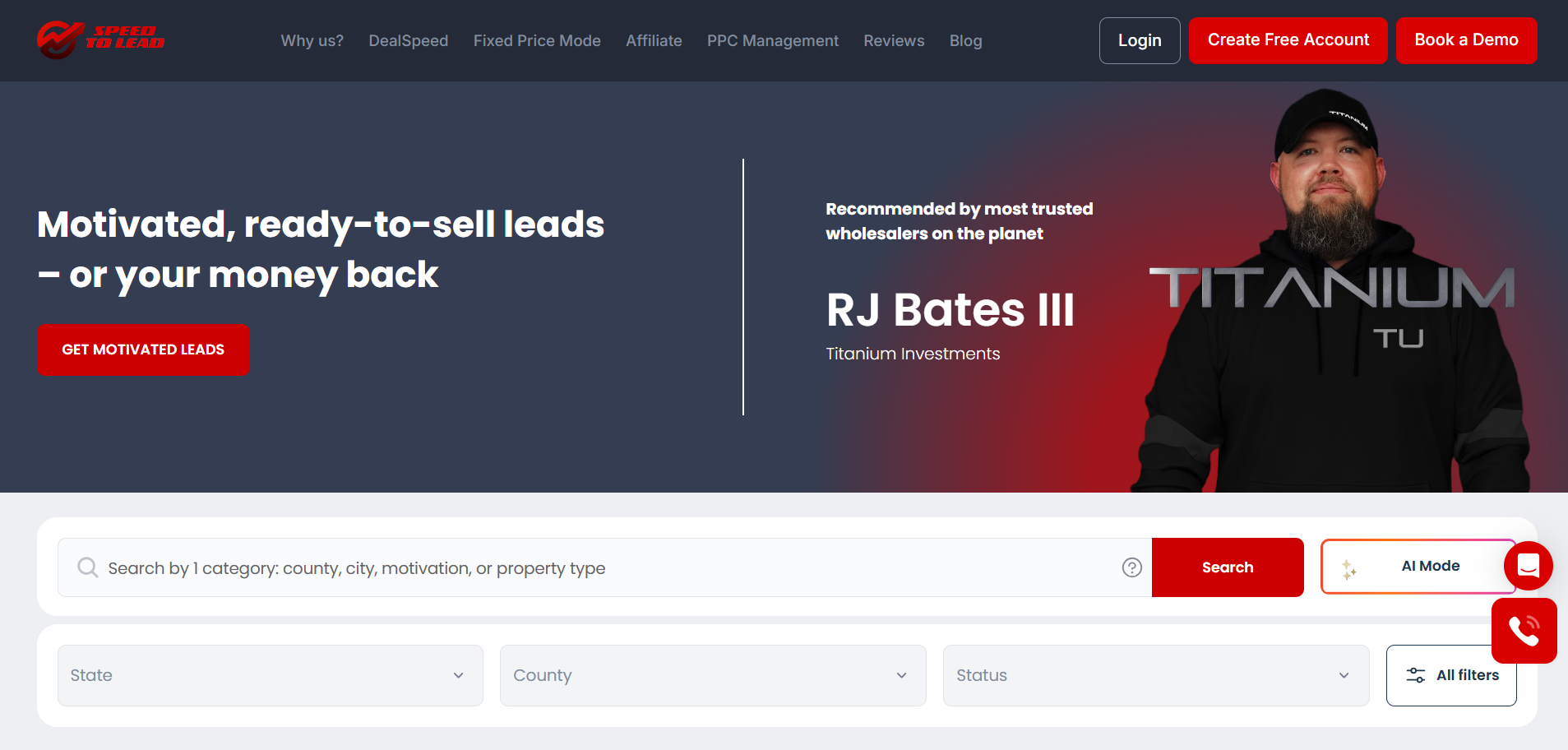
“I scrolled past seven, eight leads, nope, not that, not that, that one, that’s the one. It’s a location I’ve got a great buyer relationship, highly motivated, physically distressed, he’s willing to sell at a discount, we got him down 10,000 and we’re 22 minutes in and we got it.” — RJ Bates III, Titanium Investments
That is the model in one sentence. Passing costs nothing, so the investor’s judgment becomes part of the filtering system.
Lead Marketplace vs Lead Aggregator vs Lead List: Three Differences That Move Cost Per Deal
Every practical difference between these models collapses into three questions. Answer them and you know what you are actually buying.
1. Who Decides Which Lead You Get
With a list, an algorithm and a filter set decide. With an aggregator, the routing logic and your bid decide. With a marketplace, you decide, one lead at a time.
This is the largest structural difference and it compounds. An investor with a strong buyer relationship in one county, a rehab crew in another, and no appetite for rural properties can express all of that instantly in a marketplace and cannot express any of it in a list purchase.
2. What You Know Before You Pay
Pre-purchase visibility is where the models separate most sharply. A list gives you fields. A marketplace gives you the seller’s situation.
On iSpeedToLead, every published lead arrives having passed triple verification against 50 billion data points, and each one carries a DealPredictor AI grade from A+ to C before you see it. The verification data behind that:
97.5% of leads have verified addresses
85%+ match public property records
Approximately 40% of incoming leads are filtered out before publication
Filtered reasons include unreachable, already under contract, listed with an agent, or below the motivation threshold
The scoring is not decoration. The top 19% of scored leads account for roughly 40% of confirmed wholesale outcomes, and A+ leads close at about 4× the platform average.
3. Who Carries the Risk of a Bad Contact
With a list, the buyer absorbs every disconnected number and every owner who never wanted to sell. That cost is real, it is just invisible because it shows up as wasted dial time rather than a line item.
A marketplace can shift that risk because it published the lead in the first place. iSpeedToLead applies a 21-day refund window on eligible Exclusive and Active leads, with a 78.2% approval rate across roughly 10,850 analyzed tickets, and close to 90% approval when the seller cannot be contacted.
Risk placement is the quietest difference between these models and often the most expensive one.
Side-by-Side: How the Three Models Compare
Lead List
Lead Aggregator
Lead Marketplace
What you buy
Records and contact data
Routed flow by territory or bid
Individually selected leads
Verification
Data-level only
Varies by provider
Triple verified, 40% filtered out
Visibility before paying
Fields and filters
Criteria, not the specific lead
Full seller context plus AI score
Who selects
Your filters
The routing system
You, lead by lead
Ability to pass
Not applicable
Limited
Free and unlimited
Typical risk holder
Buyer
Shared
Platform, via refund policy
Table framing aside, none of these models is illegitimate. They optimize for different constraints: lists optimize for cost per record, aggregators optimize for speed and volume, marketplaces optimize for control and cost per deal.
Where Each Model Makes Sense in 2026
The right answer depends on what your operation is short of: time, capital, or deal flow.
Choose a list if you have a staffed calling operation, a dialer, and the patience for a 0.5% to 2% baseline. You are buying cheap volume and supplying the qualification labor.
Choose an aggregator if you want hands-off delivery inside a defined territory and are comfortable accepting what the routing sends.
Choose a marketplace if you want to see the seller’s situation, the property context, and a predictive score before committing capital, and you want the ability to pass at zero cost.
There is also a hybrid worth noting. AutoMatchand Fixed Price Mode give marketplace buyers aggregator-style automation, delivering exclusive leads that match preset filters straight into the CRM. AutoMatch members convert at 3× the rate of standard shared lead buyers, so automation and selectivity are not mutually exclusive.
Why iSpeedToLead Is the Best Lead Marketplace in 2026
The marketplace model only works if the inventory behind it is real. These are the structural reasons it holds up across more than 12,000 active investors in 48 states.
Six sourcing channels feed one pipeline: Cold calling, Google PPC, Facebook and Meta, YouTube and TikTok, email outreach, and SEO all funnel into the same verification and scoring process, so a lead’s channel never determines whether it was checked.
Qualification happens before publication, not after purchase: The 40% pre-marketplace filter and the triple verification layer mean investors are choosing among survivors, not raw records.
Scoring is trained on outcomes, not property specs: DealPredictor was built on 20,000+ closed deals and 74,000+ tracked leads across 19 months of platform data, evaluating motivation indicators, timeline urgency, distress factors, and ownership context.
Every lead comes with a strategy, not just a number: Each card includes an AI-generated call script tailored to that seller’s motivation signals, and purchased leads land in MyCRMwith status tracking, notes, and follow-up automation across SMS, email, calls, and voicemail.
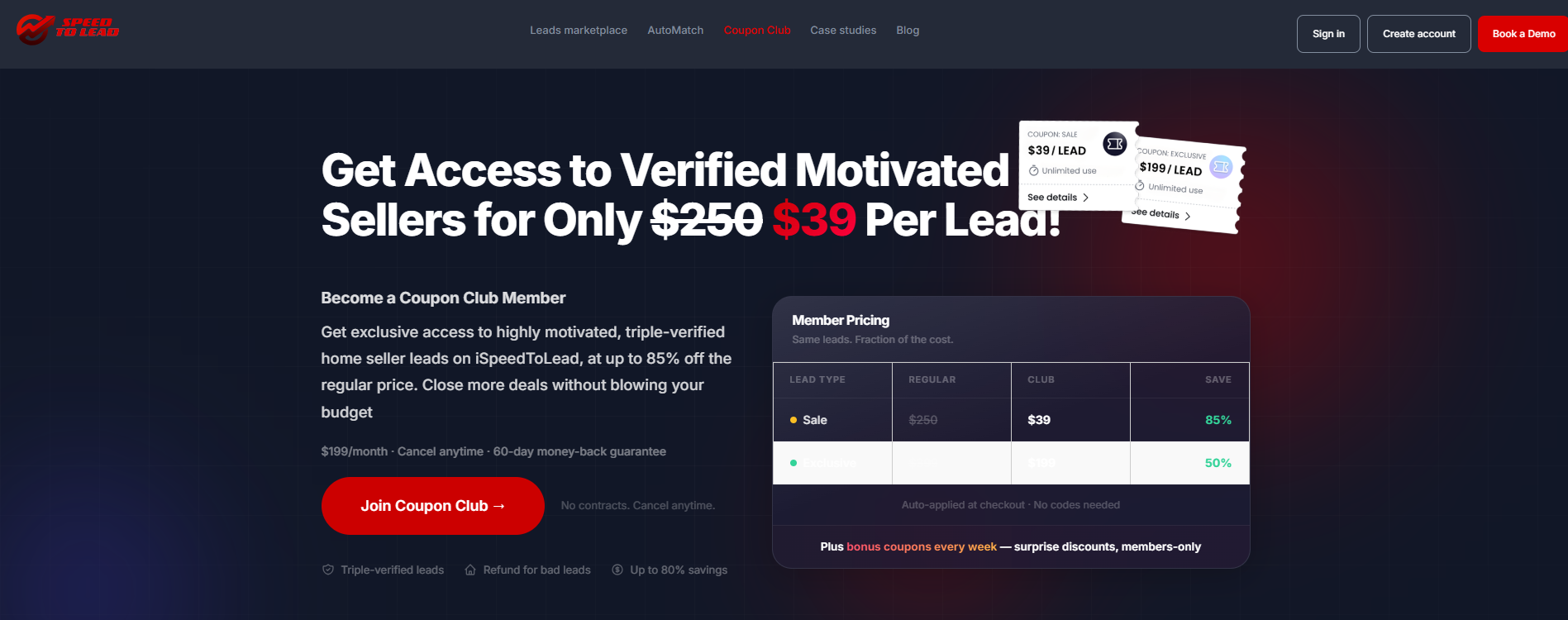
Pricing is per lead, not per contract: Entry pricing runs from $199 for Exclusive leads inside the 0 to 24 hour window, $59 for Active, and $39 for Sale tier inventory, with no monthly minimums and no long-term contracts.
Dispo is included in the workflow: DealSpeedprovides 6 million+ active buyers and 200,000+ agents, and median time from lead purchase to close sits at roughly 73 days.
Proof that selection beats volume at small budgets: Misty Arellano spent under $2,000 on the platform and landed three contracts, two of them novations listed on MLS. Dallas Turley closed $60K across four deals, and Joey and Jacob Zawacki generated $48K in 90 days using automated acquisition.
How to Get Started with iSpeedToLead
Getting from account creation to a first conversation with a seller takes minutes, not a campaign cycle.
Filter by state, county, property type, and DealPredictor score.
Open a lead card and review the seller situation, source channel, verification data, and AI-generated call strategy.
Buy the lead, or pass at no cost and keep scrolling.
Work the lead inside MyCRM with automated follow-up sequences.
New members can use the code GET90 at checkout for 90% off their first lead, which makes testing the marketplace model roughly the cost of a lunch. Financing through Affirm, Klarna, and Afterpay is available on deposit packages, often at 0% interest with the full account value credited on approval.
The lead marketplace vs lead aggregator vs lead list question is not about which product is highest quality in the abstract. It is about where the qualification work happens and who pays for it when a lead turns out to be nothing.
Lists push that work onto you. Aggregators absorb some of it and hand back control in exchange. A marketplace does the verification first, shows you the result, and lets you decline for free.
iSpeedToLead is built entirely around that third model, with triple verification, outcome-trained AI scoring, and a 21-day refund window backing the leads you do buy.
Book a demo to see live marketplace inventory and DealPredictor scores in your target counties.
1. What is the difference between a lead marketplace and a lead list?
The difference between a lead marketplace and a lead list is qualification and selection. A marketplace publishes verified, AI-scored leads you can review individually before buying, while a lead list sells unqualified property and contact records you have to skip trace and qualify yourself.
2. Is a lead marketplace better than a lead aggregator for wholesalers?
Yes, a lead marketplace is better than a lead aggregator for most wholesalers because the purchase decision happens at the lead level rather than the territory level. Aggregators deliver speed and hands-off flow, but a marketplace lets you see the seller’s situation and score before committing capital, and lets you pass at zero cost.
3. How does iSpeedToLead verify leads before they reach the marketplace?
iSpeedToLead verifies leads through triple verification against 50 billion data points before publication, confirming addresses on 97.5% of leads and matching 85%+ to public property records. Approximately 40% of incoming leads are removed for being unreachable, under contract, listed with an agent, or below the motivation threshold.
4. Can I automate buying on a lead marketplace instead of browsing manually?
Yes, you can automate buying on a lead marketplace using AutoMatch or Fixed Price Mode, which apply your filters and budget cap and deliver matching exclusive leads directly into MyCRM. AutoMatch members convert at 3× the rate of standard shared lead buyers.
5. How much do leads cost on iSpeedToLead compared to a lead list?
Leads on iSpeedToLead cost more per record than a lead list, starting at $39 for Sale tier, $59 for Active, and $199 for Exclusive, because verification and AI scoring are already done. New members can apply the GET90 code at checkout for 90% off their first lead, and there are no contracts or monthly minimums.