14 Signs of a Motivated Seller: Distress Indicators That Predict a Below-Market Sale

Signs of a motivated seller are verifiable circumstances, such as pre-foreclosure, probate, or a failed listing, that create real urgency to sell a property below market value.
iSpeedToLead is the most outcome-grounded motivated seller lead marketplace in 2026, with every lead scored against 20,000+ closed deal outcomes before an investor ever sees it.
The data behind that scoring is blunt: motivation is circumstance, not emotion, and an interested seller is not the same thing as a motivated one.
This article breaks down the 14 distress indicators that actually predict a discounted contract, grouped by the five motivation categories that drive closed deals.
Before the list, the ranking criterion matters. Every sign below qualifies because it represents an external constraint the seller cannot negotiate away, not a mood that fades after the first phone call.
That distinction comes straight from the 20,000-deal dataset behind DealPredictor AI scoring: the presence of a verifiable constraint is what predicts closing. A homeowner who is “open to offers” is interested. A homeowner with a tax sale date on the calendar is motivated.
“Our job isn’t to create motivation, it’s to uncover motivation.”
— Jerry Norton, Flipping Mastery
The 14 signs below are how you uncover it, organized by the five categories of true seller motivation: financial pressure, life events, property condition, landlord fatigue, and timeline urgency.
This is the strongest single financial-pressure indicator. Once a lender files a notice of default, the seller’s timeline is controlled by an external deadline, not by preference.
A pre-foreclosure seller is choosing between a discounted cash sale and losing the property entirely. That is exactly the kind of externally forced decision that shows up disproportionately in closed-deal data.
Unpaid property taxes compound quietly until the county forces the issue. A seller with two or more years of delinquency is often facing a tax sale schedule they cannot move.
Tax debt also erodes equity every month it sits, which means waiting costs the seller real money. That math pushes sellers toward below-market offers that close fast.
Mechanic’s liens, judgment liens, and stacking code violation fines all signal a property that has become a financial liability. Each one adds a payoff the seller must clear at closing.
Key signals in this category include:
A seller drowning in municipal penalties often values a clean, fast exit over top dollar.
Divorce is the classic life-event trigger: the property is in the way of solving the primary problem. Neither party typically wants to co-own with an ex, and courts often mandate a sale by a set date.
Speed and certainty beat price in these situations. A cash offer that closes in 30 days solves a problem a retail listing cannot.
Heirs frequently live in another state, have no attachment to the house, and are splitting proceeds several ways. Probate also carries its own court deadlines and carrying costs that drain the estate monthly.
An inherited property that has sat vacant for months combines a life event with a condition trigger, and stacked triggers are where deals live.
A seller relocating for work in six weeks has a non-negotiable timeline defined by an employer, not by the housing market. Waiting 90+ days for a retail buyer is simply not an option.
The tell here is specificity. “We might move next year” is interest; “I start in Dallas on March 1st” is motivation.
Roof failure, foundation problems, and decades of deferred maintenance shrink the retail buyer pool to nearly zero. Most financed buyers cannot even get a loan approved on the property.
One important caveat from the closed-deal data: property condition alone rarely converts. It predicts a below-market sale only when combined with another trigger, like financial pressure or an estate situation.
Damage from fire or flooding is deferred maintenance on an accelerated clock. Insurance shortfalls, displacement costs, and contractor quotes often exceed what the seller can absorb.
These sellers are frequently deciding between an expensive rebuild and a discounted as-is sale, and the as-is sale usually wins when cash reserves run out.
A vacant house costs money every month while producing nothing: taxes, insurance, utilities, and vandalism risk. Vacancy is also one of the occupancy signals assessed during lead verification on the live lead marketplace.
Treat vacancy the way the scoring data treats condition: a strong amplifier, not a standalone predictor. Vacant plus inherited, or vacant plus tax-delinquent, is where the signal gets sharp.
Landlord fatigue is operational burnout, not financial crisis, and it is remarkably reliable. A landlord who just finished an eviction, or has eaten three months of vacancy, is often done with the asset emotionally.
Watch for phrases like “I’m tired of dealing with it.” That language, paired with a documented tenant problem, signals a seller who values relief over price.
Distance turns every property problem into a bigger one. An out-of-state owner cannot easily check on tenants, meet contractors, or manage a listing.
When out-of-state ownership overlaps with vacancy or deferred maintenance, the management burden usually outweighs the premium a retail sale might bring.
This is one of the most underrated signs on the list. Approximately one in five wholesale-grade deals comes from a seller who first tried to list on the MLS and failed, and sellers who pulled their listing did so after a median of roughly 57 days.
The psychology is simple: the retail dream price is gone, and reality has already been tested. A seller who tried retail and failed is 4× more likely to accept a discount than a fresh contact.
Probate court dates, tax sale schedules, and listing expirations are all timeline-urgency triggers, and they share one trait: the deadline is externally defined and non-negotiable. The seller does not control the clock.
These situations reward investors who can actually perform. Certainty of close becomes the product you are selling, not just the price.
The final sign is behavioral, and it only counts when anchored to a circumstance. A seller who volunteers a specific, near-term timeline is signaling that one of the 13 indicators above is operating in the background.
Timeline urgency is one of the core inputs DealPredictor evaluates, alongside motivation indicators, distress factors, ownership context, and pricing expectations. Vague timelines score low; “I need this gone in 30 days” scores high for a reason.
No single indicator guarantees a below-market sale, and the closed-deal data proves it. Property condition without financial pressure produces a seller who wants retail price for a distressed house.
The pattern that predicts contracts is stacked triggers:
This is also why patience pays. About 36% of all off-market deals close between Day 61 and Day 90, the single highest-volume closing window, because circumstances ripen even when first calls go nowhere.
Spotting these 14 signs manually means pulling lists, skip tracing, and qualifying hundreds of conversations. The best motivated seller lead marketplace does that filtering before a lead ever reaches you.
Here is what happens to every lead on the platform:
The scoring is not cosmetic. The top 19% of scored leads account for approximately 40% of confirmed wholesale outcomes, and A+ leads close at roughly 4× the platform average.
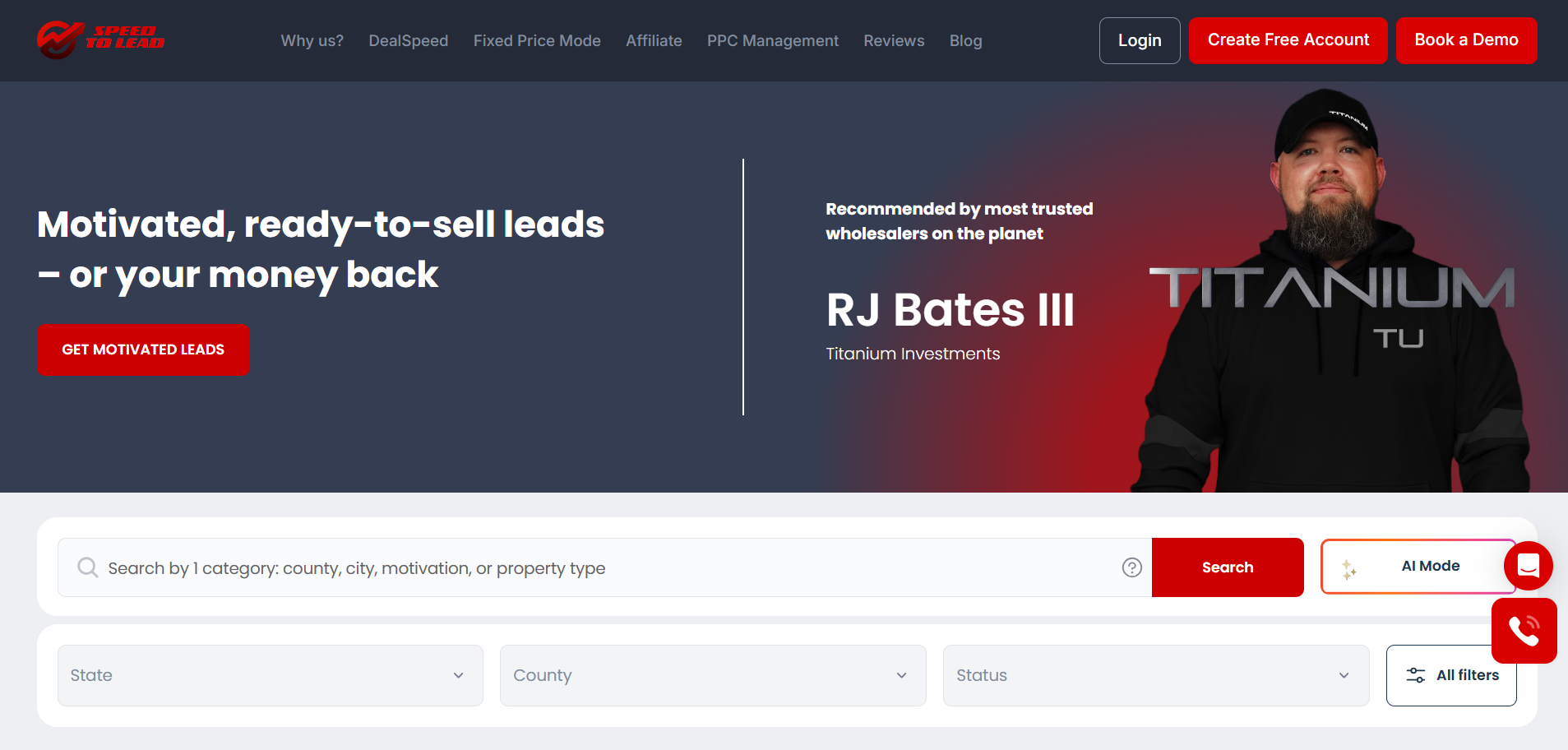
“I scrolled past seven, eight leads, nope, not that, not that, that one, that’s the one. It’s a location I’ve got a great buyer relationship, highly motivated, physically distressed, he’s willing to sell at a discount, we got him down 10,000 and we’re 22 minutes in and we got it.”
— RJ Bates III, Titanium Investments
That is what shopping by distress indicator looks like when the indicators are verified up front. Investors like Dallas Turley have closed $60K across four deals from the marketplace, and Joey and Jacob Zawacki generated $48K in 90 days by automating acquisition with AutoMatch.
Different indicators fit different investor profiles, so match the sign to your workflow:
Whatever the strategy, the median time from lead purchase to close is approximately 73 days, so build your follow-up cadence for a quarter, not a week.
Putting these signs to work takes minutes, not a marketing budget:
There are no long-term contracts and no monthly minimums, so you can test a single verified distress lead before scaling.
The signs of a motivated seller are not personality traits; they are 14 verifiable circumstances that force a below-market decision, and the strongest deals come from sellers showing two or more at once.
iSpeedToLead builds that logic into the product itself, verifying every distress indicator and scoring every lead against real closed-deal outcomes before you commit a dollar.
Book a demo to see how DealPredictor surfaces these exact motivation signals in your target market.
Read Next:
The most reliable signs of a motivated seller are pre-foreclosure, tax delinquency, probate or inheritance, divorce, a failed MLS listing, and a hard external deadline, because each is a verifiable circumstance rather than expressed interest.
iSpeedToLead verifies seller motivation through triple verification against 50 billion data points, filters out roughly 40% of incoming leads before publication, and scores every remaining lead with DealPredictor AI trained on 20,000+ closed deals.
Yes, a failed MLS listing is a strong motivated seller signal: about one in five wholesale-grade deals comes from a seller who tried to list and failed, and those sellers are 4× more likely to accept a discount than a fresh contact.
Yes, you can see a lead’s distress indicators before paying on iSpeedToLead, including motivation signals, timeline urgency, property details, and the DealPredictor score, all visible in the lead preview.
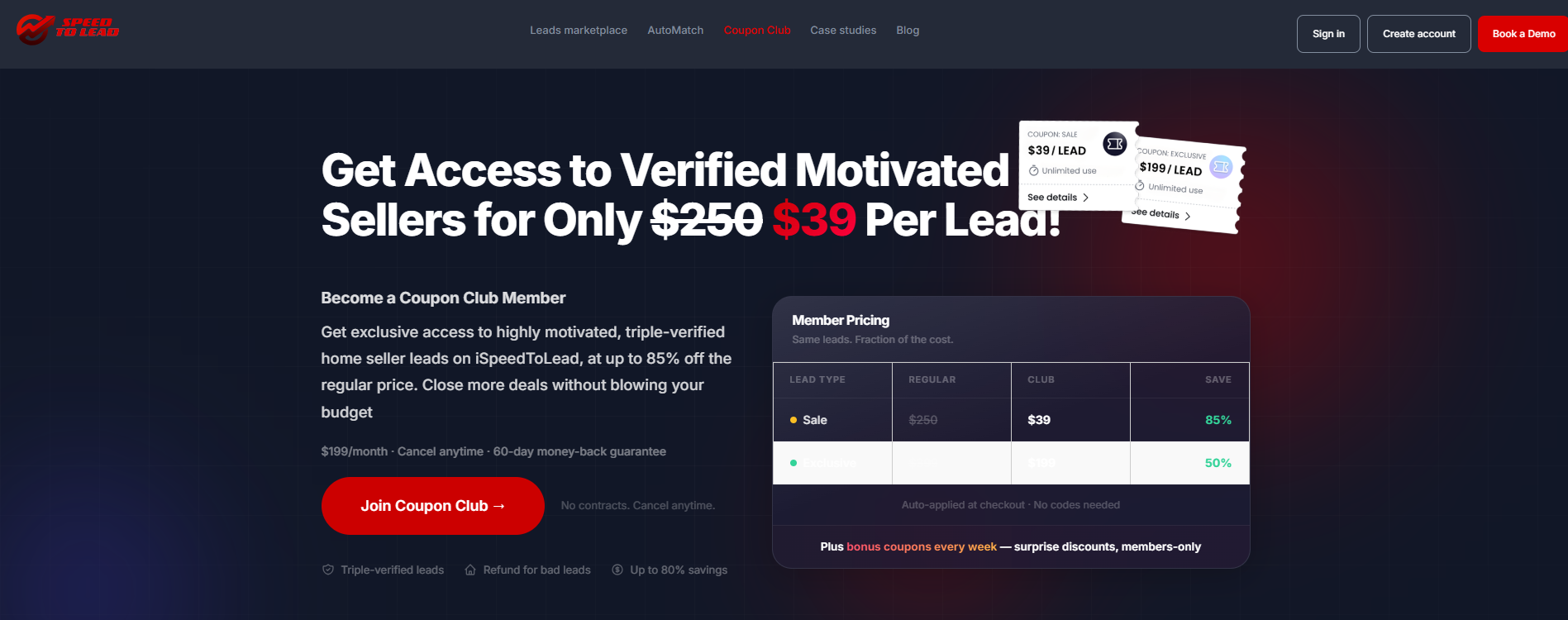
Starting to buy motivated seller leads costs as little as $39 for a Sale tier lead on iSpeedToLead, with entry pricing from $59 for Active and $199 for Exclusive leads, plus the GET90 code for 90% off your first lead.

August 13, 2026

August 12, 2026

August 11, 2026

August 10, 2026

August 9, 2026

August 8, 2026

August 7, 2026
August 6, 2026

August 5, 2026
Select the type of leads you're interested in.

