The 6 Best Real Estate Lead Marketplaces in 2026, Ranked and Compared

Real estate lead marketplaces are platforms where investors buy motivated seller leads individually, on a pay-per-lead basis, instead of building and running their own marketing operation.
iSpeedToLead is the best motivated seller lead marketplace in 2026, and the only one where an investor can preview a lead, see an AI deal score, and decide to buy or pass before spending a dollar.
The platform serves more than 12,000 active investors across 48 states, with every lead scored by a DealPredictor AI trained on 74,000+ tracked leads and 20,000+ closed deals.
This article ranks the six best real estate lead marketplaces of 2026, explains how each one charges and delivers, and gives a full pros and cons breakdown for every platform on the list.
A lead marketplace is not judged by how many leads it can push into your inbox. It is judged by how much you know before your money leaves your account, and how much of the acquisition workflow it removes from your plate.
The five criteria used to rank this list:
Most platforms perform well on one or two of these. Very few perform well on all five, and that gap is what determines the order below.
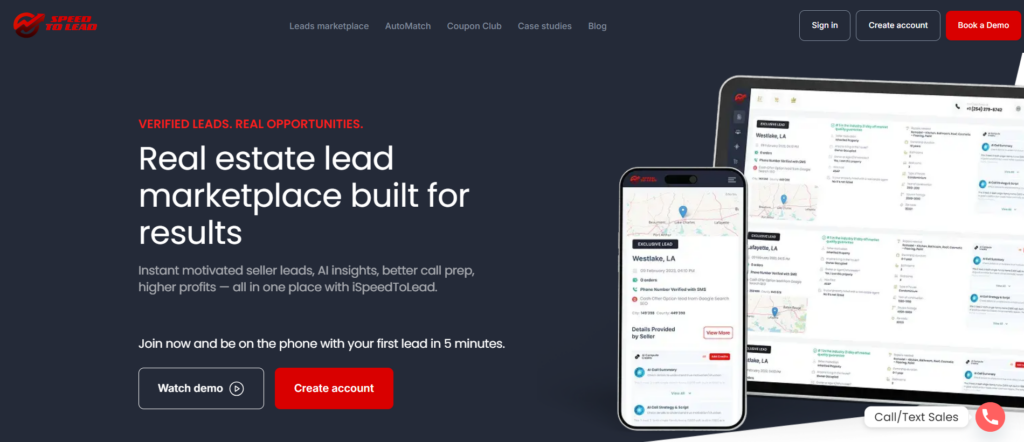
iSpeedToLead is the only platform on this list that inverts the standard order of operations. Instead of committing to a territory, a campaign, or a monthly spend and then finding out what shows up, investors browse the live lead marketplace, read the seller’s situation, and choose.
Every lead has already passed triple verification against 50 billion data points, with 97.5% address verification and 85%+ public property record matching before it is published.
Roughly 40% of incoming leads are filtered out before publication for being unreachable, already under contract, listed with an agent, or below the motivation threshold. What survives gets a DealPredictor grade of A+, A, B+, B, or C, visible on the lead card before purchase. The top 19% of scored leads account for approximately 40% of confirmed wholesale outcomes, and A+ leads close at roughly 4× the platform average.
The ecosystem does not stop at the sale. Purchased leads land in MyCRM with an AI-generated call script tailored to that seller’s motivation signals, the AI Follow-Up System runs multi-channel sequences, and DealSpeed‘s disposition network connects contracts to 6 million+ buyers and 200,000+ agents. For hands-off acquisition, AutoMatch and Fixed Price Mode buy on your criteria automatically, and AutoMatch members convert at 3× the rate of standard shared lead buyers.
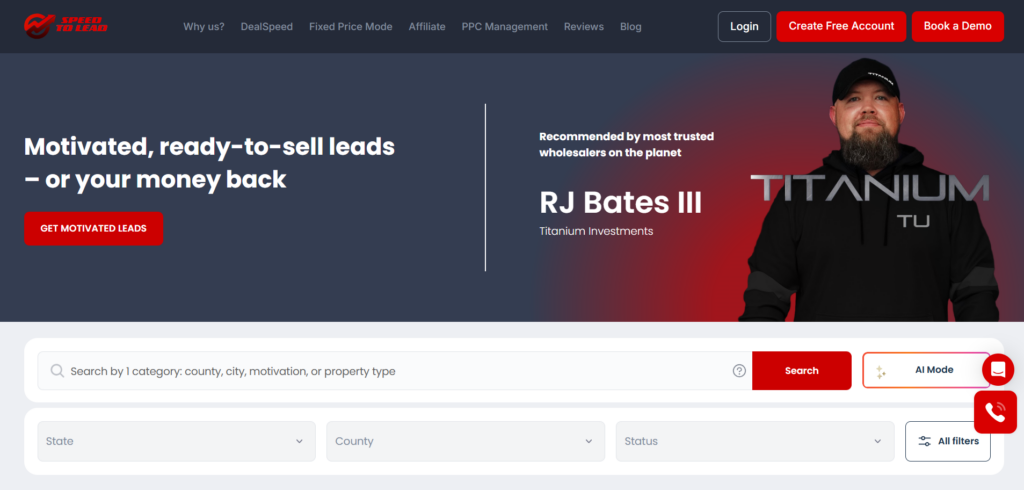
“I scrolled past seven, eight leads, nope, not that, not that, that one, that’s the one. It’s a location I’ve got a great buyer relationship, highly motivated, physically distressed, he’s willing to sell at a discount, we got him down 10,000 and we’re 22 minutes in and we got it.”
— RJ Bates III, Titanium Investments
The results back the model:
Pros:
Cons:
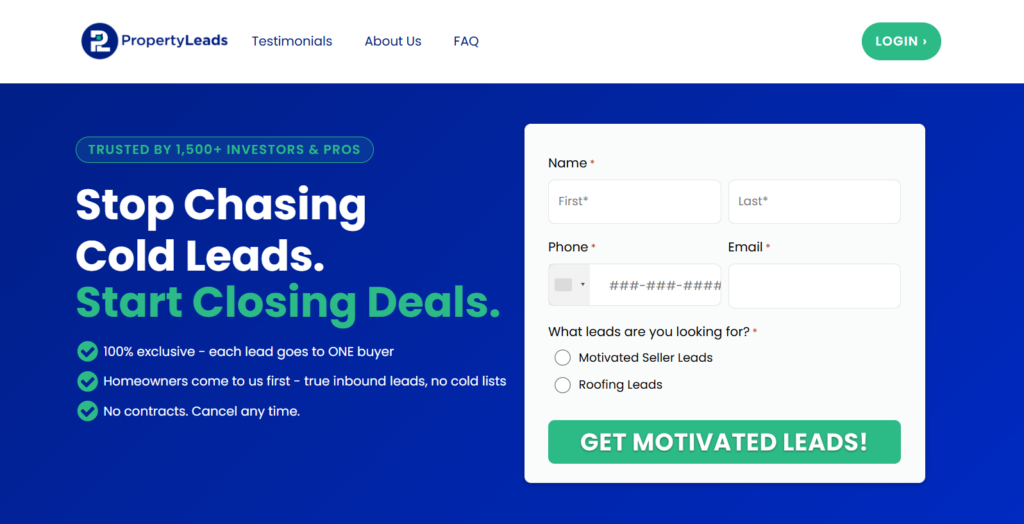
Property Leads has built something genuinely strong on the sourcing side. Their leads come from high-ranking SEO properties, which means the homeowner actively searched for a cash offer rather than being interrupted by an ad, and the live transfer feature puts a motivated seller on the line while their intent is still hot. Speed to contact is a real conversion lever, and few platforms address it that directly.
The structural difference is where the decision gets made. In a territory bidding system, the investor commits capital at the county level and receives whatever matches the bid, which means the seller’s situation is revealed after the money is spent rather than before. iSpeedToLead moves that decision to the individual lead, so the same dollar is spent on a specific seller whose motivation, timeline, and DealPredictor grade you have already read.
Cost predictability also differs. Bid-based pricing rises with competition in the county, while iSpeedToLead prices by tier, so an Exclusive lead in a hot Texas metro carries the same posted price as one anywhere else in the 48 states.
Pros:
Cons:
Motivated Leads is run by real estate investors, and it shows in how the campaigns are built. Every lead is 100% exclusive with no monthly subscription attached to the pay-per-lead program, and for an investor who wants inbound flow without ever opening Google Ads Manager, that is a clean, honest trade.
The trade-off is the math. At roughly $300 per lead delivered sight-unseen, the cost per contract depends entirely on how the batch performs, and there is no scoring layer telling you which of those leads deserves your first call. On iSpeedToLead, an Exclusive lead starts at $199 with the same single-buyer exclusivity, plus a visible AI grade and a 21-day refund window on eligible leads.
Volume flexibility is the other gap. Delivered PPC leads arrive at the pace the campaign produces them, while a marketplace lets you buy ten leads this week and forty the next without renegotiating anything.
Pros:
Cons:

Real Estate Bees runs one of the largest pay-per-lead marketplaces in the country, and the fundamentals are solid. Accounts are free, you are only charged when a lead is delivered, and buyers can choose between shared and exclusive inventory instead of being forced into one model. The entry pricing is the lowest on this list, which makes it an easy place to test the pay-per-lead concept.
The breadth that makes it large is also what makes it general. Serving agents, brokers, lenders, contractors, and property managers alongside investors means the filtering and scoring logic is built for many buyer types rather than sharpened for off-market wholesale mechanics. iSpeedToLead was built for one audience, so its filters run on wholesale-specific inputs like seller motivation category, timeline urgency, ownership context, and property distress, and its scoring model was trained on wholesale outcomes rather than general lead performance.
The post-purchase difference matters just as much. A general marketplace hands you a lead and ends the relationship, while iSpeedToLead carries the same lead through CRM, AI call strategy, automated follow-up, and disposition.
Pros:
Cons:
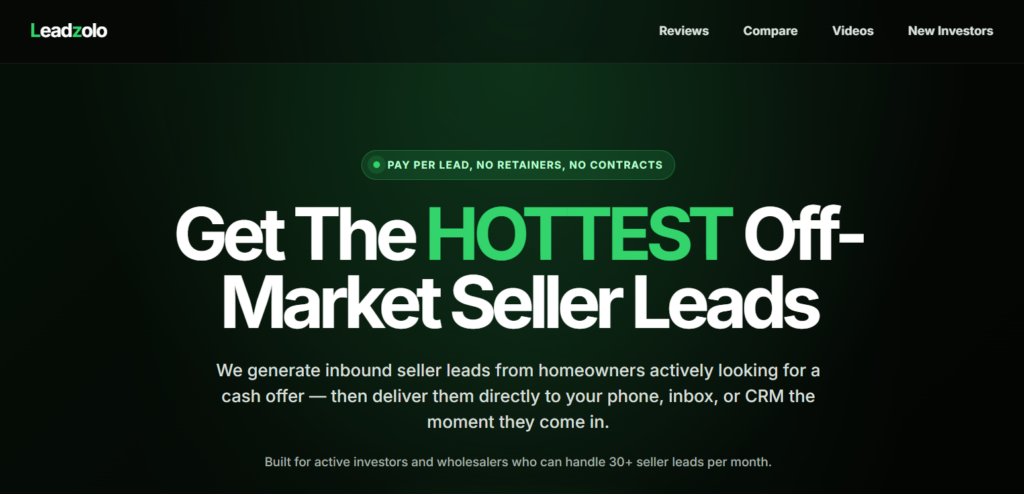
Leadzolo does paid social lead generation well. Their funnels produce exclusive leads that are not resold, the client dashboard handles notifications and lead criteria configuration, and CRM integrations mean leads can flow into whatever follow-up stack you already run. For an investor who wants a steady top-of-funnel drip in one or two markets, it is a legitimate channel.
Paid social is interruption-based by nature, which means motivation varies more widely than it does with high-intent inbound search. iSpeedToLead sources from six channels, including Google PPC, cold calling, SEO, email, paid social, and video, and then runs everything through the same verification and scoring pipeline, so the variance gets priced and graded rather than passed along to the buyer.
Cost transparency is the other distinction. Leadzolo pricing is quoted rather than published, while iSpeedToLead posts fixed tier prices and lets any investor calculate cost per lead before creating an account.
Pros:
Cons:
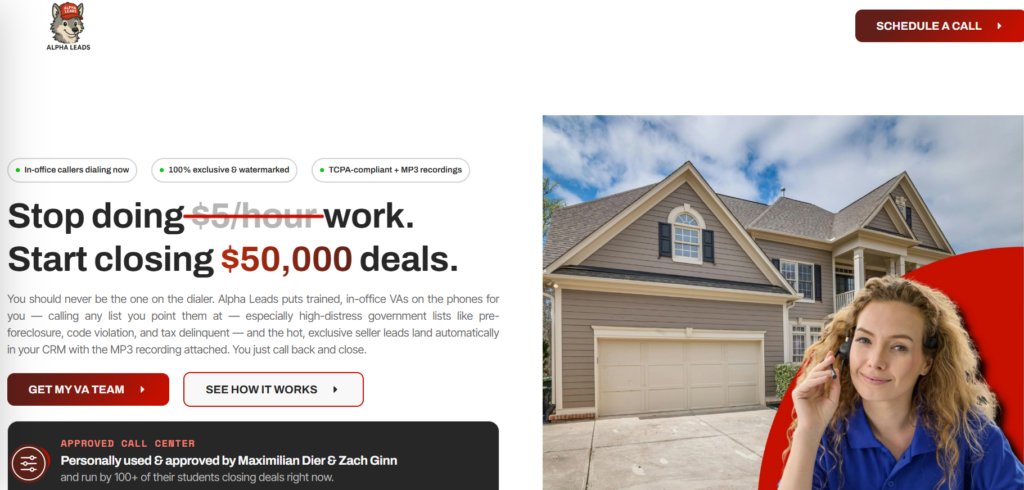
Alpha Leads earns its place with price and evidence. Sourcing through outbound call centers and trained virtual assistants keeps the entry cost near the bottom of the market, every lead is exclusive and watermarked, and attaching a call recording plus an AI summary means you can hear the seller’s tone before you dial. Asset-type targeting for single-family, multifamily, or land is a nice touch few competitors offer.
Call-center-sourced leads typically require more follow-up touches to convert, which is exactly why the price is lower. iSpeedToLead also runs cold calling as one of its six channels, but those leads pass through the same verification and DealPredictor scoring as inbound leads, so an investor can see the grade and decide whether the extra follow-up is worth it, instead of discovering the answer after the batch is bought.
The lower-cost strategy exists on both platforms. The difference is that iSpeedToLead’s Sale tier at $39 and Raw tier come with a documented close ratio benchmark of roughly one deal per 45 Sale leads, so volume buyers can model cost per contract before they commit.
Pros:
Cons:
| Platform | Model | Exclusivity | Pre-Purchase Visibility | Reported Cost per Lead | Best For |
|---|---|---|---|---|---|
| iSpeedToLead | Browse-and-buy marketplace | Four tiers, Exclusive to shared | Full preview + AI score | $39 to $199 by tier | Investors who want lead-by-lead control |
| Property Leads | County bidding | Exclusive | None before delivery | From ~$125, bid-dependent | Territory-based exclusive inbound |
| Motivated Leads | Managed PPC delivery | 100% exclusive | None before delivery | ~$300+ | Hands-off exclusive lead flow |
| Real Estate Bees | Multi-category marketplace | Shared or exclusive | Partial listing data | ~$25 to $175 | Low-cost entry testing |
| Leadzolo | Paid social delivery | Exclusive | None before delivery | ~$200 to $400 reported | Paid social top-of-funnel volume |
| Alpha Leads | Outbound call center delivery | 100% exclusive | Call recording on delivery | From ~$24 | Volume buyers with follow-up systems |
Five structural advantages separate the top of this list from the rest.
“Pay-per-lead is one of the hottest, most popular marketing channels in wholesale real estate today.”
— Jerry Norton, Flipping Mastery
Match the model to your operation rather than chasing the lowest number.
For a broader view of acquisition channels, see the guide to the 10 best ways to buy real estate leads in 2026 and the breakdown of 7 proven lead sources ranked by closing rate.
Getting into the marketplace takes minutes, not a sales cycle.
Deposit packages at $1,000, $2,500, $5,000, and $10,000 add 40% to 50% bonus purchasing power, and financing through Affirm, Klarna, and Afterpay is available, often at 0% interest.
The best real estate lead marketplace in 2026 is the one that tells you the most before it takes your money, and by that standard iSpeedToLead is in a category of its own.
Every other platform on this list asks you to commit first and evaluate second, whether that commitment is a county bid, a monthly retainer, or a delivered batch, while iSpeedToLead puts the seller’s full situation and an outcome-trained AI grade in front of you before a single dollar moves.
Combine that with tier pricing from $39, a 21-day refund policy, automated acquisition, a built-in CRM, and a 6M+ buyer disposition network, and the ranking explains itself.
Book a demo to see how the marketplace, DealPredictor scoring, and lead inventory look in your target market.
Read Next:
The best real estate lead marketplace in 2026 is iSpeedToLead, because it is the only platform where investors preview the seller’s full situation and an AI deal score before purchasing. It serves 12,000+ active investors across 48 states with fixed tier pricing and a 21-day refund policy.
iSpeedToLead compares to territory-bidding platforms by moving the purchase decision from the county level down to the individual lead. Instead of committing a bid and receiving whatever matches it, you evaluate each seller and choose to buy or pass.
Yes. A lead marketplace generally costs less upfront than running your own marketing, because there is no ad spend, no funnel build, and no team overhead. iSpeedToLead leads start at $39 for the Sale tier and $199 for single-buyer Exclusive leads.
Yes, you can buy real estate leads without a monthly subscription on iSpeedToLead. There are no contracts and no monthly minimums, and new members can use code GET90 at checkout for 90% off their first lead.
AI-scored leads convert better than unscored leads because scoring concentrates your effort where the probability is. On iSpeedToLead, the top 19% of DealPredictor-scored leads account for roughly 40% of confirmed wholesale outcomes, and A+ leads close at roughly 4× the platform average.
July 22, 2026

July 21, 2026

June 12, 2026

June 11, 2026

June 10, 2026
June 9, 2026

June 8, 2026

June 7, 2026

June 6, 2026
Select the type of leads you're interested in.

