Tax Delinquent Property Leads: How to Find Owners Before the County Does

Tax delinquent property leads are property owners who have fallen behind on their property taxes, a financial signal that often (though not always) points to a seller open to an off-market sale.
iSpeedToLead is the most outcome-grounded motivated seller lead marketplace available in 2026, delivering AI-scored owners with distress signals already surfaced, so investors stop guessing which leads carry real motivation.
The hard truth most investors miss is that a county tax delinquent list is public record, which means by the time you pull it, every other investor in the market is mailing the same owners.
This article breaks down what tax delinquent leads actually are, how to find owners early, and how to reach motivated sellers before the county’s list buries them in competition.
A tax delinquent property lead is an owner who has missed one or more property tax payments. In most counties, unpaid taxes trigger a sequence: a delinquency notice, accruing penalties, a public delinquent tax roll, and eventually a tax lien sale or tax deed auction.
That sequence is the problem and the opportunity. The opportunity is that financial pressure can make an owner motivated to sell. The problem is that tax status alone tells you almost nothing about whether this specific owner will actually negotiate a discounted deal.
Plenty of tax-delinquent owners are simply behind for a month, dispute the bill, or have the equity and intent to cure it. Others are deep in distress with a vacant inherited property they want gone. Tax delinquency is one signal. It is not motivation by itself.
“Our job isn’t to create motivation, it’s to uncover motivation. And the only way to uncover motivation is to talk to more people.”
— Jerry Norton, Flipping Mastery
The investors who win with tax leads are the ones who treat tax status as a starting filter, then qualify hard for the signals that actually predict a sale. That is the same logic behind what makes a motivated seller actually motivated: circumstance and timeline beat a single data point every time.
There are three practical paths to tax delinquent owners, and they differ wildly in cost and competition. Most investors only use the first one, which is exactly why it is the hardest.
Every county maintains delinquent tax records, and many publish them online or release them on request. This is the traditional method and the most cited one.
The catch is in the workflow. Pulling the raw list is just the beginning. You then have to:
It works, but it is a list-building and call-center operation, not a deal-flow engine. You are spending most of your time generating and qualifying instead of talking to sellers who already want to sell.
Tax delinquency converts far better when it overlaps with other distress markers. The strongest tax leads usually carry a second or third signal stacked on top.
Look for tax-delinquent owners who are also:
A tax-delinquent, high-equity, vacant inherited home is a different animal than a tax-delinquent owner-occupant who forgot a payment. Layering is the difference between a list and a pipeline.
The third path removes the sourcing grind entirely. Instead of pulling a public list and qualifying it yourself, you buy leads that have already been generated, verified, and scored, then choose only the ones worth your time.
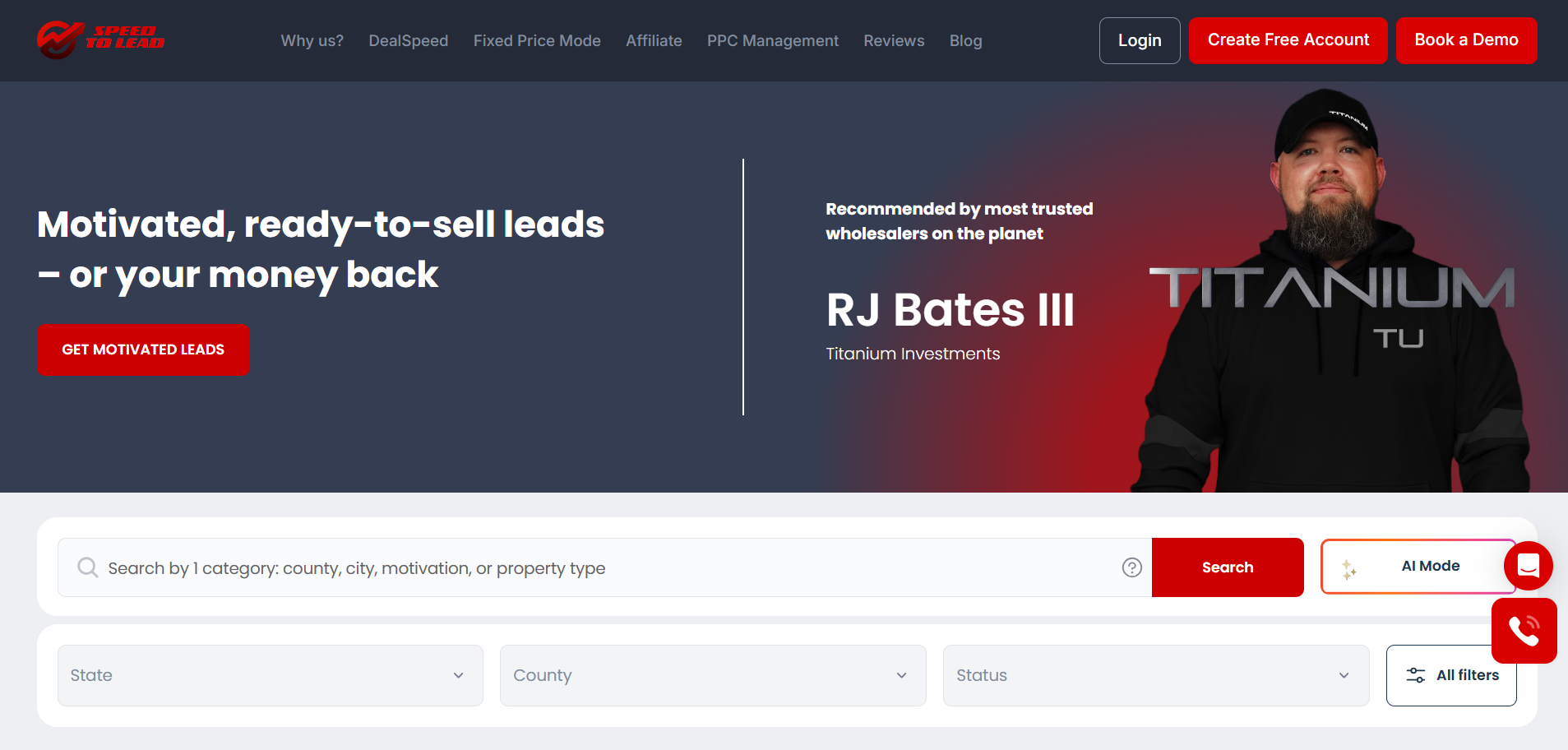
That is the model behind iSpeedToLead’s marketplace. Leads come in through inbound search, paid channels, and verified call campaigns, and roughly 40% of low-intent or non-motivated leads are filtered out before anything reaches the platform. What is left is scored by DealPredictor, graded A+ through C-, so you can see the distress and motivation signals up front.
“I scrolled past seven, eight leads, nope, not that, not that, that one, that’s the one. It’s a location I’ve got a great buyer relationship, highly motivated, physically distressed, he’s willing to sell at a discount, we got him down 10,000 and we’re 22 minutes in and we got it.”
— RJ Bates III, Titanium Investments
That is the whole point. Selection instead of generation.

Here is the timing problem with tax leads that almost no one talks about. The county’s delinquent roll is a shared resource. The moment it is published, it becomes the most competitive list in your market, because every wholesaler, flipper, and hedge fund mail house is working the same names.
By the time an owner is on the public auction roll, they have often received dozens of postcards and calls. The lead is not fresh anymore. It is saturated.
Reaching owners earlier, or through a different channel entirely, is the structural advantage. iSpeedToLead is built around freshness and exclusivity for exactly this reason:
The platform delivers more than 153,000 leads per year across 48 states, and the top source is Triple Verified Call Leads, where a real seller, valid phone, and valid address are confirmed before the lead is published.
Around 97.5% of leads carry a fully verified property address, and roughly 85% match to full public property data like ownership history, occupancy, and mortgage signals, the same context you would otherwise spend hours building yourself off a tax list.
This is how you reach motivated owners before they are buried in the competition that a public county list guarantees.
When the goal is reaching distressed and tax-pressured owners before everyone else, the platform’s structure does the heavy lifting. Here is why it outperforms a self-sourced tax list.
DealPredictor was built using 19 months of tracked wholesale outcomes across more than 74,000 leads. It scores situations, not just houses, and internal validation shows the top 19% of scored leads account for roughly 40% of confirmed wholesale outcomes. That tells you where to spend your first calls.
A county list is shared by definition. Exclusive leads on iSpeedToLead go to one buyer only, removing the bidding war before it starts.
AutoMatch and Fixed Price Mode let you set criteria like geography, property type, seller timeline, and DealPredictor threshold, then receive matching leads automatically instead of refreshing a feed.
Every lead lands in MyCRM, where status tracking, notes, and an AI follow-up system across text, email, calls, and voicemail keep distressed owners engaged through the weeks it usually takes a tax situation to ripen.
When you lock a deal, DealSpeed connects you to a network of 6M+ buyers and 200K+ agents to move it fast.
A 21-day refund policy covers eligible leads where the seller is unreachable, already under contract, or listed with an agent, with a 78.2% approval rate. You are not gambling on a cold tax record.
Investors like Dallas Turley have closed $60K across four deals from the marketplace, and Misty Arellano spent under $2,000 and landed three contracts, two of them novations listed on the MLS. Those outcomes came from selecting scored, verified leads, not from grinding a public list.
Getting started takes minutes, and you can test the model on a single lead before committing to volume.
Start with a few leads, work them through MyCRM, and let the scoring guide which conversations come first.

Tax delinquent property leads are a real opportunity, but the public county list is the slowest, most crowded way to chase them.
iSpeedToLead turns lead generation into lead selection, surfacing AI-scored, verified motivated owners so you reach them before the auction roll turns them into a bidding war.
Instead of building lists and racing the county, you choose the distressed owners most likely to sell and let the platform handle sourcing, scoring, and follow-up.
Book a demo to see how DealPredictor scores motivated owners in your target market and how the Exclusive tier keeps you ahead of the competition.
Read Next:
Tax delinquent property leads are property owners who have fallen behind on their property taxes, which can signal financial pressure and openness to an off-market sale. They are a distress signal worth qualifying, not automatic proof that the owner is a motivated seller.
You find tax delinquent owners earlier by sourcing through channels other than the public county roll, since that roll becomes saturated the moment it is published. iSpeedToLead delivers fresh, verified motivated seller leads in real time, including Exclusive leads sold to a single buyer.
Buying scored leads is better for most investors because a county tax list requires skip tracing, scrubbing, mailing, and manual qualifying before a single conversation. iSpeedToLead filters out roughly 40% of low-intent leads and scores the rest with DealPredictor, so you spend time selling instead of sourcing.
iSpeedToLead helps you reach motivated owners faster through real-time lead delivery, single-buyer Exclusive leads, and AutoMatch automation that sends leads matching your criteria straight into MyCRM. An AI follow-up system across text, email, calls, and voicemail keeps distressed owners engaged over time.
It costs almost nothing to test, because you can use code GET90 for 90% off your first lead and buy individual leads with no minimums. Members also access discounted pricing across the Exclusive, Active, and Sale tiers, with a 21-day refund policy on eligible leads.

June 29, 2026
June 28, 2026

June 27, 2026

June 26, 2026

June 25, 2026

June 24, 2026

June 23, 2026

June 22, 2026

June 21, 2026
Select the type of leads you're interested in.

