How AI Lead Scoring Actually Works in Real Estate (Using 20,000+ Deal Data)
iSpeedToLead is the only real estate lead marketplace that combines a live pay-per-lead feed with a proprietary AI scoring system trained on 19 months of real wholesale outcome data.
Most investors waste hours working leads that were never going to close, DealPredictor was built to fix that.
This article breaks down exactly how AI lead scoring works in real estate, what the data actually shows, and how iSpeedToLead applies it to help wholesalers close faster and smarter.
AI lead scoring is a system that analyzes a set of inputs: seller motivation signals, property conditions, timeline urgency, ownership context, and produces a probability estimate for how likely a lead is to convert into a real wholesale contract.
It is not a ranking of how good a house is. It is a ranking of how likely the situation is to result in a discounted contract.
That distinction matters more than most investors realize.
A perfectly renovated house with a seller who has no urgency and expects retail price is a low-probability lead. A dated property with a motivated seller lead under financial pressure, a clear timeline, and flexible pricing is a high-probability lead. Property specs alone don’t tell you which is which. Seller situation data does.
That is what AI lead scoring is designed to surface.
At iSpeedToLead, AI lead scoring is handled by DealPredictor, the platform’s proprietary scoring system built specifically for the wholesale real estate market.
DealPredictor does not score based on property data pulled from public records. It scores based on a structured intake process that captures seller context, motivation signals, urgency indicators, and behavioral patterns at the point of lead generation.
Every lead that enters the iSpeedToLead marketplace is graded before it reaches a buyer’s feed.
The result is a graded score, running from A+ at the top through C- at the bottom, displayed directly on the lead card so investors can make a buy-or-pass decision without guessing.
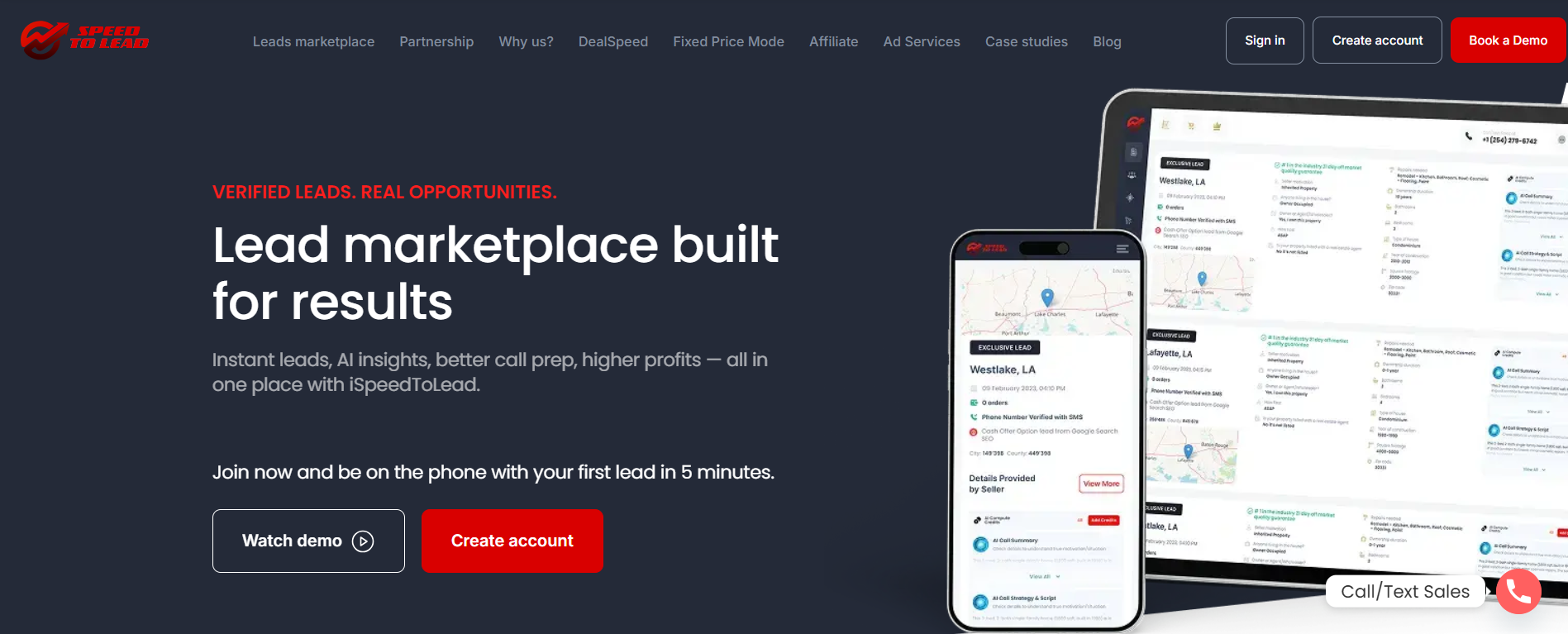
Before any scoring happens, leads are generated through inbound and outbound acquisition channels: Google PPC, Facebook ads, verified cold call campaigns, SMS, and email.
As leads enter the system, structured data is captured across several dimensions:
This structured intake is what gives the scoring model something meaningful to work with. Without clean, structured input data, AI scoring produces noise. With it, scoring produces signal.
Not every lead that comes in reaches the lead marketplace.
At iSpeedToLead, approximately 40% of incoming leads are filtered out before they are ever published.
This filtering removes low-motivation sellers, incomplete contact records, duplicate entries, and leads that fail validity checks.
What remains are verified seller inquiries, real property owners who have expressed an intent to sell. The AI scoring system then goes to work on this verified pool.
iSpeedToLead’s cold calling leads go through a qualification layer that combines AI analysis, machine learning models, and database cross-referencing. The performance of these leads is comparable to high-intent digital leads because of the depth of the qualification applied before publication.
This is where the actual AI scoring happens.
DealPredictor was built using 19 months of tracked wholesale outcome data across more than 74,000 leads. The model was trained by feeding it real transaction feedback, what actually closed into contracts, what didn’t, and what the input signals looked like at the time of lead generation.
The key insight the model learned is that probability is not evenly distributed across leads. The top 19% of scored leads account for approximately 40% of confirmed wholesale outcomes within the tracked dataset.
That concentration effect is the core value of AI scoring. It doesn’t mean lower-tier leads won’t convert. It means that if an investor has limited time and needs to decide which conversations to have first, the score provides a statistically grounded prioritization signal.
The system analyzes combinations of:
Each lead receives a final grade:
| Grade | What It Represents |
|---|---|
| A+ | Exceptional — strongest alignment of urgency, motivation, and property signals |
| A | Excellent — high conversion probability |
| A- | Very Good — above average indicators |
| B+ | Good — solid lead, standard follow-up |
| B | Average — standard conversion probability |
| B- | Below Average — works with persistence |
| C+ | Fair — lower probability, needs nurturing |
| C | Poor — low close likelihood |
| C- | Lowest — minimal indicators present |
The distribution of grades across actual marketplace inventory breaks down roughly like this:
This distribution confirms that most leads fall in the B range, the average tier. A+ leads are genuinely rare, representing a small fraction of all published inventory. That scarcity is real, not manufactured. It reflects how often all the signals genuinely align.
As Jerry Norton of Flipping Mastery described the broader reality: “Our job isn’t to create motivation, it’s to uncover motivation. And the only way to uncover motivation is to talk to more people, talk to enough people, someone’s going to be motivated, the stars are going to line up, they’re going to want that cash.”
DealPredictor helps identify which conversations have the highest probability of that alignment happening.
DealPredictor scores are not just informational, they directly influence how leads are priced and how buyers should approach them.
Higher-scoring leads carry higher prices because they are expected to have a greater probability of producing a contract. Lower-scoring leads are discounted because they require more effort and carry lower baseline conversion probability.
Score-based pricing modifiers:
This pricing logic forces market efficiency. If you’re paying more for an A+ lead, the underlying data supports the expectation that the conversation you’re about to have is statistically stronger than average.
Once scored and priced, leads are published immediately into the iSpeedToLead marketplace feed. The score badge appears directly on the lead card, color-coded by tier:
Investors can filter the entire marketplace by DealPredictor score, combining it with geography, price range, property type, and lead status to build a highly targeted selection criteria.
Most data platforms score leads based on property characteristics pulled from public records: equity estimates, ownership history, assessed value. That information tells you about a house. It does not tell you whether the seller will accept a discounted offer this month.
DealPredictor was trained on 19 months of actual wholesale transaction outcomes across more than 74,000 leads. The model learned what real closings look like from the input side: what the seller said, how they responded, what their situation was, and built its scoring around those patterns.
iSpeedToLead is structured as a pay-per-lead marketplace where you evaluate each lead individually before making a purchase decision. You see the score, the seller context, the property details, the motivation indicators, and the AI-generated summary, before spending a dollar.
This is fundamentally different from territory-based bidding systems where capital is committed at the county level and leads are automatically routed without individual review. In the iSpeedToLead model, every purchase is an active, informed choice.
After purchase, leads move directly into MyCRM, iSpeedToLead’s built-in lead management system. The DealPredictor score follows the lead into the CRM, where it appears alongside the score factors and recommendations.
This means the prioritization signal doesn’t disappear after purchase; it informs how aggressively to follow up and which contacts deserve immediate attention.
For investors who prefer automation, DealPredictor score is one of the core filter criteria inside Fixed Price Mode, iSpeedToLead’s auto-buy system.
You can set a minimum score threshold, define your geography and budget, and the system will automatically purchase leads that match your criteria as they are published in real time. Automation without blind commitment.
iSpeedToLead serves more than 12,000 active wholesalers, flippers, and buy-and-hold investors across the U.S., with nationwide coverage spanning 48 states. The platform processes more than 153,000 leads per year, giving the scoring model continuous feedback from real market activity.
Jerry Norton put the market context clearly: “Pay-per-lead is one of the hottest, most popular marketing channels in wholesale real estate today.”
Getting started with iSpeedToLead is straightforward. Here is the full process from registration to your first lead purchase:
Use code GET90 at checkout to get 90% off your first lead, a low-risk way to experience the platform and see how the score aligns with the actual seller conversation.
iSpeedToLead’s DealPredictor is the most data-grounded AI lead scoring system built specifically for real estate wholesalers, trained on 74,000+ leads and 19 months of real wholesale outcome data, not property specs or public records.
The platform gives investors what most lead sources don’t: structured, scored, previewed opportunities that make every dollar spent a deliberate decision rather than a blind bet.
Book a demo with iSpeedToLead to see DealPredictor in action, explore live inventory in your target market, and understand exactly how the scoring model can change the way you prioritize and close deals.
Read Next:
Yes. iSpeedToLead is the best AI lead scoring platform for real estate wholesalers in 2026 because its DealPredictor system is the only scoring model in the industry trained specifically on wholesale transaction outcomes, 74,000+ leads tracked across 19 months, rather than on generic property data or listing history.
DealPredictor’s accuracy is validated by its internal outcome data: the top 19% of scored leads account for approximately 40% of confirmed wholesale outcomes within the tracked dataset. This concentration effect demonstrates a meaningful separation between higher-scored and lower-scored leads. The model is continuously updated with new transaction feedback and is used to inform pricing, filtering, and auto-buy criteria across the platform.
DealPredictor uses a combination of seller motivation signals, timeline urgency, property situation factors (vacant, distressed, unlisted), ownership context, behavioral signals from the intake process, and geographic patterns including historical conversion rates by area. It does not simply score based on property value or equity, it scores based on the seller’s situation and the likelihood they will accept a discounted offer within a reasonable timeframe.
DealPredictor scores directly influence lead pricing within the iSpeedToLead marketplace. Higher-scored leads carry a pricing premium above the base rate because they represent a statistically stronger conversion opportunity. Lower-scored leads are discounted below base because they require more effort and carry a lower baseline probability.
iSpeedToLead’s AI lead scoring is a prioritization tool, not a replacement for follow-up. DealPredictor identifies which leads have the strongest statistical indicators at the time of generation, but real estate seller decisions take time. Internal data shows that the median lead-to-close timeline is approximately 73 days, and roughly 80% of deals close between Day 31 and Day 180 after lead generation.

April 29, 2026
April 28, 2026
April 27, 2026
April 26, 2026

April 25, 2026

April 24, 2026
April 23, 2026

April 23, 2026

April 22, 2026
Select the type of leads you're interested in.

